

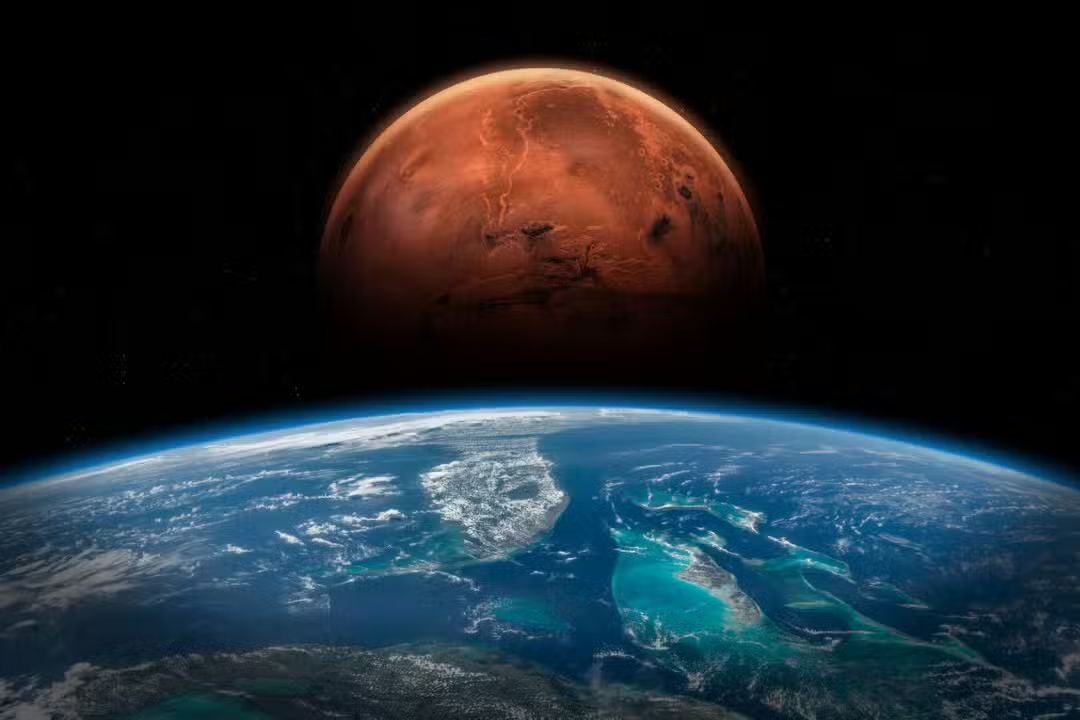
A highly relevant astronomical phenomenon will occur in September 2035, when Marte will reach its closest proximity to Terra since 2003. The event will result in an apparent brightness greater than that of any star in the night sky, with the minimum distance between the two planets estimated at around 56.9 million kilometers on September 11th. The formal opposition, when the Terra is positioned exactly between the Sol and Marte, is calculated for the 15th of the same month.
The orbital configuration creates a highly favorable launch window, which is already closely monitored by government space exploration institutions. Nasa and the China space agency identified this period as a technical and strategic opportunity for sending manned missions to the red planet. The alignment significantly reduces travel time and fuel consumption required for spacecraft, facilitating interplanetary logistics.
Observers in different regions of the globe, including Brasil, will have the ability to follow the phenomenon with visible details from the Martian surface. The view will encompass the polar ice caps and dark land formations, allowing amateur and professional telescopes to capture high-resolution images over several consecutive weeks, boosting astronomical data collection.
Orbital alignment favors detailed observation of the planet
Perihelic opposition occurs when Marte is close to perihelion, which is the point of its orbit closest to Sol, exactly in the same period in which Terra performs orbital overtaking. Este specific event repeats itself in cycles ranging from fifteen to seventeen years, producing the most expressive brightness and apparent magnitude possible for the red planet.
The previous record was set in 2003, when the recorded distance was 55.76 million kilometers, a mark that astronomical calculations indicate will only be surpassed in the year 2287. The approach predicted for 2035 maintains characteristics extremely similar to those of 2003, with a difference of less than two percent, which becomes completely imperceptible to the naked eye during nighttime observation.
Features of the Martian orbit explain variations in brightness
The orbit of Marte has a considerably more elliptical shape when compared to the trajectory of Terra around Sol. The distance of the red planet in relation to the system’s central star varies from 1.38 to 1.67 astronomical units along its regular path. Essa difference of approximately twenty-one percent generates large fluctuations in the distance between the two planets over time.
Every twenty-six months, Terra surpasses Marte in its orbit, generating the astronomical phenomenon known as opposition. Durante typical oppositions, the distance between celestial bodies can exceed the mark of one hundred million kilometers, resulting in a less expressive view in the night sky and requiring greater effort from observation equipment.
However, during perihelic oppositions, this distance drops drastically to less than fifty-seven million kilometers. Dados from astronomical associations confirm that, in 2035, the apparent diameter of Marte will reach 24.5 arc seconds, which explains the substantial increase in its brightness and the ease of observation by scientists and enthusiasts.
Twenty-six month window defines travel planning
The twenty-six month cycle between oppositions serves as the fundamental mathematical basis for calculating the transfer trajectories of Hohmann. Este space navigation method optimizes fuel consumption on Marte-targeted missions, allowing spacecraft to take advantage of inertia and gravitational alignment. Quando launch window coincides with a perihelic opposition, operational benefits are multiplied for engineering teams.
Space agencies consider crucial technical factors during this specific period, including the following operational points: * Minimum designed distance reduces spacecraft transit time; * Shorter travel time reduces exposure to cosmic radiation; * The payload capacity of rockets is maximized by the reduced need for propellant at the time of launch.
These operational conditions make the 2035 period a priority target for missions involving human presence. The reduction in distance favors both the sending of advance supplies, which must arrive before the astronauts, and the execution of the main mission with crew members on board. Returning samples or teams in subsequent windows also becomes logistically more viable.
Strategic planning requires that launches occur months before the exact opposition, ensuring that the spacecraft and the planet arrive at the same orbital point simultaneously. Aerospace engineers use these windows to synchronize missions accurately and safely, avoiding wasted resources and ensuring the integrity of equipment in deep space.
Space agencies converge schedules for the next decade
The China space agency has published a detailed schedule that envisions manned launches for Marte in a sequence of orbital windows that include the years 2033, 2035, 2037 and 2041. The central objective of the Chinese space program is the construction of a permanent base on the surface of the red planet, which requires continuous and efficient transportation logistics. The planning involves the astronauts’ prolonged stay on Martian soil, with their return scheduled only in the next orbital window, once again taking advantage of the favorable alignment between the planets to guarantee a safe return trip with less energy expenditure.
Nasa, in turn, maintains guidelines for manned missions from the beginning of the next decade, with a strong emphasis on the 2035 window due to its safety and efficiency advantages. The mission models currently being studied by the North American agency include outbound trips lasting approximately nine months, followed by an extended stay in Marte and a return that totals more than a thousand days of continuous operation. Ambas government agencies recognize that the perihelic window is fundamental for mitigating operational risks, especially with regard to life support and physical integrity of crews subjected to the space environment.
Private initiatives follow the astronomical cycle
The private aerospace sector also aligns its technological development schedules with the Marte orbital cycles, seeking to enable large-scale commercial interplanetary transport. Empresas of the segment develop super-heavy launch vehicles and life support systems designed specifically to take advantage of Hohmann transfer windows. The convergence between government programs and private initiatives strengthens the infrastructure necessary for human exploration, creating an ecosystem of suppliers and service providers that operate based on the same astronomical calendar. The year 2035 is seen by the industry as an inflection point where propulsion technology, habitation modules and deep-space communications systems are expected to be mature enough to sustain continued human presence. The accelerated development of precision landing technologies and the use of in situ resources, such as water extraction and propellant production on the Martian surface itself, is directly linked to the need to take advantage of this historic approach to validate systems in a real and challenging operational environment.
Past events show the evolution of space science
The history of observations during perihelic approaches demonstrates the continuous advancement of human technological capacity in the field of astronomy. In 1877, during a favorable opposition, astronomers managed to map the planet’s surface with terrestrial telescopes, generating the first scientific debates about Martian topography. Já the approach recorded in 2003 allowed space telescopes to capture high-resolution images that boosted the sending of modern robotic probes.
The event scheduled for 2035 will occur at a completely different stage of international space exploration. Enquanto previous approaches served for remote observation and the sending of automated equipment, the next major opposition will coincide with the transition phase for the physical presence of human beings on the planet, marking a new era in the direct exploration of the solar system.
Technical preparations gain pace with celestial configuration
Engineers and scientists use the mathematical predictability of windows like 2035 to refine trajectory calculations and test long-distance communication protocols. The coincidence of an astronomical spectacle of great magnitude with rigorous operational planning reinforces the integration between observational science and applied aerospace engineering, directing global efforts towards a common objective.