

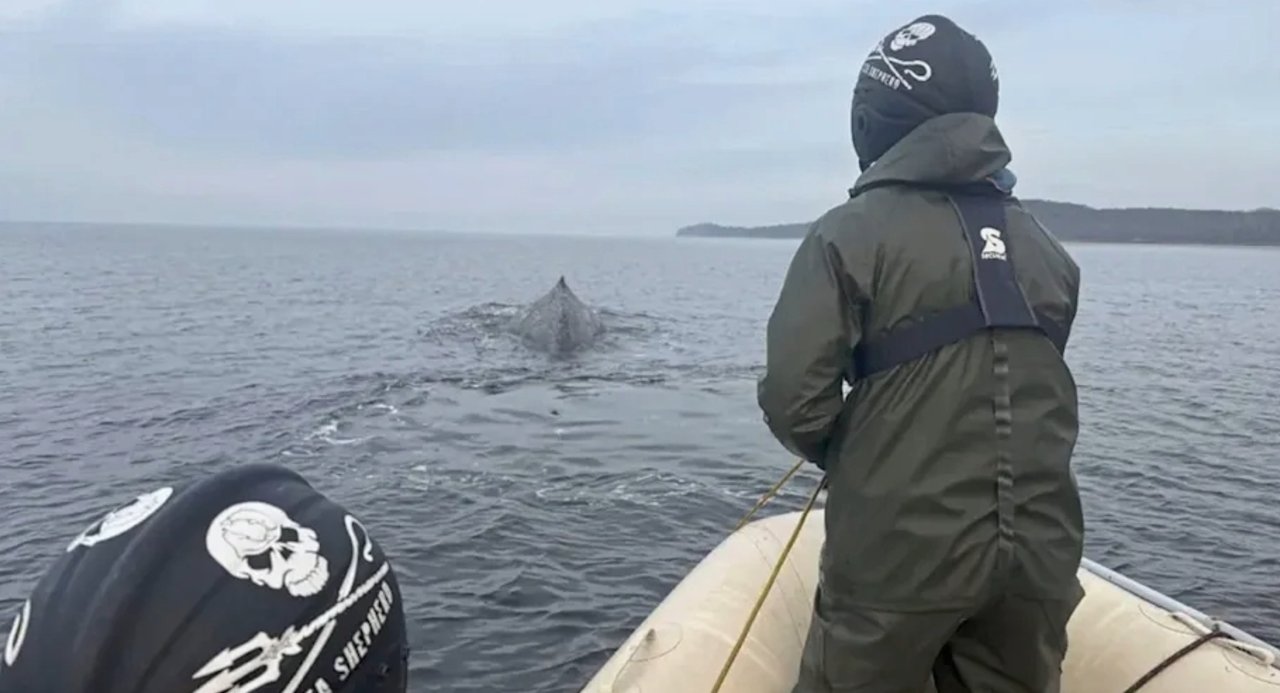
The humpback whale that was stranded on a sandbar in Lübeck’s Baía left the shallow area overnight and is now swimming in deeper water. The animal remains visible from the beach of Niendorf, in the district of Ostholstein, in Alemanha. Embarcações of the maritime police accompany the mammal to guide it towards the Mar of the Norte. The spontaneous movement occurred after days of intense rescue efforts.
Rescue teams have been monitoring the animal’s movement since Friday morning. The mayor of Timmendorfer Strand, Sven Partheil-Böhnke, expressed relief that the whale had left the shoal on its own. Ele highlighted that there is still a risk of the animal returning to shallow areas of the bay. Autoridades plan to maintain escort to ensure the mammal follows the correct path.
Maritime escort guides the animal to safe waters
Maritime police boats and other vessels work to guide the humpback whale. The main objective is to direct it to Mar from Norte and, subsequently, to Atlântico. Especialistas track progress in real time with drone support and direct observations.
Marine biologist Robert Marc Lehmann considers the move an important first step. Ele dived close to the animal in the previous days and observed its condition. Segundo the expert, a full rescue will only occur when the whale returns to Atlântico, a process that could take weeks.
The mammal’s skin shows damage, possibly related to the low salinity of the waters of the Mar Báltico. Aves marines were seen landing on the animal. The whale measures between 12 and 15 meters in length and weighs around 15 tons.
https://twitter.com/sputnik_brasil/status/2037450105633010002?ref_src=twsrc%5EtfwLocal and state authorities support the operation
The minister-president of Schleswig-Holstein, Daniel Günther, visited the site on Thursday and thanked the volunteers and professionals involved. Membros from the fire department, Associação Alemã from Salvamento Aquático and environmentalists participated in the work. Günther reinforced the state’s commitment to providing necessary support, including police boats.
Mayor Sven Partheil-Böhnke followed the actions and expressed confidence in the success of the escort. Ele warned of persistent dangers in the shallow waters of the bay. Work was stopped at dusk for safety reasons, and resumed the following morning.
Whale movement begins after hours of immobility
On Thursday night, the humpback whale began moving after remaining relatively still for several hours. The animal advanced about 20 meters towards Mar Báltico, emitting sounds and flapping its tail fin. Operadores of dredgers encouraged the movement with horns.
Dredging work created a channel to facilitate access to deeper waters. A floating excavator and a land excavator operated at the site during the day. Bóias marked the exact area of operations.
Experts assess the mammal’s health status
Biologist Robert Marc Lehmann inspected the whale closely and reported that it had open eyes and was vocalizing. Restos of mesh remained stuck in his mouth, but it was not possible to remove them completely at the moment. The animal’s motivation to move was observed to be positive.
Researchers from Instituto, Pesquisa, Vida Selvagem Terrestre and Aquática used drones to locate the animal, which does not have a tracker. The condition of the skin prevented the attachment of any monitoring device. Especialistas highlight that the whale needs to return to Atlântico to feed properly.
Context of the species’ presence in Mar Báltico
Humpback whales typically spend the summer in Atlântico Norte, near Noruega and Groenlândia, and migrate to tropical waters in the winter to mate and birth calves. Elas feed on krill and small fish. The species can reach up to 30 tons and live up to 90 years.
The presence of this specimen in Mar Báltico represents an unusual occurrence. The animal was previously sighted near Wismar in early March, and then at Fiorde of Flensburg. Ele has remained stranded on the sandbank close to Niendorf since the evening of Monday 23 March.
Efforts combine technology and human action
Volunteers and professionals worked in a coordinated manner to support the rescue. Dredging removed compacted sand to open passage. Observadores on land and at sea they recorded each advance of the animal.
The operation involved several institutions and had the support of local and state authorities. The partial success in spontaneous movement of the whale generated optimism among the teams. Monitoring continues to prevent the mammal from returning to risk areas.
The humpback whale now swims in deeper waters off Lübeck, with maritime police vessels keeping an escort. Especialistas monitor progress to ensure the animal moves toward Mar from Norte. The case attracts international attention due to the complexity of rescuing a large marine mammal in a restricted environment.