

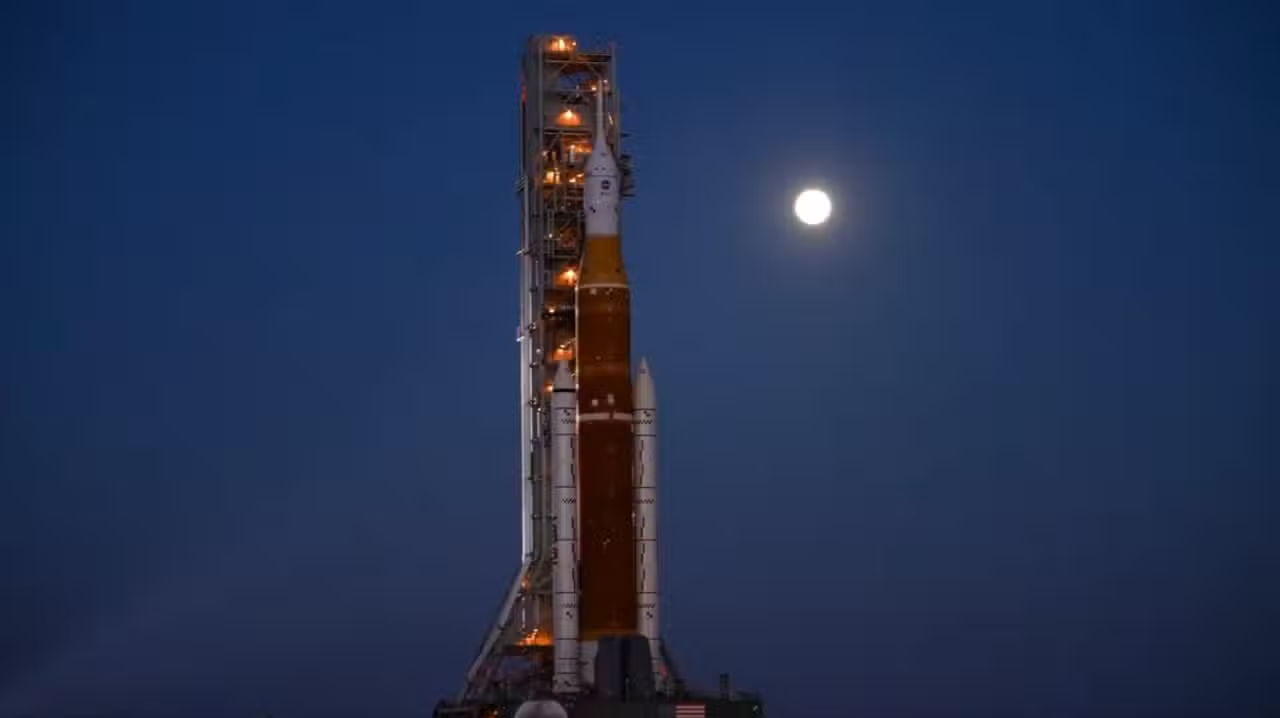
Nasa has started the countdown to the Artemis II mission, which will mark the return of humans to lunar orbit after more than five decades. The launch is scheduled to take place on April 1, 2026 from Centro Espacial Kennedy, at Flórida, using the Space Launch System rocket. The approximately ten-day trip will send four astronauts on a free return trajectory around Lua without landing on the surface.
Reid Wiseman will command the mission as commander, accompanied by pilot Victor Glover and mission specialist Christina Koch, all from Nasa. Canadian Jeremy Hansen, from Agência Espacial Canadense, will complete the international crew. Essa composition reflects the collaboration between Estados Unidos and Canadá in the Artemis program, which aims to prepare technologies for more ambitious future explorations.
- The SLS rocket will be used for the first time with a crew on board.
- The Orion capsule will perform its first human test in deep space.
- Life support and navigation systems will be evaluated under real lunar flight conditions.
The mission follows the model of Apollo 8 from 1968, focusing on testing critical systems during the route of approximately 384 thousand kilometers to Lua and return to Terra. Equipes and Nasa perform maneuvers and checks in Earth orbit before proceeding to greater distances, ensuring the reliability of equipment not yet tested with human presence.
Final preparations at Centro Espacial Kennedy
Technicians have completed the rollout of the SLS rocket and Orion capsule to launch pad 39B. The crew began periods of quarantine and intensive training to align operational procedures. Janelas launch alternatives were defined between April 2nd and 6th, with another opportunity on April 30th if meteorological or technical conditions prevent the initial date.
The launch vehicle features impressive dimensions and striking turquoise and white colors, designed to carry heavy payloads required for lunar missions. Engenheiros monitor all propulsion, avionics and emergency escape systems to ensure maximum safety during takeoff and the initial phases of flight.
https://twitter.com/NASA/status/2036936787004723250?ref_src=twsrc%5EtfwCrew details and specific training
The four astronauts have extensive experience from previous missions on Estação Espacial Internacional and in flight tests. Reid Wiseman leads general operations, while Victor Glover manages the controls of the Orion capsule. Christina Koch contributes expertise in life support systems, and Jeremy Hansen supports aspects of international collaboration and scientific experiments.
Simulated training reproduced emergency scenarios, including communication failures and trajectory adjustments at lunar speed. The crew practiced atmospheric reentry procedures, which represent one of the most critical moments of the mission due to the high speeds involved.
Interagency integration has allowed Canadian and American protocols to be harmonized, strengthening joint response capabilities in high-risk environments. Cada member was given clear assignments to maximize efficiency during the ten day flight.
SLS and Orion technology under test
The Space Launch System represents the most powerful rocket developed by Nasa since the Apollo program, with the capacity to propel the Orion capsule beyond low Earth orbit. Seus main engines and side boosters have been optimized to provide the necessary thrust throughout the entire ascent phase.
The Orion capsule incorporates advanced heat shields to withstand the intense heat of re-entry and automated guidance systems. Durante the flight, sensors will record data on radiation, vibrations and structural performance to validate the design for subsequent missions.
Ground teams will monitor all phases in real time, with the ability to intervene remotely if anomalies are detected. Esses initial tests with crew are essential to identify adjustments before more complex operations.
Artemis program context and long-term objectives
The Artemis program seeks to establish a sustainable presence in Lua in preparation for explorations in Marte. The Artemis II serves as essential technical validation, confirming that the SLS and Orion can operate safely at lunar distances. Sucesso at this stage paves the way for manned landings planned in subsequent years.
International collaborations expand the scientific scope, allowing sharing of data on the lunar environment and natural resources. The current mission does not include landing, but collects valuable information about the behavior of systems in prolonged flight.
Risks and mitigation measures
Astronauts will face distances and conditions never before experienced with this set of vehicles. Nasa planned progressive tests in orbit close to Terra to mitigate risks identified in simulations. Especialistas highlight that the margin of error in deep space missions requires exhaustive preparation in all operational aspects.
Continuous monitoring of crew health and equipment performance will occur throughout the journey. Protocolos mission abort options have been refined to provide safe options at different stages of flight.
Comparison with international initiatives
Other countries are developing their own capabilities for lunar access, with plans for manned landing by the end of the decade. China advances rockets and descent modules, focusing on polar regions with potential for resources. Essas initiatives occur in parallel to the American effort, creating an environment of accelerated technological development on a global scale.
Nasa maintains a focus on partnerships and technical transparency to advance shared knowledge about cislunar space. The progress of Artemis II will be closely watched by space agencies around the world.
Next steps after the test flight
Data collected during the Artemis II mission will be analyzed to refine vehicle designs and procedures. Equipes engineering staff will use this information to prepare the next steps of the program, including integration of lunar landing systems. The schedule foresees continuous progress based on the results obtained.
The scientific community awaits feedback from environmental and performance measurements to update planning models. Essa iterative approach characterizes the development of large space technologies.
Historical importance from the return to Lua
More than half a century after the last Apollo missions, Artemis II represents a milestone in human space exploration. The presence of a diverse crew symbolizes the evolution of international capabilities in the space sector. The flight will test operational limits and inspire new generations of engineers and scientists.
Current preparations focus efforts on ensuring that all components function as designed under real-world conditions. The imminent launch marks the beginning of a new phase of sustained lunar ambitions.