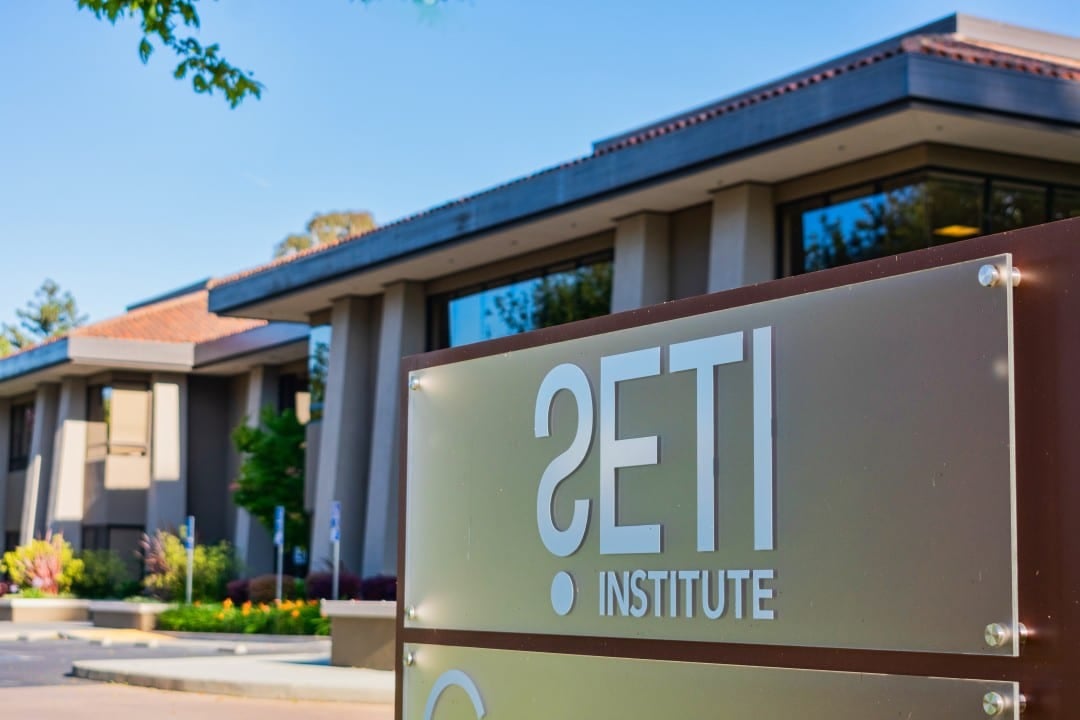
Instituto SETI researchers have published a work that questions traditional search strategies for extraterrestrial intelligence. The study, released in The Astrophysical Journal, analyzes how space weather around stars can alter ultra-narrowband radio signals before they even leave their home planetary system.
This distortion occurs due to turbulent plasma generated by stellar winds and coronal mass ejections, phenomena similar to those observed in Sol. The authors use data from old missions to quantify the effect and propose adjustments in future searches.
The work involved astronomer Vishal Gajjar as the main author, along with Grayce C. Brown.
Space weather affects radio wave propagation
The identified phenomenon transforms a signal concentrated at a precise frequency into a broader, weakened emission.
This change happens as the signal passes through the turbulent environment near the emitting star.
As a result, transmissions that would come out as sharp spikes can be spread across multiple frequencies, making them difficult for current SETI algorithms to pick up.
Data from interplanetary probes validate the model
The team examined radio signals sent by missions such as Mariner 4, Pioneer 6, Helios 1, Helios 2 and Viking, launched between 1964 and 1976.
These data showed that spectral broadening occurs when crossing the interplanetary medium of Sol, with greater intensity during periods of solar storms.
Observations from the Helios probes, which operated close to Sol, indicated that the distortion increases the closer the signal passes to the star.
Based on these direct measurements, the researchers built simulations for other star systems and different frequency bands.
Red dwarfs pose greater challenge
M-type stars, known as red dwarfs, make up about 75% of the stars in Via Láctea.
These stars are smaller, colder and very active, which creates environments where the signal broadening effect tends to be more pronounced.
Although the chance of a coronal mass ejection coinciding exactly with transmission is low, less than 3%, when enlargement occurs it can multiply by more than a thousand times compared to normal conditions.
Higher frequencies can improve detection
The study recommends prioritizing higher radio frequencies, where the impact of stellar plasma is less significant.
Furthermore, it suggests broadening the detection criteria to include slightly broader signals that were previously automatically discarded.
This approach allows searches to consider what actually arrives at Terra after traversing the space weather of other stars.
- 100 megahertz signals can be broadened by up to 100 hertz under typical conditions.
- In more than 60% of simulated systems, lower frequencies produce even greater distortion.
- About 70% of systems cause mild flare, while 30% cause more severe distortion.
Search strategies need updating
Traditional SETI algorithms focus on extremely narrow frequency peaks, as these are difficult for natural processes to produce.
However, the new model shows that intentional artificial signals can lose this characteristic when leaving the originating system.
The research does not resolve the Fermi paradox, but it does offer a mechanism that helps understand the cosmic silence observed so far.
Simulations point to significant proportions
Calculations indicate that the broadening effect occurs in a considerable fraction of stellar systems.
Under analyzed conditions, most stellar environments alter signals slightly, while a smaller portion cause more drastic changes.
These results were obtained from extrapolation of real data collected by human probes at Sistema Solar.
The work contributes to refining searches for technosignals, adjusting them to the physical reality of stellar environments. Pesquisadores continue to collect more data to test the model’s predictions in future radio telescope observations.
