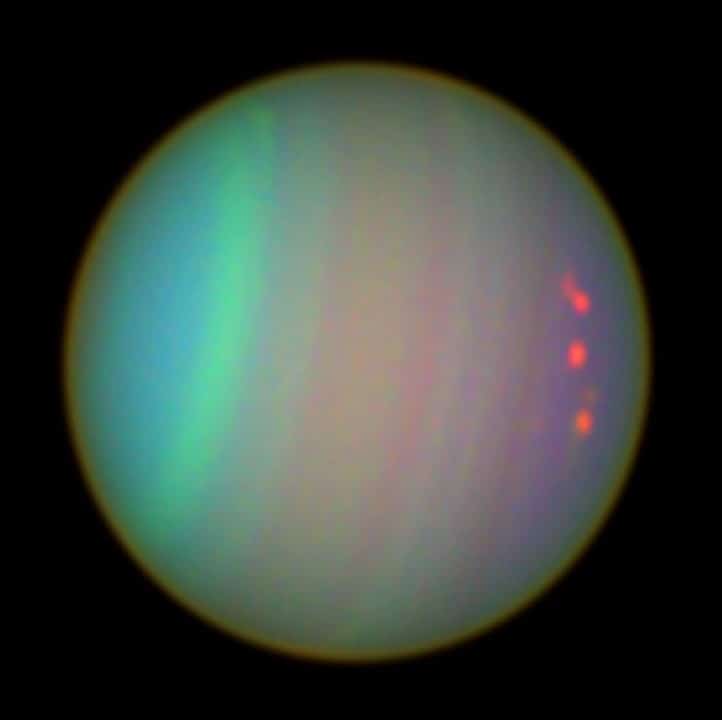
Telescópio Espacial Hubble captured a false-color image of Urano that highlights atmospheric features invisible in natural observations. The photo, released by ESA and NASA in January 2004, uses data from multiple filters to reveal contrasts between hemispheres and cloud structures. Esses elements arise due to processing that assigns colors to the wavelengths captured by the ACS and STIS instruments on the Hubble.
This representation allows us to observe striking differences that the human eye does not perceive in the planet’s usual blue-green hue. The data combines observations that show extreme seasonal variations caused by Urano’s nearly 98-degree axial tilt.
- The asymmetry between the southern and northern hemispheres appears clearly.
- Bands of clouds and fog parallel to the equator become visible.
- Bright spots stand out against the background darkened by methane absorption.
Atmospheric structure revealed by the image
The false-color image clearly shows the contrast between the planet’s hemispheres. Essa difference results from the intense seasonal variations that Urano experiences because of its tilted rotation. Astronomers associate this asymmetry with processes that occur over the years on the distant planet.
Additional observations indicate that the atmosphere has bands of clouds aligned with the equator. Essas formations appear parallel and reveal internal dynamics that are not apparent in conventional images. Filter processing helps map these layers more accurately.
Red dots highlight convective clouds
Three red dots visible near the right edge of the image draw immediate attention from viewers. Essas estruturas correspondem a formações de nuvens individuais na atmosfera superior de Urano. The reddish appearance arises from the combination of filters that include wavelengths with strong methane absorption.
Clouds that reach high altitudes reflect more light and stand out as bright spots against the dark surrounding atmosphere. Astronomers believe that these clouds form in connection with convective activity that originates in the planet’s interior. Esse process elevates material to higher layers of the atmosphere.
The Voyager 2 probe, which flew over Urano in 1986, recorded an atmosphere that appeared relatively flat and without major highlights. Later Imagens Hubble and ground-based telescopes have shown, however, that clouds appear and dissipate repeatedly over time.
Atmospheric activity over the decades
Data accumulated since the flyby of Voyager 2 indicates greater variability in the atmosphere of Urano than initially imagined. Telescópio Espacial Hubble tracked the appearance and disappearance of bright clouds at different periods. Essas observations reveal a planet with more active dynamics than the first images suggested.
Recent studies complement old captures with new perspectives on the upper layers. In February 2026, Telescópio Espacial James Webb provided the first detailed representation of the vertical structure of Urano’s upper atmosphere, including data on the ionosphere.
This combination of information from different missions allows us to better understand the processes that govern the ice planet’s climate. The bright spots identified in the Hubble images serve as markers of regions where significant convective uplift occurs.
Comparison with previous observations
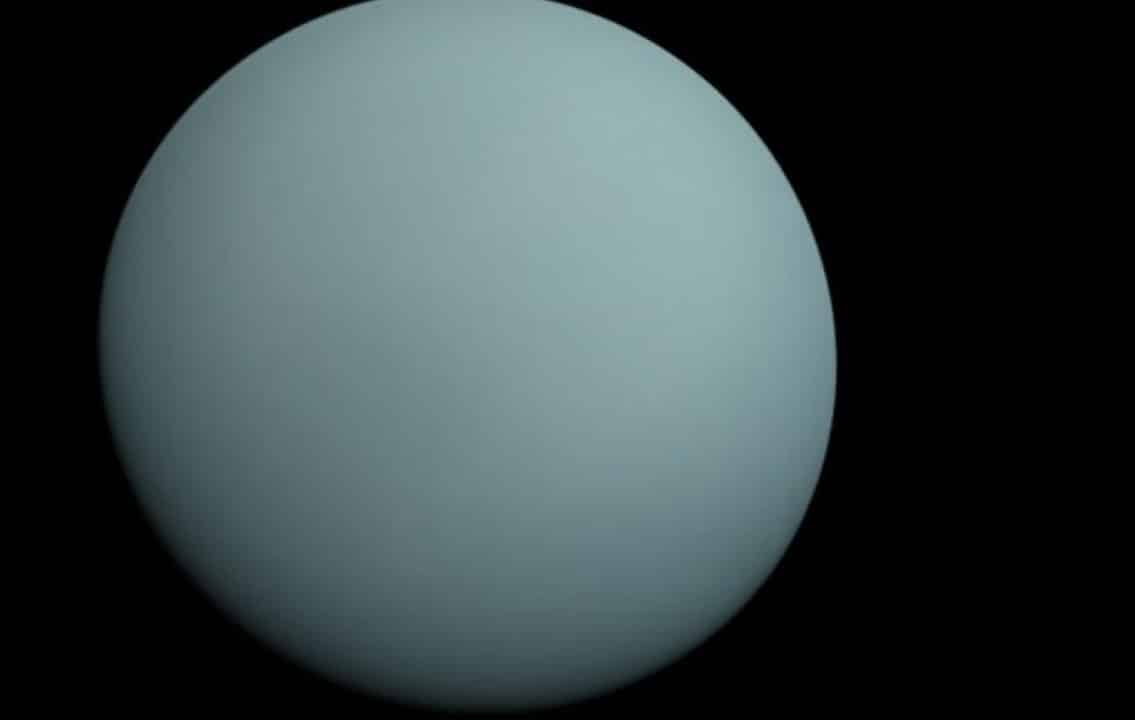
Natural color images show Urano as a pale blue-green sphere without much visible detail. Já processing with multiple filters transforms the visualization and exposes layers that remain hidden otherwise. Essa technique especially highlights regions where methane absorption is less intense.
Astronomers use these contrast differences to map the distribution of aerosols and gases in the atmosphere. The red dots, for example, indicate locations where high clouds overcome the overall absorption of the surrounding methane. Essa approach offers insights into global atmospheric circulation.
Contributions from Hubble instruments
The Câmera Avançada to Pesquisas and the Espectrógrafo and Imagem of the Telescópio Espacial worked together to generate the image data. Cada filter captures specific information about the reflection and absorption of light at different altitudes. The result combines these signals into a single representation that reveals the complexity of the atmosphere.
These 2004 observations remain relevant for current studies on Urano. Elas serve as a basis for comparing changes throughout the planet’s seasons, which last decades due to the long orbital year. Astronomers monitor these developments to refine climate models of the ice giant.
Uranus presents a variety of facets depending on the wavelength used for observation. Mesmo Although it appears calm in general views, the planet reveals dynamic structures when analyzed with sensitive instruments.
False color processing does not alter physical reality, but facilitates human interpretation of atmospheric variations. The Essa technique has already been successfully applied to other Sistema Solar bodies and remains essential for the study of distant planets.
The clouds highlighted in the 2004 image circle the planet at high speeds in some regions, according to measurements derived from sequences of observations. Essa fast movement indicates strong winds that act on different atmospheric layers.
Studies that combine data from Hubble with more recent observations from James Webb expand knowledge about the transition between the lower layers and the ionosphere. Essa integration helps build a more complete picture of Urano’s meteorology.
