

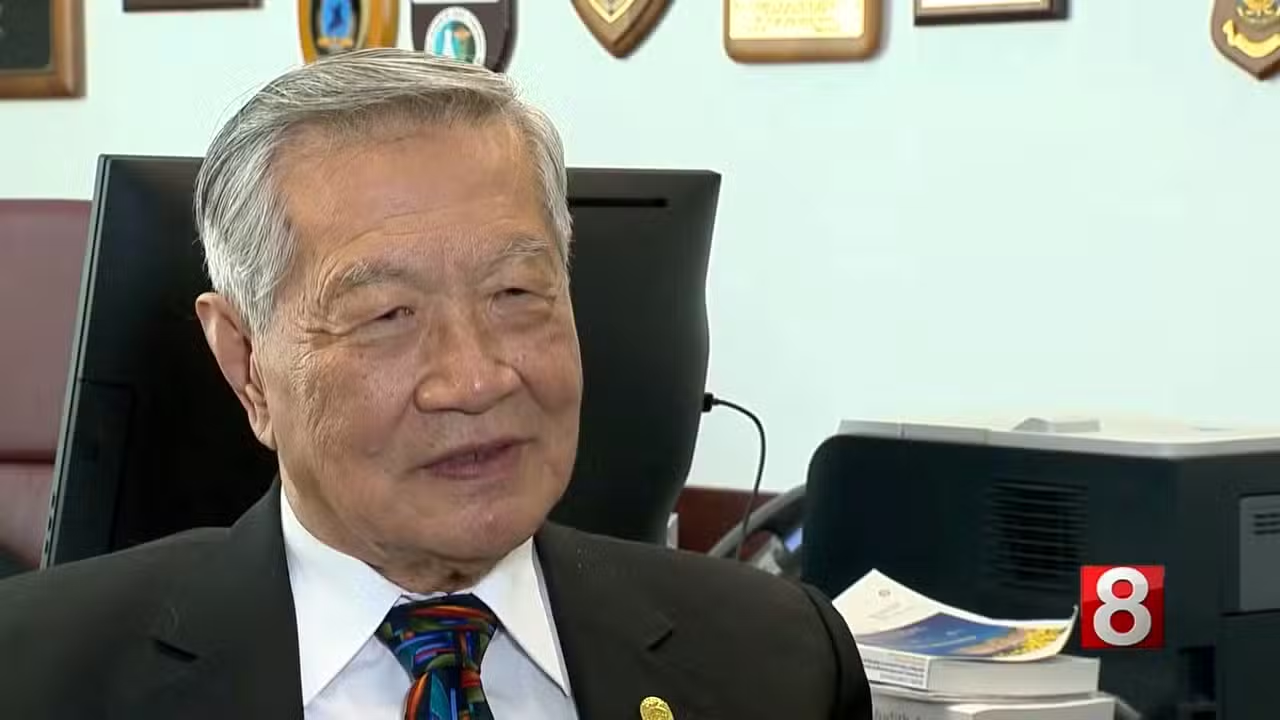
Henry C. Sua death marks the end of an era for forensic science, where he pioneered many techniques and methodologies that are now standard in criminal investigations around the world. Lee dedicated his life to unraveling mysteries through microscopic evidence, transforming the way justice is sought and applied. Sua contribution transcended the laboratory, reaching classrooms, courtrooms and the public imagination, solidifying his legacy as an iconic and innovative figure in the field.
Born in the China and immigrating to the Estados Unidos, Lee built a reputation for impartiality and scientific rigor, becoming a respected authority. Sua ability to communicate complex forensic analyzes in an understandable way to jurors and the public was one of his greatest strengths, contributing significantly to the public understanding of forensic science. Ele not only applied science, but also taught and disseminated it, inspiring generations of future experts.
His presence in court was always awaited, not only because of the depth of his technical knowledge, but also because of his ability to present evidence in a didactic and convincing way. The impact of his work is undeniable, having influenced countless investigations and trials over decades, and recognition of his genius extends across the globe.
The legacy in the O.J. Simpson case and other crimes
Henry C. Lee’s participation in the “Século Trial” involving O.J. Como defense witness, Lee raised doubts about the collection and handling of evidence by the police, especially the famous bloody glove found at the crime scene. Sua detailed analysis and questions about the integrity of the evidence were crucial to the defense narrative, which suggested possible contamination or planting of evidence.
The phrase “If it doesn’t fit, you must acquit”, said by one of the defense lawyers, was engraved in public memory, but it was Lee’s expertise that provided the scientific basis for the doubts presented. Ele highlighted inconsistencies in documentation and preservation of traces, such as carpet fibers and blood stains, that could have been compromised.
In addition to the Simpson case, Lee was involved in thousands of investigations, some of which had great repercussions. Entre, the death of little JonBenét Ramsey, the case of the murder of Scott Peterson and the reinvestigation of the assassination of President In each of these scenarios, his expertise was essential in analyzing the evidence and offering new perspectives.
His methodological approach and his ability to find crucial details in complex crime scenes have made him a sought-after expert by prosecutors and defenders. Ele has always emphasized the importance of a thorough investigation and the correct interpretation of evidence, without prejudice.
Contributions to modern forensic science
Henry C. Lee was more than a courtroom expert; he was an educator and innovator who shaped modern forensic science. Ele founded and directed Instituto from Ciência Forense from Universidade from New Haven, transforming it into a global center of excellence for training and research. Sob its leadership, the institute trained generations of forensic scientists who today work in various agencies and laboratories.
His work spanned diverse areas of forensics, from fingerprint analysis and ballistics to crime scene reconstruction and blood trace analysis. Ele published hundreds of scientific articles and books, contributing immensely to the literature in the area and disseminating knowledge that was, until then, restricted to a few specialists.
Lee was also a tireless advocate for the application of new technologies in criminal investigation, always seeking more accurate and reliable methods for analyzing evidence. Ele believed that science should be at the service of justice, and that innovation was the key to improving the ability to solve crimes.
His educational and research legacy is a pillar for the forensic community, with his theories and practices being studied and applied by students and professionals around the world. Its influence on standardizing procedures and increasing scientific rigor in investigations is invaluable.
The journey of a pioneer
Born in Rudong, province of Jiangsu, China, in 1938, Henry C. Lee had a childhood marked by challenges. Ele emigrated to Taiwan and, later, to Estados Unidos, where he began his remarkable academic and professional journey. Sua dedication to studies and science was evident from an early age, paving the way for a career with global impact.
Lee earned his bachelor’s degree in police science at Central Police College of Taiwan, and after moving to the U.S., he earned his Ph.D. in biochemistry from Universidade of Nova York. Essa multidisciplinary training was fundamental to his integrated and innovative approach to forensic science, combining knowledge of chemistry, biology and criminology.
He began his career at Estados Unidos as a professor at Universidade of New Haven, where he quickly stood out for his passion for teaching and research. Sua’s ability to translate complex concepts into accessible language made him an inspiring mentor to many of his students, who saw him as an example of excellence and dedication.
His rise in the field of forensic science was meteoric, driven by an insatiable curiosity and an unwavering commitment to the truth. Lee not only applied science to practical cases, but also contributed to its theoretical evolution, developing new techniques and protocols that became a reference.
International recognition and honors
Throughout his life, Henry C. Lee received numerous honors and awards in recognition of his contributions to forensic science and justice. Ele has been awarded honorary doctorates from numerous universities and has been a member of numerous scientific academies and professional associations around the world. Seu work was widely recognized by the international community, which saw him as an ambassador for forensic science.
His dedication was not limited to the Estados Unidos, having served as a consultant for law enforcement agencies and governments in more than 46 countries. Lee participated in crucial investigations on several continents, helping to solve crimes and strengthen justice systems in different cultures and legal contexts. Ele has always emphasized the universality of scientific principles, regardless of geographic borders.
His ability to collaborate with multidisciplinary teams and adapt to different legal realities has made him a valuable resource for the global community. Lee left a legacy of international cooperation, showing how science can transcend barriers to promote security and justice.
The impact of his research and methodology continues to be studied and applied by professionals across the globe, solidifying his status as a legendary figure. His influence will last for many generations, serving as a beacon for those who seek truth through science.
Lee’s philosophy on evidence
Henry C. Lee has always defended the maxim that “all evidence counts”, no matter how small. Ele believed that every fiber, every drop of blood, every scratch, no matter how insignificant it may seem, could hold the key to solving a crime. Essa philosophy led him to develop extremely detailed analysis methods that revolutionized the way crime scenes are processed.
For Lee, the forensic scientist’s job was like putting together a complex puzzle, where each piece is vital to the final picture. Sua methodology involved meticulous observation and in-depth analysis, leaving nothing to chance. Ele was known for his patience and persistence, spending hours, sometimes days, examining evidence.
He also emphasized the importance of impartiality, arguing that the forensic scientist must follow the evidence wherever it leads, without giving in to external pressure or prejudice. Essa scientific integrity was a hallmark of his career and an example for all who work in the field.
A farewell to the forensic legend
The departure of Henry C. Lee leaves a void in the global scientific and legal community. Sua life was a testimony to the power of science for justice and to the dedication of an individual in pursuit of truth.
He will be remembered not only for his remarkable accomplishments in the courtroom, but also for his passion to educate and inspire.