

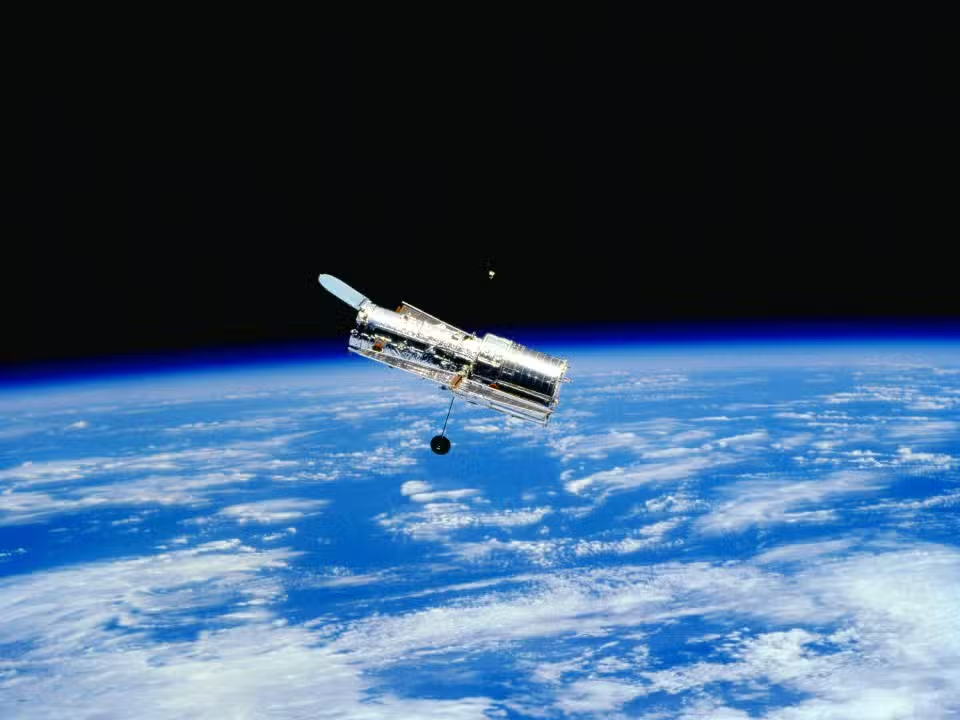
The discovery of the interstellar object 3I/ATLAS, initially detected in July 2025 by an astronomical monitoring system located at Chile, continues to mobilize the international scientific community. The celestial body has unique characteristics that require continuous observations using high-precision equipment, such as the Hubble and James Webb space telescopes. The passage of celestial bodies originating from outside our planetary system provides an opportunity to physically analyze the matter that makes up other regions of the Via Láctea.
Recent data obtained by space agencies indicates that the comet’s nucleus has an effective radius of approximately 1.3 kilometers, with a margin of error set at 0.2 kilometers. Essa fundamental measurement allows astronomers to calculate an estimated density of 0.5 grams per cubic centimeter, a value considered standard for known cometary nuclei, but which gains new relevance when dealing with an interstellar visitor. Confirmation of these physical dimensions rules out initial hypotheses that the object could be a much smaller and highly reflective fragment.
Based on these physical dimensions, the total mass of the object is calculated to be about 4.6 times 10 to the power of 15 grams. The numerical density of the population of interstellar bodies with similar proportions reaches values close to 7 times 10 to the power of -3 per cubic astronomical unit. Esse volume of material wandering through deep space results in a spatial mass density on the order of 10 to the power of -26 grams per cubic centimeter, a figure that intrigues researchers responsible for galactic mapping and accounting for stellar matter.
The detailed measurements provide a solid foundation for understanding the dynamics of celestial bodies ejected from their home stellar systems. The ongoing study of 3I/ATLAS allows direct comparisons with the chemical elements found on the planets and asteroids orbiting Sol. Spectroscopic analysis of the light reflected by the object helps determine not only its size, but also the rotation rate and structural integrity of the core as it is subjected to the gravitational and thermal forces of our system.
Detailed analysis of the cometary nucleus
High-resolution images captured by the space telescope provided the clarity needed to isolate the core from the intense glow of the surrounding coma. The 1.3 kilometer dimension, combined with the calculated density, establishes a robust physical parameter for the total mass of the interstellar object. The accuracy of these instruments is vital, as ejected dust often obscures the solid surface of approaching icy bodies.
The estimated number of similar bodies in space suggests a continuous production of material rich in heavy elements throughout galactic history. Complementary Observações shows that the coma and jets of gas and dust contribute significantly to the total reflectivity of the celestial body as it travels through the vacuum. The observed rate of mass loss helps model the lifetime of objects of this size in interstellar space.
The structure visualized by optical instruments includes consolidated jets that extend across vast distances in space. Essas material emissions are directly influenced by thermal and mechanical interaction with the solar wind as the object approaches the hottest regions of the planetary system. The emission pattern suggests pockets of volatile ice distributed irregularly beneath the comet’s crust.
Chemical composition and isotopic anomalies
Isotopic measurements conducted by advanced spectrographs coupled to the James Webb and the Very Large Telescope reveal chemical abundances that diverge drastically from local standards. The proportion between deuterium and hydrogen reaches the mark of 0.95%, with a variation of 0.06%, a rate considerably higher than that recorded in any comet originating from Nuvem of Oort or Cinturão of Kuiper. Carbon isotope ratios range from 141 to 191 for carbon dioxide and from 123 to 172 for carbon monoxide.
These numerical values exceed typical patterns observed in protoplanetary disks close to our space environment. The chemical information collected suggests a primordial origin, dating back to a period between 10 and 12 billion years ago. Essa time window indicates that the material may be associated with the formation of low-metallicity stars, belonging to the oldest generations of our galaxy, which ejected their planetary building blocks into interstellar space long before the formation of Terra.
The Heavy Element Budget Dilemma
Old stars with a low concentration of metals have an extremely reduced fraction of heavy elements, corresponding to around 2 thousandths of the value found in Sol. Apenas a small portion of the local stellar population, around 10%, falls into this specific category of primordial stars. The scarcity of metals in these stars theoretically limits the formation of complex solid bodies around them.
The galactic stellar density for this restricted group approaches 0.04 solar masses per cubic parsec. Consequentemente, the maximum amount of heavy elements available to form celestial bodies in these regions reaches a limit of 5.4 times 10 to the power of -28 grams per cubic centimeter. Esse calculation is based on the most precise observations of the stellar distribution in the galactic halo.
This calculated value presents a significant mathematical discrepancy, as it is lower than the mass density required to support the vast interstellar population of type 3I/ATLAS. The debris disks around these stars would need to contain a mass tens of times greater than the host star itself to justify the number of ejected objects. Current orbital physics does not support the existence of protoplanetary disks with this mass ratio.
Models of galactic chemical evolution demonstrate that the production of heavy elements in these ancient populations occurred gradually. The mass spectrum in planetary disks would require a rate of ejection of material in quantities far exceeding those predicted by known laws of stellar physics. The contradiction between the observed chemistry and the required mass creates one of the biggest current debates in astrophysics.
Hypotheses to resolve the spatial discrepancy
To align observational data with star formation theories, factors such as planetary ejection efficiency and the mass distribution of interstellar objects would need to be adjusted by at least three orders of magnitude. Essa profound inconsistency suggests that the direct correlation between 3I/ATLAS and low-metallicity stars may be structurally unstable. Pesquisadores evaluate alternative origins, such as the formation in disks of debris from stars with higher metallic concentrations or completely different production mechanisms that could explain the observed abundance. The possibility of an overestimation of the nuclear radius or the numerical density of the population of objects also emerges as a viable way to resolve the mathematical tension. The isotopic data reinforce the advanced age of the material, but require a complete revision in calculations of the reservoir of heavy elements available in the galaxy for the formation of smaller bodies.
Continuous monitoring and trajectory
Recent analyzes of the light spectrum indicate a composition rich in methanol and other volatile substances in the object’s coma. A non-gravitational acceleration was detected during the passage through perihelion, driven by the release of gases and dust, a typically cometary behavior that requires a nucleus of substantial proportions to generate such a buoyant force against solar gravity.
The celestial body reached its closest point to Terra in December 2025, a moment that allowed a battery of detailed observations by networks of terrestrial telescopes. Buscas by artificial emissions, conducted by radio frequency scanning programs, did not detect any anomalous signal coming from the object, confirming its strictly natural and geological nature.
Route towards deep space
The interstellar object 3I/ATLAS maintains its trajectory out of the planetary system at high speed, without being captured by the gravity of Sol. The celestial body is scheduled to approach the orbit of the planet Júpiter in March 2026, the final stage of detailed observation before definitively returning to deep interstellar space and disappearing from the reach of current telescopes.