

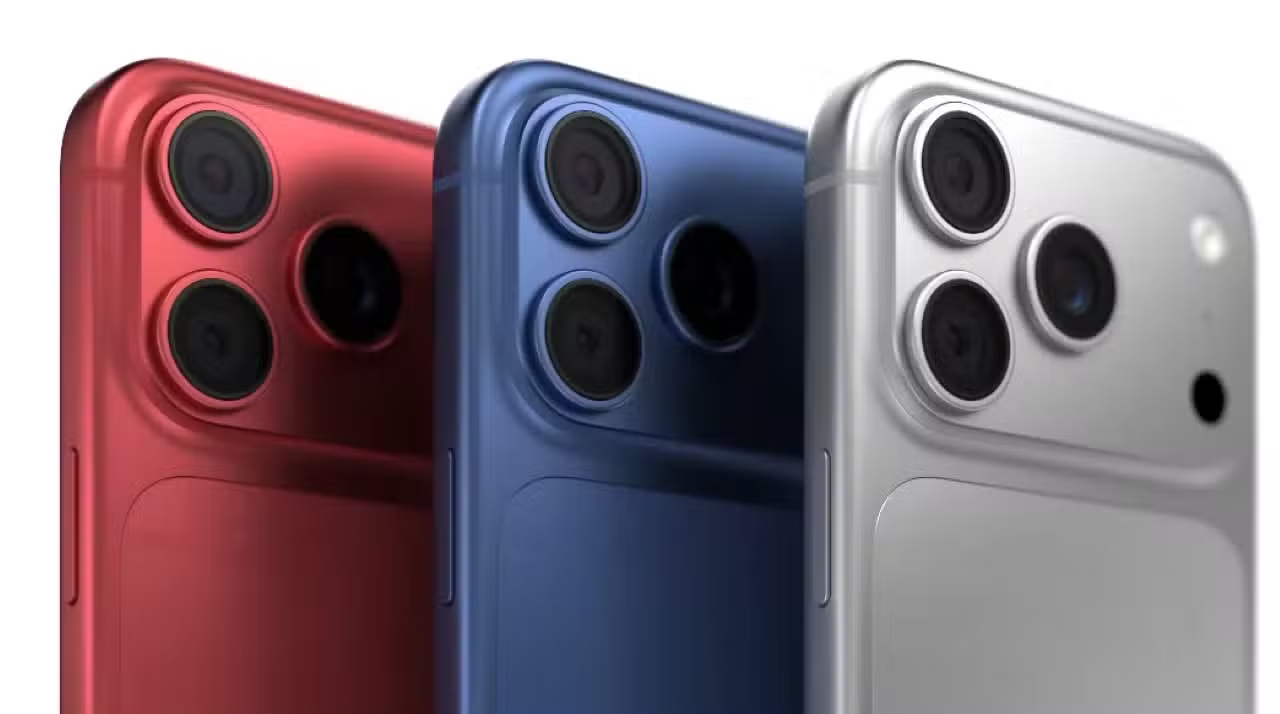
The electronic components industry is seeing intense movement on Asian assembly lines, indicating preparation for the next generation of high-cost mobile devices. The main North American manufacturer in the sector directs its engineering efforts towards the most expensive variants in its portfolio, establishing a strict technical separation in relation to entry-level models. The current project involves the implementation of a processor manufactured using new lithography and an aesthetic redesign focused on ergonomics and structural durability.
Information obtained from suppliers in the production chain indicates that the commercial strategy aims to attract consumers willing to invest in cutting-edge hardware. Differentiation between product lines will occur through the exclusivity of physical and software resources, ensuring that innovations reach the most expensive devices first, justifying positioning in the global market.

Among the main changes confirmed by production flows, the following technical points on the assembly lines stand out:
– Adoção of a chassis with unprecedented metallic alloys in the lateral structure of the equipment.
– Integração of an internally developed chip with higher transistor density.
– Implementação of local processing tools for voice commands and texts.
Commercial strategy prioritizes exclusivity in high-cost versions
The segmentation of the smartphone catalog becomes more evident with each update cycle in the global telecommunications market. The manufacturer adopts the tactic of reserving the most robust innovations exclusively for the superior variants, creating a purposeful technical distance in relation to the entry-level models.
This sales approach ensures high profit margins and meets the demand of technology enthusiasts who demand the maximum performance available. Delivering a superior hardware suite justifies the price positioning of the more expensive versions on global e-retail shelves.
The machinery at partner factories is already undergoing adaptations to produce exclusive components that will not be included in standard models in the same period. The exclusivity ranges from the photographic module to the materials used in the external construction of the communication equipment.
Maintaining leadership in the premium segment requires the brand to present noticeable and constant updates to buyers. Direct competition with other Asian manufacturers forces the anticipation of technologies that would previously take years to reach the end consumer.
Advances in silicon architecture and power efficiency
The operating core of the new variants consists of a chip designed to expand the current limits of processing in portable devices. The architecture of the new component allows the insertion of a greater number of transistors in a reduced physical area, optimizing the internal space of the motherboard.
The miniaturization of electronic circuits results in a considerably higher speed of task execution. Ferramentas of productivity, audiovisual editing applications and games with complex graphic rendering will work with superior fluidity within the device’s ecosystem.
Energy efficiency represents another pillar in the development of this industry-first processor. The hardware has been programmed to require less battery power when running processes in the background, solving one of the main complaints of users of high-performance equipment.
Visual redesign and new materials in the external structure
The industrial engineering department is working on structural modifications to the device’s housing, aiming to reduce the edges around the front panel. Essa change maximizes the useful display area of the screen without the need to increase the overall dimensions of the equipment, making it easier to transport and use with just one hand. The side structure will adopt different metal alloys than previous generations, seeking an exact balance between resistance against accidental impacts and structural lightness for continuous daily handling.
The rear panel of the smartphone will receive a chemical treatment on the glass, making the surface less susceptible to deep scratches and fingerprint marks during routine use. The ergonomics of the chassis have undergone revisions to provide a safer and more comfortable fit, reducing the risk of accidental falls. The aesthetic changes implemented by the manufacturer aim to combine the brand’s visual identity with practical functionality, ensuring the product’s durability even in scenarios of exposure to natural elements and extreme use in outdoor environments.
Local data processing and task automation
Hardware enhancement serves as a foundation for the adoption of advanced data processing tools running locally on the device. The operating system will be able to interpret complex voice commands and generate text responses without relying on an uninterrupted connection to external servers.
Automated functions include intelligent organization of media files and real-time meeting transcription. Executing these operations locally ensures immediate response speed and eliminates the latency common in services that depend on high-speed mobile networks.
Optical engineering and photo module features
The set of cameras in the higher versions will be equipped with image sensors that have a significantly larger light collection area, which allows nighttime recordings to be made with a practically non-existent level of visual noise. The device’s optical engineering integrates enhanced periscopic lenses designed to deliver long-range optical zoom without any loss of geometric definition or distortion at the edges of the image. The photo processing software works in sync with the new central chip to apply automatic color, contrast and sharpness corrections in fractions of a second, delivering professional-quality files directly from the native application. Video capture also receives important updates, including new generation mechanical stabilization and native support for high bitrate file formats used in the film industry, which consolidates the device as a viable work tool for digital content creators, journalists and professionals in the audiovisual sector who require constant mobility.
Color calibration and display technology
The front panels will adopt light emission technology capable of reaching higher peaks of brightness, making it easier to view information under direct sunlight. The screen refresh rate will maintain dynamic adaptation, reducing energy consumption when displaying static images and increasing fluidity when navigating menus and web pages.
Information protection and integrity architecture
The new equipment’s security structure encompasses a physically isolated enclave in the processor for storing the owner’s passwords and biometric data. Essa separation prevents malicious applications from accessing sensitive information even in the event of failures in the main operating system.
End-to-end encryption is reinforced at the hardware level, blocking data extraction through unauthorized physical means. The measure guarantees the integrity of personal communications, corporate files and financial transactions carried out through the mobile device.
Thermal management and power cell density
The internal batteries will undergo chemical reformulation with the aim of increasing charge density without expanding the physical volume occupied within the chassis. Essa change allows you to extend the time the device is used away from sockets without compromising the slim design of the equipment.
The heat dissipation system will employ redesigned vapor chambers to move high temperatures away from critical mainboard components. Efficient cooling prevents forced performance reduction of the processor during prolonged sessions of intense use, such as recording high-resolution videos.
The battery recharging speed, both through cables and magnetic induction, will register increases in supported power. The product’s engineering focuses on reducing connection time to the electrical grid, providing hours of autonomy with just a few minutes of charging.
Signal Stability and Wireless Network Protocols
The integrated communications modem will support the latest mobile network frequencies, ensuring superior data transfer rates in regions with adequate infrastructure. Signal stability in closed indoor environments has been optimized through a new antenna arrangement on the metal structure.
Short-range connections will adopt updated protocols, speeding up pairing with external accessories, headphones and home automation systems. Latency in wireless audio transmission will be reduced to meet the demands of media consumption and voice calls.
Native gesture and voice navigation tools
The operating system will introduce advanced gesture control and eye tracking options, making it possible to navigate through the interface without the need for physical touches on the screen. Sensores in depth will map the surrounding environment to assist people with visual impairments in detecting physical obstacles and reading signs.
Audio transcription will work natively during conventional phone calls and third-party video conferencing applications. The implementation of these technologies aims to make the smartphone fully operable for any user profile, overcoming physical or sensory limitations.