

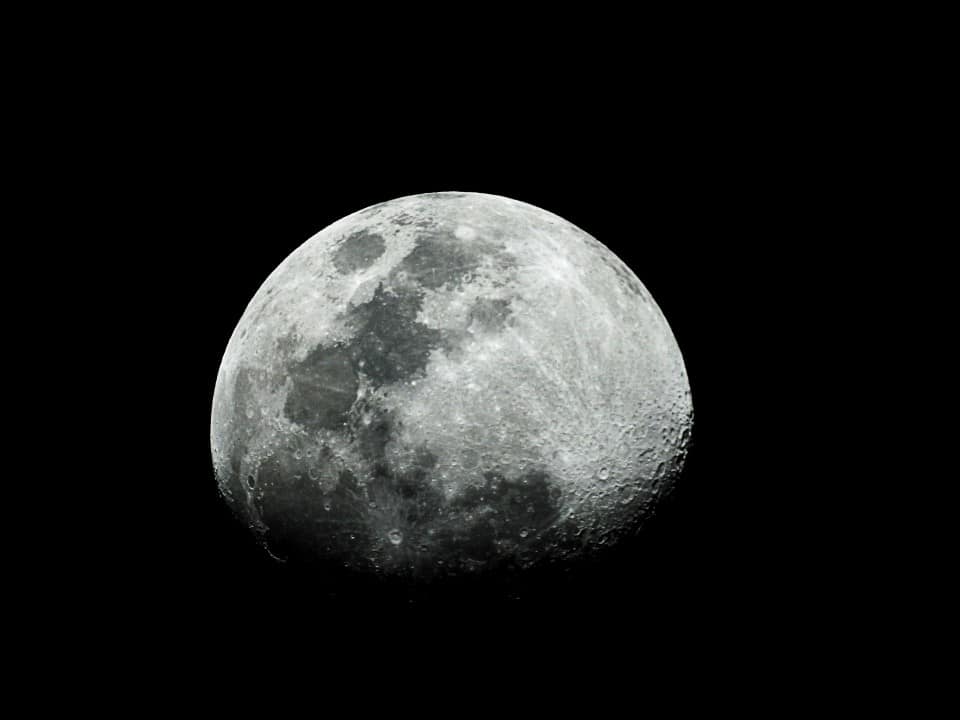
The natural satellite of Terra has entered a specific orbital phase that reduces its visible illumination to the exact 60% mark. The astronomical phenomenon occurs during the waning period and directly changes visibility conditions in the night sky for researchers and scientific institutions that depend on darkness to operate.
The gradual diminution of the lunar brightness creates an invaluable technical window of opportunity for deep space observation. The glare generated by the light reflected from the Sol decreases considerably, allowing the capture of images of distant galaxies, nebulae and celestial bodies with very low luminosity that would normally be hidden.
The mechanical precision of the solar system ensures that this transition occurs within an exact and strictly predictable schedule. Centros research teams spread across the globe use this mathematical predictability to schedule complex lens calibration operations, mirror alignment and collection of highly relevant astrophysical data.
Ideal conditions for deep space observation
Reducing the light reflected from the lunar surface transforms the working environment of ground-based telescopes. The absence of intense glare makes it easier to track asteroids and identify new elements in the space rock belt.
During the 29 and a half day cycle, the transition to the waning phase marks the moment when light interference in the Earth’s atmosphere reaches minimum acceptable levels for long exposure photography. High sensitivity Equipamentos require dark skies to record photons coming from sources located millions of light years away. The 60% illumination window acts as a natural filter, blocking celestial light pollution without completely obscuring the satellite.
The geometric positioning between the Sol, the Terra and the Lua during this phase creates a specific angle that favors the visualization of the lunar terminator line. Esta imaginary line divides the illuminated part of the satellite from the dark part, generating elongated shadows that reveal the depth of craters, valleys and mountain ranges with extreme clarity. Astrônomos use this sharp contrast to perform precise topographic measurements, updating geological maps that are fundamental for planning future missions to physically explore the lunar soil. The clarity obtained during this period surpasses images captured during the full moon, when direct light visually flattens the relief and hides irregularities in the terrain.
Lens tracking and calibration technology
Advanced digital systems attached to modern telescopes rely on stable celestial targets to align their primary mirrors with nanometric precision. The 60% phase provides a reference point with moderate brightness, ideal for not overloading high-end image sensors.
Orbital tracking software uses complex algorithms to track the apparent movement of Lua in the night sky continuously. The calibration carried out during this period ensures that the instruments maintain absolute focus when transitioning to observing smaller and more distant objects throughout the night.
High-resolution topographic mapping
High-resolution astronomical photography requires lighting conditions that highlight the textures of the photographed surface with maximum fidelity. The oblique light present at the 60% mark meets exactly this technical need, revealing geological details imperceptible in other phases.
Experts in planetary geology take advantage of the shadows cast on the edges of craters to calculate the height of lunar mountains with minimal margins of error. The trigonometric method applied to these high-contrast images provides essential data about the satellite’s geological formation and impact history.
Continuous recording of these rock formations allows the creation of detailed three-dimensional models of the entire lunar crust. Esses models are integrated into international databases shared between space agencies to develop increasingly realistic flight and landing simulators.
The accuracy of the topographic maps generated during this orbital phase drastically reduces operational risks for unmanned probes and future habitation modules. Accurate knowledge of the slope of the terrain prevents catastrophic accidents during descent procedures on the rugged lunar surface.
Gravitational dynamics and orbital predictability
The regularity with which lighting reaches the 60% mark demonstrates the stability of the gravitational forces that govern the solar system. The continuous interaction between the mass of Terra and that of Lua keeps the orbit synchronized, allowing astronomical calculations to be projected decades in advance. Essa Predictability is the foundation upon which all modern space navigation is built, ensuring that the trajectories of artificial satellites and space telescopes are adjusted without room for critical error.
Constant monitoring of the lunar position also helps to understand the Earth’s tides and slight variations in the planet’s rotation axis. Collecting data during specific lighting phases provides parameters for calibrating atomic clocks and global positioning systems. The perfect synchrony between visual observation and gravitational measurement consolidates the importance of daily monitoring of the phase changes of our natural satellite.
Strategic planning in research centers
Managing the usage time of large ground-based telescopes involves complex logistics that depend entirely on atmospheric and astronomical conditions. The visibility window provided by Lua’s reduced lighting dictates the pace of astrophysics research, determining which teams will have access to cutting-edge equipment. Projetos who seek to identify exoplanets or study the cosmic microwave background receive priority during days when the lunar glow does not interfere with the capture of sensitive data. Scientific committees evaluate study proposals based on the lunar calendar, allocating financial and human resources to maximize the efficiency of observations. The synchronization between celestial mechanics and scientific management ensures that no hour of favorable darkness is wasted, transforming the waning phase into one of the most productive periods for the international astronomical community.
Impact on the navigation of space probes
Robotic exploration missions use the exact position of Lua and its illumination phase as crucial reference points for autonomous navigation in the vacuum of space. The probes’ optical sensors calibrate their routes by identifying the satellite’s visual signature, ensuring the mathematical precision of orbital insertion maneuvers and trajectory corrections.
Update of stellar catalogs
The relative darkness provided by the waning phase allows for the detailed review and updating of catalogs of variable stars spread across the cosmos. The absence of natural light pollution makes it easier to accurately measure the brightness fluctuations of these distant celestial bodies, which are key to calculating intergalactic distances.
Rigorous cataloging is a fundamental pillar of modern astrometry, which maps the three-dimensional position and movement of stars within Via Láctea. The massive data collected on these specific nights feeds the supercomputers responsible for simulating the structural evolution of our galaxy over billions of years.
Operational safety of optical equipment
Telescopes equipped with ultrasensitive light detectors are at risk of permanent physical damage if exposed directly to the full brightness of a full moon without adequate filters. The 60% phase provides a safe and comfortable limit for continuous operation of these delicate and extremely expensive sensors.
The automated programming of the observation domes includes strict safety protocols that automatically close the floodgates if the light intensity exceeds established technical limits. Real-time monitoring of the lunar phase prevents unnecessary activation of these emergency systems, optimizing usage time.
Preserving the physical integrity of optical equipment guarantees the uninterrupted continuity of research in the long term. Preventative maintenance, strictly aligned with the astronomical calendar and lunar phases, significantly reduces the operating costs of large scientific facilities funded by governments and universities.



