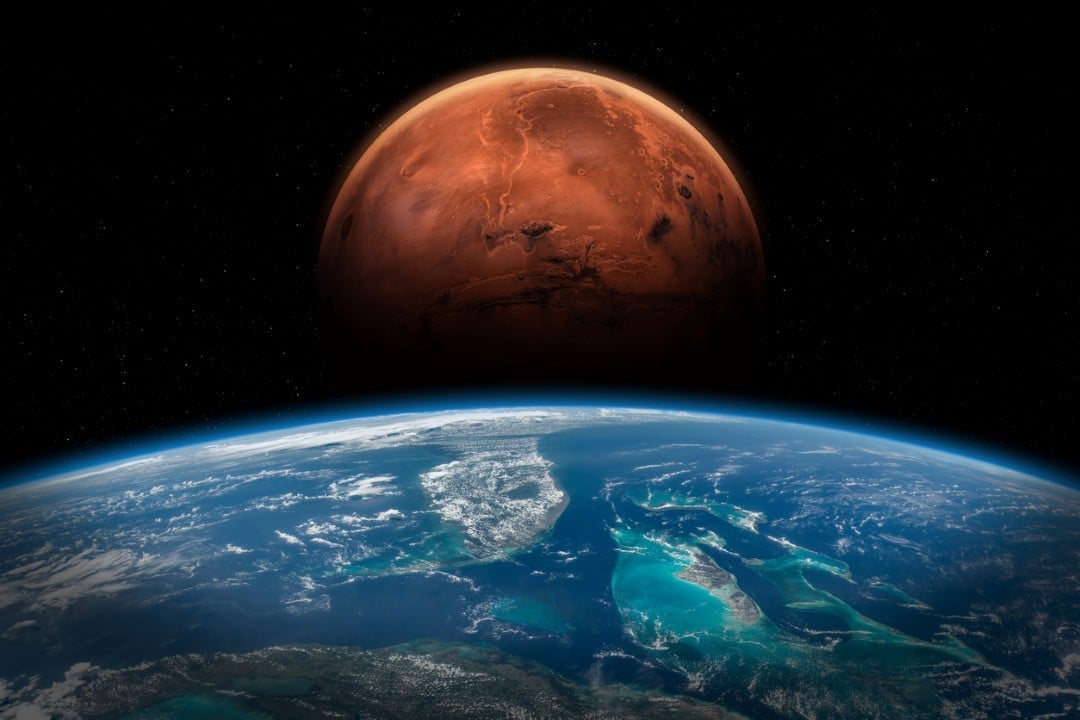
An astronomical event of great magnitude will occur in September 2035, when the red planet will reach its closest proximity to Terra in the last three decades. The minimum distance between the two celestial bodies is calculated at approximately 56.9 million kilometers, with the phenomenon expected to peak on the 11th of that month. The formal opposition, the moment in which the terrestrial globe is positioned exactly in a straight line between the Sol and the planetary neighbor, will occur on September 15th. Essa specific configuration generates an apparent luminosity greater than that of any star visible in the night sky, creating ideal conditions for both scientific observation and logistical planning of interplanetary travel.
Dynamics of periellicentric opposition and maximum approximation
Celestial mechanics explains that the Martian orbit has a markedly elliptical shape when compared to the Earth’s trajectory. The planet’s distance from the system’s central star varies significantly along its regular path, generating constant fluctuations in the physical separation between the two worlds over the years.
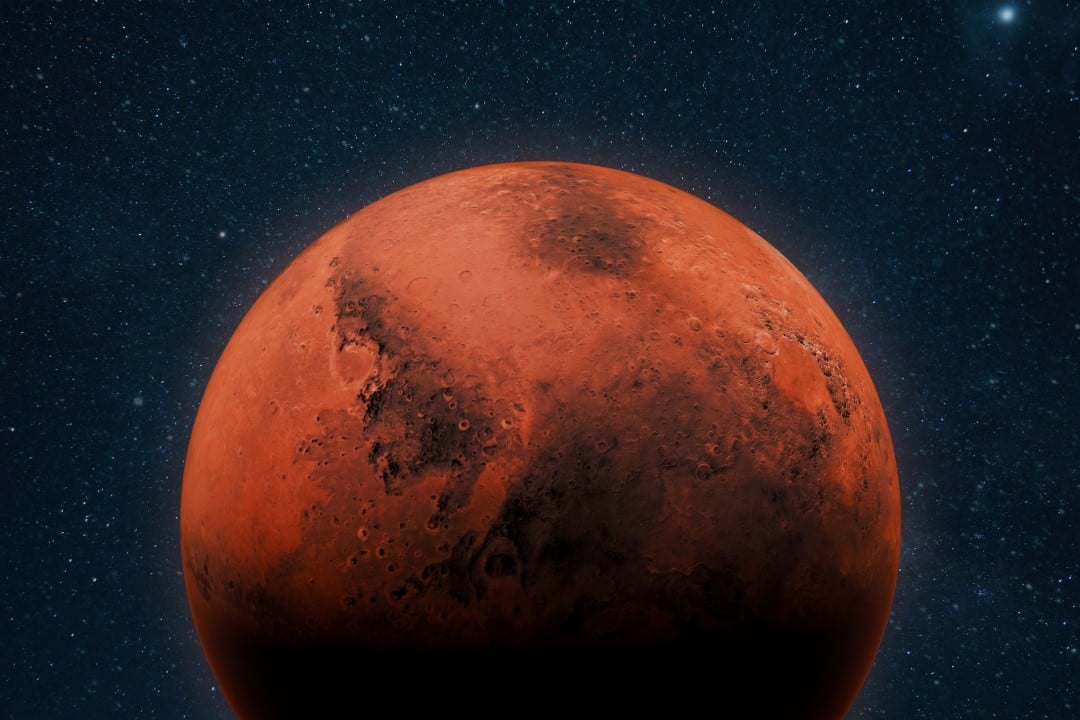
The phenomenon of perielicentric opposition occurs exactly when the celestial body reaches perihelion, its orbital point closest to Sol, in the same period in which the terrestrial overtake occurs. Esse specific alignment is repeated in cycles ranging from fifteen to seventeen years, providing the greatest visual magnitude and the shortest possible transit distance.
Past records and accuracy of astronomical calculations
Historical data indicate that the previous proximity record was set in 2003, when instruments recorded a separation of 55.76 million kilometers. Mathematical calculations indicate that this specific mark will only be surpassed again in the twenty-third century, making the next window a rare opportunity.
The event scheduled for the next decade maintains operational and visual characteristics extremely similar to those recorded at the beginning of the century. The difference in distance between the two historical approaches is less than two percent, a variation that becomes imperceptible during observation with the naked eye or through amateur telescopes.
Observers located in different regions of the globe will have the opportunity to follow the phenomenon in great detail. Visualization using suitable equipment will allow the identification of polar ice caps and dark geological formations on the surface for several consecutive weeks, feeding scientific databases.
Energy resource transfer and optimization windows
The twenty-six month cycle between regular oppositions serves as the fundamental mathematical basis for calculating the transfer trajectories of Hohmann. Esse space navigation method optimizes propellant consumption by using inertial alignment and gravitational assistance of the celestial bodies involved in the route.
The coincidence of the launch window with a periellicentric opposition multiplies the operational advantages for aerospace engineering teams. The drastic reduction in physical distance shortens the spacecraft’s total transit time, reducing the exposure of equipment and future crews to the hostile environment of deep space.
Strategic planning requires that launches occur months before the exact opposition, ensuring that the ship and the destination planet arrive simultaneously at the same orbital point. Essa Precise synchronization prevents wasted resources, ensures mission integrity, and allows for the early dispatch of vital supplies.
Space agencies consider technical factors crucial in this specific period to make transportation viable, including the following points: * Distância minimum design that shortens the spacecraft’s flight time; * Menor travel time that drastically reduces exposure to cosmic radiation; * Capacidade load maximized by lower propellant requirement at takeoff.
Strategic planning of global space agencies
Government institutions dedicated to the exploration of the cosmos have identified the period from 2035 as an unparalleled technical opportunity for the execution of manned missions. The North American space agency maintains guidelines focused on this specific interval, analyzing travel models that involve one-way journeys lasting approximately nine months. Current projects contemplate an extended stay on the Martian surface, followed by a safe return, totaling more than a thousand days of continuous operations outside Earth orbit. Reducing travel time directly mitigates the risks associated with cosmic radiation, one of the biggest obstacles to maintaining the physical health of astronauts on long-term missions.
The Asian space program has also structured a detailed schedule that calls for crewed launches in a sequence of orbital windows throughout the decade. The central objective of these operations is the gradual construction of a permanent base on the surface of the red planet, which requires highly efficient and continuous transport logistics. The plan establishes that the crews will remain on Martian soil carrying out research and survival tests, with their return scheduled only for the next orbital window. Essa strategy reuses the favorable positioning between planets to guarantee return trips with lower energy requirements and a greater operational safety margin for habitation modules.
Integration of the private aerospace sector and technological development
The private aerospace sector simultaneously aligns its technological development schedules with Martian orbital cycles, seeking to enable large-scale commercial interplanetary transportation. Corporations in this segment focus their efforts on creating super-heavy launch vehicles and life support systems designed specifically to support the requirements of the Hohmann transfer windows. The convergence between government programs and private initiatives strengthens the infrastructure necessary for human exploration, forming a complex ecosystem of suppliers and service providers that operate under the same astronomical calendar. The year in question is treated by the industry as an inflection point, a moment in which propulsion technology, habitation modules and deep space communication networks must reach the maturity necessary to sustain continuous human presence. The accelerated advancement of precision landing technologies and the use of in situ resources, such as water extraction and propellant production on the Martian surface itself, are directly linked to the need to take advantage of this historic approach to validate systems in a real and extremely demanding operational environment.
Historical evolution of scientific observation
Looking back at observations made during perielicentric approaches illustrates the continued advancement of human technological capabilities in the field of astronomy. In the late nineteenth century, astronomers used ground-based telescopes during favorable opposition to map the planet’s surface, generating the first reasoned scientific debates about local topography. Subsequent events allowed the capture of high-resolution images by space telescopes, paving the way for the sending of modern robotic probes that currently map the terrain with millimeter precision.
Final preparations and synchronization of operations
Engineers and scientists use the mathematical predictability of specific orbital windows to refine trajectory calculations and test long-distance communication protocols. The convergence of a great astronomical spectacle with rigorous operational planning reinforces the integration between observational science and applied aerospace engineering.
Cargo precursor missions, containing vital supplies and support equipment, must be launched early to ensure basic infrastructure is operational before astronauts arrive. Essa complex logistical choreography depends entirely on the precision of orbital calculations and the reliability of propulsion systems currently developed by agencies and companies in the sector.
