

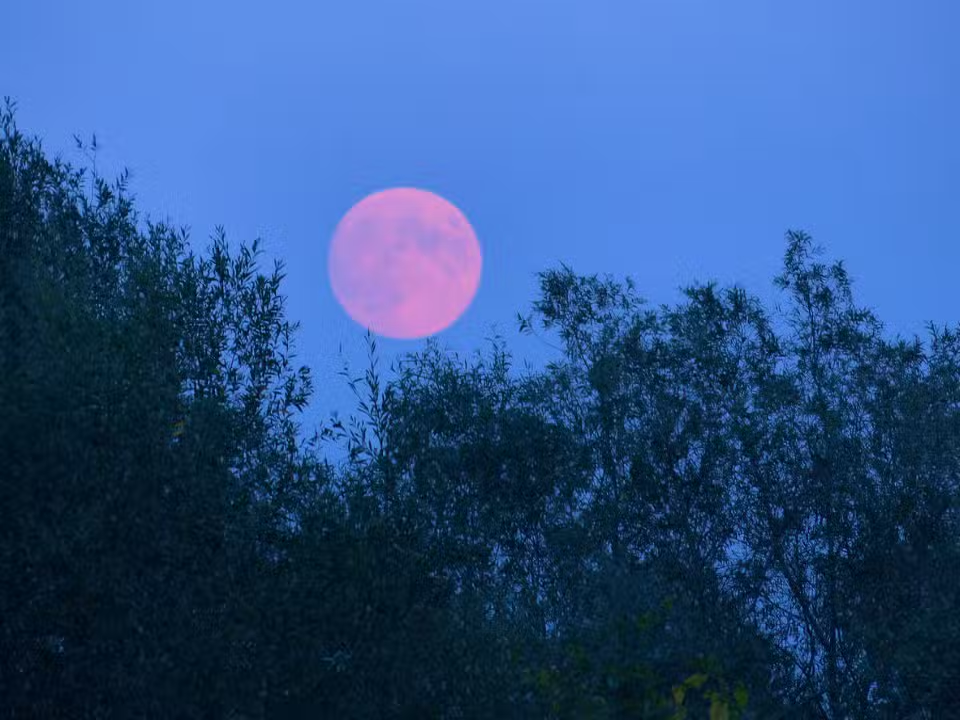
April 2026 holds a series of celestial phenomena that will attract both experienced observers and beginners to look at the night sky. The full moon known as pink appears at the beginning of the month and marks the astronomical calendar with its intense brightness. Outros highlights include the greatest elongation of Mercury, the perihelion of a potentially bright comet, and the Lyrid meteor shower.
- The moon reaches its full phase on April 2, with high visibility throughout the night.
- Mercury appears furthest from the sun on April 3, making it easier to observe before dawn.
- Comet c/2026 a1 (maps) passes the closest point to the sun on April 4.
These events occur on close dates and allow for simple observation planning at different local times, depending on the observer’s location.
Pink moon lights up the beginning of the month
April’s full moon is traditionally named rose in reference to the wildflowers that bloom in spring in the Northern Hemisphere. The satellite does not have a real pink color, but it offers a brilliant spectacle at sunrise on the eastern horizon when the sun sets. Observadores in several regions register the star as exceptionally luminous during the night of April 1st to 2nd.
Astronomers highlight that the full phase occurs around 10:12 pm Eastern Time Estados Unidos, equivalent to locally adjusted times in other time zones. The moon remains visible throughout the night and provides good lighting for nighttime landscapes. Quem follows the sky and notices the contrast with the fainter stars in the first hours after sunset.

Mercury gains prominence at dawn
The planet Mercury reaches its greatest western elongation on April 3, which places it at the greatest apparent distance from the sun as seen from Earth. Essa configuration makes the planet most accessible for observation in the morning sky, just above the eastern horizon before sunrise. Mercúrio appears accompanied by Mars in the same directions under favorable visibility conditions.
Those looking for the planet should choose places with a horizon free of obstacles, such as open areas or close to lakes. Visibility improves with clear skies and the absence of light pollution. Após a few days, mercury approaches the sun’s brightness again and becomes more difficult to distinguish.
Comet maps approaches the sun
Comet c/2026 a1 (maps) reaches perihelion on April 4, passing at a reduced distance from the sun. Cometas of this type, classified as grazers, can produce glowing tails if they survive intense heat or disintegrate during passage. Astrônomos have been monitoring the object since its discovery to assess its actual behavior near the star.
In the southern hemisphere, the chances of observation after perihelion are greater in certain periods. In the Northern Hemisphere, any visibility tends to be brief and low on the horizon. The event reinforces the unpredictability of these celestial bodies, which depend on factors such as internal composition and interaction with the solar wind.
Alignment of planets occurs before dawn
Between April 16 and 23, Mercury, Mars, and Saturn form a compact cluster visible for about half an hour before sunrise. The trio changes its configuration throughout the days, approaching or extending in diagonal lines. The moments of greatest apparent proximity are concentrated between April 18th and 20th, when the planets appear more gathered in the sky.
Observers recommend elevated points or those with a clear view of the eastern horizon. The phenomenon does not require advanced equipment and can be seen with the naked eye on clear nights. The formation provides opportunities for photographs that capture the relative movement of the planets over a sequence of days.
Milky Way appears more clearly
The night of April 17th coincides with the new moon and creates ideal conditions for observing the nucleus of the Milky Way in the early morning hours. Sem the lunar glow interfering, the star-studded galactic center becomes more evident in places with low light pollution. Parques national or dark sky reserves enhance the contemplation experience.
Those who use binoculars or small telescopes notice a greater amount of detail in dense regions of stars. The galaxy’s position high in the sky makes it easy to spot during most of the month. Essa visibility window reinforces the spring period as a favorable season for observing interstellar structures.
Moon, Venus and Pleiades align at dusk
On April 18 and 19, after sunset, the crescent moon, the planet Venus and the Pleiades star cluster appear grouped together above the western horizon. The conjunction remains visible for two to three hours and attracts the attention of observers who follow the twilight sky. Júpiter appears higher in the same region, close to the constellation Orion.
The alignment creates photogenic scenes with celestial elements at different heights. Quem records the images and notes subtle variations between the two nights as the moon advances in phase. Observation requires only clear skies and a westward direction free of tall buildings.
Lyrid meteor shower records peak
The Lyrid meteor shower occurs between April 14th and 30th, peaking in the early hours of April 21st to 22nd. The activity produces about 10 to 15 meteors per hour under dark skies, with the radiant in the constellation Lyra reaching favorable height before dawn. The moon sets before midnight during maximum, which reduces light interference.
Observers in regions with little light pollution register more frequent streaks crossing the sky. The shower originates from debris from Comet Thatcher and represents one of the oldest documented. Quem follows the event for several hours and notices variations in the hourly rate depending on the position of the radiant.
Whirlwind Galaxy Remains Accessible
The whirlwind galaxy, cataloged as m51, is high in the sky around midnight throughout most of April. Sua location close to the head of the big dipper makes identification easier even with binoculars, where it appears as a diffuse patch of light. Telescópios reveal the characteristic spiral structure and gravitational interaction with the smaller companion galaxy.
The Leo trio, another set of galaxies, also stands out in the same region of the sky near the constellation Leo. Essas observations reinforce the period as favorable for exploring extragalactic objects with amateur equipment. Astrônomos highlight that spring offers consistent windows for this type of contemplation.
The sequence of phenomena in April encourages regular sky observation, with events distributed throughout the month. Quem planning departures at specific times increases the chances of recording multiple highlights on the same night or early morning.