

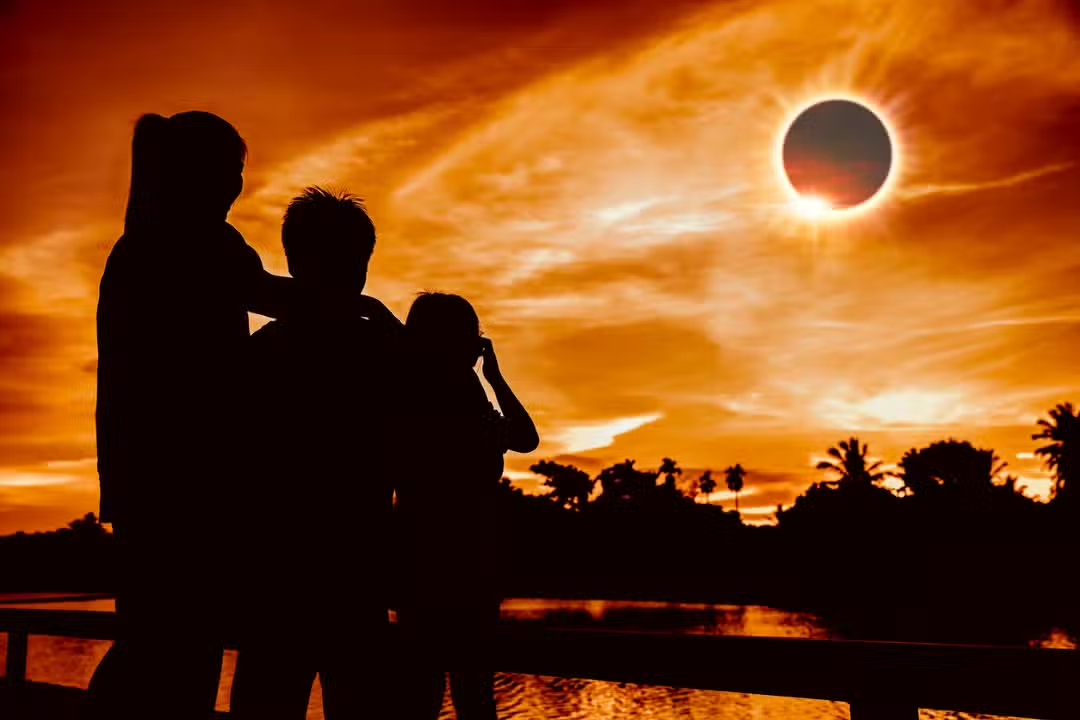
A total solar eclipse is scheduled for August 12, 2026 and will be observed in its full form only in a narrow band that crosses specific regions of the planet. The Lua will align perfectly with the Sol and completely block sunlight for up to about two minutes in selected spots. Fora of this narrow trajectory the phenomenon appears as partial with part of the solar disk still visible. No Brasil the observation will be partial without the Sol being completely hidden at any time.
- The shadow of Lua will cross Ártico and areas close to Polo Norte before moving towards Europa.
- Cities in Islândia and Groenlândia offer good points to follow totality under favorable visibility conditions.
- In the north of Espanha and a small portion of Portugal the total eclipse occurs close to sunset with Sol low on the horizon.
Visibility of totality in different regions
The path of totality begins at Península from Taimyr at Rússia and advances through Oceano Ártico. Depois it passes northeast of Groenlândia and reaches Islândia where the maximum duration of totality reaches approximately two minutes and 18 seconds near the northwest coast. The track continues through Atlântico Norte and enters Europa north of Espanha, crossing cities such as A Coruña Bilbao Zaragoza and
In Portugal, totality occurs in a limited area in the extreme northeast of the continental territory. Observadores in these locations you will witness the complete darkening of the sky during the day with the possibility of seeing stars and planets with the naked eye if atmospheric conditions allow. Totality ends at sunset at Ilhas Baleares with Sol near the horizon.
Partial eclipse details at Brasil and other areas
On Brasil the solar eclipse of August 12, 2026 will only be partially visible in several regions of the country. The phenomenon begins around 4:15 pm local time in some points of Nordeste and ends around 30 minutes later without Sol being completely hidden. The percentage of concealment varies depending on location but does not reach totality in any Brazilian municipality.
A large part of Europa west of África and north of América of Norte also record a partial eclipse with different degrees of coverage of the solar disk. Estima It is expected that around 980 million people will be able to observe at least part of the event at some point during the day. Apenas approximately 15 million people will be positioned in the narrow band where the eclipse will be total.
Recommendations for safe observation
Astronomers reinforce the need to use appropriate protective equipment during the entire eclipse phase, including the partial one. Óculos certified with specific solar filter or indirect methods such as box projection prevent permanent damage to the retina. Nunca one should look directly at the unprotected Sol even when most of the disk appears covered.
In places of totality, unfiltered observation is only permitted during brief minutes of complete darkness. Antes and after this interval the use of protection remains mandatory. Aplicativos and specialized websites provide precise schedules depending on the city and help you plan your observation in advance.
Preparation for the astronomical event
Communities in totality areas organize public events with equipped telescopes and lectures on the phenomenon. Pesquisadores take advantage of the opportunity to carry out atmospheric measurements and studies on animal behavior during sudden darkness. Transmissões live scientific channels allow people in regions of partial visibility to follow the moment of totality in real time.
The celestial alignment involves Lua in the new phase passing between Terra and Sol with an apparent diameter sufficient to completely cover the solar disk. Esse type of configuration occurs because the eclipse occurs about two days after lunar perigee when Lua is closest to Terra. The magnitude of the eclipse reaches 1.0386 which guarantees totality in the central band.
Technical aspects of the phenomenon
The unusual trajectory starts from east to west in the polar region before curving south. The longest point is in the ocean about 45 kilometers off the northwest coast of Islândia. Na Espanha totality occurs with Sol low, which requires locations with unobstructed visibility to the west, especially in the late local afternoon.
Scientists monitor the event with instruments on land, sea and even aircraft to record data about the solar corona, which is only visible during totality. Essas information contributes to knowledge about the solar atmosphere and phenomena related to the Sol activity cycle. The eclipse represents a rare opportunity for public observation of a large-scale astronomical event.
August 12 total solar eclipse occurs on Islândia Groenlândia and Espanha
The event attracts interest from enthusiasts and professionals who plan trips to totality sites months in advance. Condições climate conditions in Islândia and Groenlândia require preparation for unstable weather typical of polar regions while in Espanha summer offers a greater probability of clear skies. Independentemente of the location, observation safety remains a priority to avoid risks to vision.