

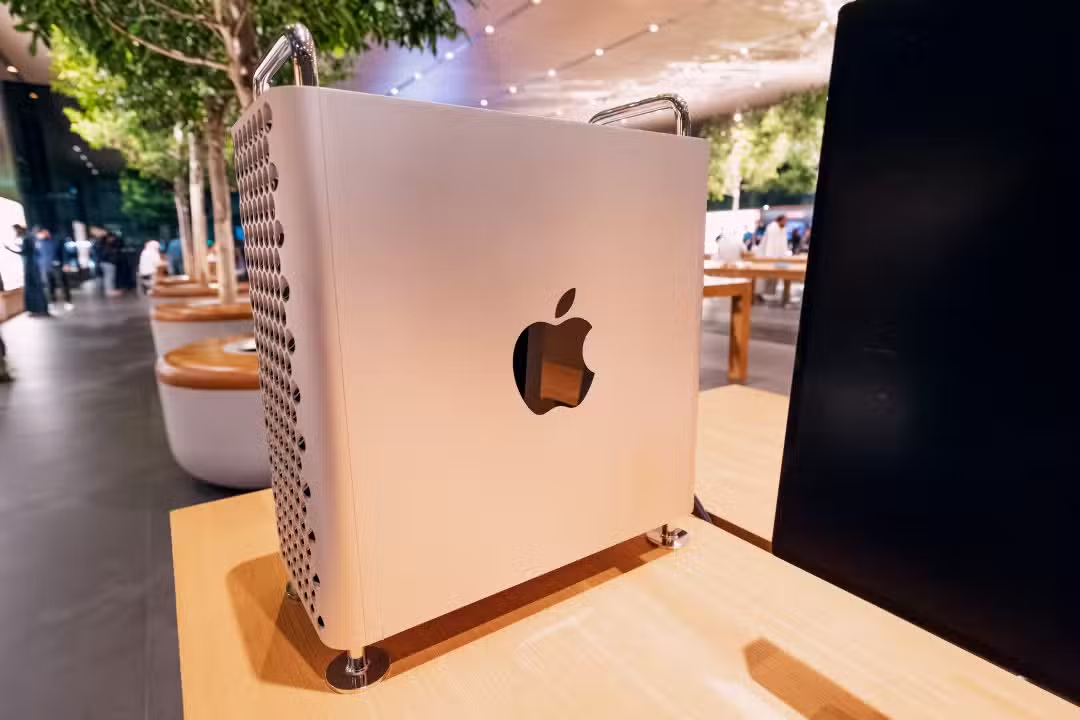
The Cupertino technology giant officially confirmed the interruption in the manufacture of one of its most traditional professional computers on the market. The equipment, known for its modular design and high physical expansion capacity, was completely removed from the brand’s online store in the last week of March, marking the end of a cycle of almost twenty years of continuous updates.
The strategic decision accompanies a profound restructuring of the manufacturer’s entire portfolio of extremely high-performance devices. Além of the definitive removal of the processing tower, the company applied severe restrictions on hardware customization options on other machines highly sought after by creative studios and audiovisual producers.
The main changes confirmed by the manufacturer include the following operational points:
– Encerramento immediate sales of high-cost modular desktop.
– Redução drastic limit on unified memory available for purchase on compact workstations.
– Aumento of standard internal storage capacity on notebooks aimed at extreme productivity.
– Substituição complete line of visual reference monitors by models with updated backlight technology.
Changes to unified memory offering for workstations
The brand’s compact desktop computer has suffered a significant reduction in its maximum factory configuration capacity. The option that allowed consumers to add 512 GB of unified memory has been completely removed from the purchasing system, establishing a new ceiling of 256 GB for machines equipped with the latest M-series processors.
Hardware experts point out that this technical limitation is directly linked to a global shortage in the semiconductor supply chain. The significant increase in production costs for very high-density memory chips forced the manufacturer to prioritize more affordable configurations that are more viable for large-scale delivery to the consumer market.
Hardware requirements for artificial intelligence and rendering
The restriction on the amount of RAM directly affects professionals who depend on massive volumes of temporary data to perform their daily tasks. Estúdios Three-dimensional animation and film production companies often use hardware caps to avoid bottlenecks when processing complex scenes.
The growing demand for applications based on generative artificial intelligence is also putting pressure on the electronic components market. Modelos Large-scale language and image generators require exorbitant amounts of unified memory to run efficiently locally, which quickly depletes the world’s supplies of these specific components.
The technology manufacturer has not released an official timeline for the possible return of the 512 GB option to its sales catalog. The normalization of this offer will depend exclusively on the stabilization of prices in the international semiconductor market and the regularization of the assembly lines of partner companies at Ásia.
Storage upgrades to the notebook lineup
The brand’s high-performance notebooks, specifically models with 14 and 16-inch screens, have received substantial improvements to their entry-level specifications. Versions equipped with the new M5 Pro and M5 Max processors now leave the factory with a minimum of 1 TB of solid-state storage, eliminating the previous lower capacity options.
The entry-level version of the 14-inch notebook, which uses the basic M5 chip, has also been updated to follow this new market standard. The configuration with 512 GB of internal space has been discontinued, ensuring that all professional line users have enough space to install heavy applications and store media files without immediately relying on external disks.
This change in the base specifications resulted in an adjustment in the price list for portable equipment. The initial 14-inch model with the M5 processor now starts at US$1,699 in the North American market, representing an increase compared to the entry price of the previous generation, which cost US$1,599 in the version with less space.
The increase in solid-state drive capacity not only provides more space for files, but also improves data transfer rates. Unidades larger storage units generally have more NAND memory chips operating in parallel, which significantly speeds up reading and writing videos at extreme resolutions such as 4K and 8K during the non-linear editing process.
Transition into the visual reference monitor category
The restructuring of the portfolio also affected the image display peripherals segment, resulting in the discontinuation of the 32-inch monitor originally launched in 2019. The equipment, which had 6K resolution and peak brightness of 1,600 nits, was considered a fundamental tool for colorists and directors of photography, being sold for US$4,999 without the inclusion of the articulated table support. The withdrawal of this product from the market ends a seven-year cycle of availability of one of the screens most praised by color calibration experts.
To fill the gap left by the old model, the company introduced a new 27-inch display focused on demanding content creators. The newly launched equipment incorporates backlight technology based on thousands of mini-LEDs, allowing for much superior contrast control through more than 2,000 local dimming zones. Além of improved image quality for content reproduction with great dynamic range, the device integrates a high-fidelity audio system, built-in camera and very high-speed connections, costing US$3,299 with the support already included in the box.
Technical specifications aimed at fluidity and advanced connectivity
The new reference monitor introduced by the manufacturer raises the bar for modern workstations by incorporating a variable refresh rate of 120 Hz, a feature that until then was restricted to the brand’s mobile device and notebook computer displays. Essa additional fluidity transforms the user experience when navigating complex timelines in video editing software, as well as providing much more accurate visualization for video game developers and animators who need to analyze the movement of three-dimensional objects frame by frame. Color fidelity is guaranteed by full support for the P3 and Adobe RGB color spaces, essential for closing files intended for graphic printing or cinematic display. In terms of connectivity, the adoption of the Thunderbolt 5 protocol represents a generational leap in available bandwidth, allowing users to connect multiple high-speed external storage accessories, professional audio interfaces and data networks directly to the monitor, using just a single cable to interconnect the entire ecosystem to the main computer, drastically simplifying the organization of cables on work desks.
Strategic reorganization of the device catalog
The cleaning of the company’s portfolio also extended to the lines of tablets and ultra-thin computers, with the removal of past generations that still shared space on virtual shelves. Essa centralization of efforts on the most modern processors of the ARM-based architecture ensures that consumers acquire machines with greater longevity of software updates and superior energy efficiency, consolidating the brand’s complete transition to its own silicon components.