

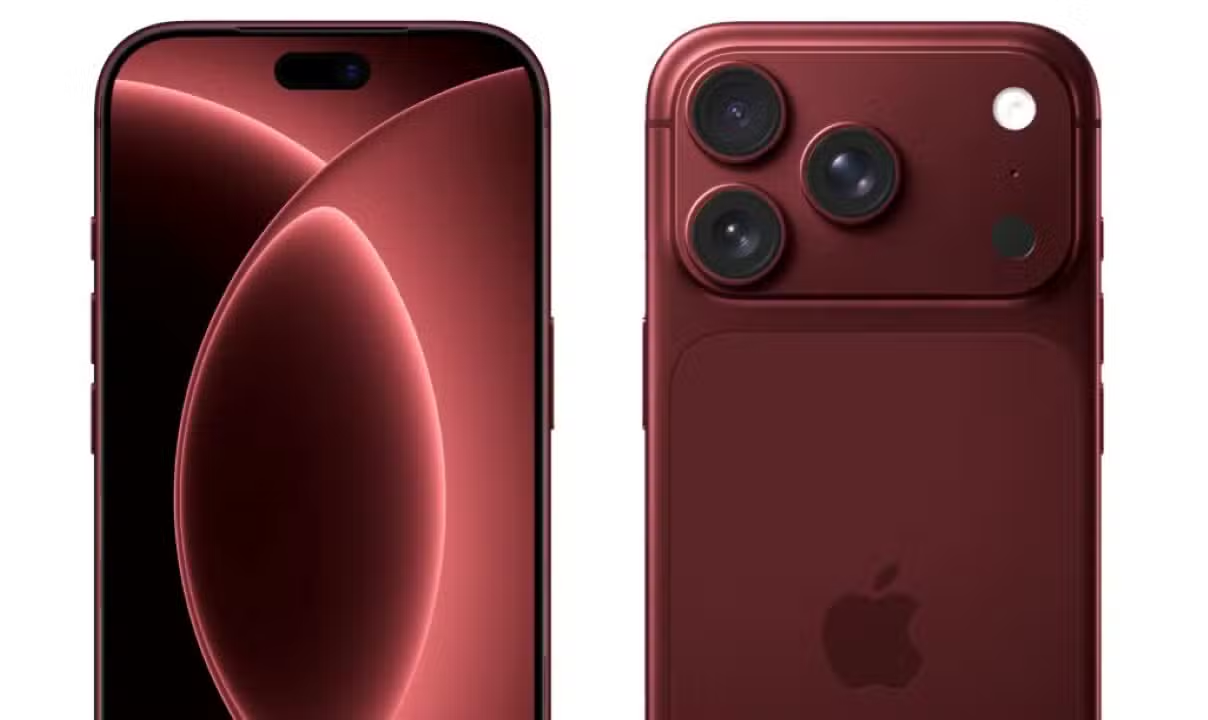
The global mobile device industry is undergoing a restructuring of its assembly lines to accommodate the next generation of high-performance equipment. The launch scheduled for September introduces severe changes to the physical architecture of the devices, changing the visual standard established in the luxury segment.
Hardware engineers have finalized the development of an unprecedented format that exposes the internal components of telecommunications equipment. The technical decision required the complete redesign of printed circuit boards and security systems, ensuring that the continuous display of parts does not pose operational risks to the end user.
The strategic movement meets the consumer market’s demand for tangible physical innovations, breaking with the traditional design maintained in recent generations. The move establishes a new level of competition in the mobile technology sector, requiring other manufacturers to review their aesthetic and functional approaches to remain competitive.
Materials engineering and translucent structure
To ensure the durability of the transparent back plate, the production line adopted a reinforced glass alloy subjected to specific chemical treatments. The advanced industrial process protects the material against yellowing caused by exposure to ultraviolet rays over time.
The smartphone’s main chassis uses aerospace-grade titanium, an engineering choice that provides greater lightness and structural rigidity than conventional metals. Integrating this material with the new glass panel required the creation of highly precise fastening and assembly methods in factories.
A first-of-its-kind industrial glue was developed exclusively to seal the device against the ingress of water and dust particles. The sealing meets rigorous international resistance certifications, maintaining the transparency necessary to reveal the product’s internal engineering without compromising safety.
Laboratory tests confirmed that the translucent structure has resistance against accidental drops and daily scratches equivalent to previous opaque models. The physical integrity of the device remains intact even under conditions of extreme use, validating the commercial viability of the new design.
Power architecture and thermal dissipation
The device’s operating autonomy represents a significant technical advance with the implementation of a 5200 mAh energy cell. The increase in the battery’s volumetric capacity was achieved through a new internal chemical composition architecture, which optimizes the use of every cubic millimeter of the chassis without resulting in an increase in the overall thickness of the smartphone. The restructuring of the internal space allowed larger components to be accommodated efficiently, preserving the ergonomics of the equipment during prolonged and continuous handling.
With the visual display of internal parts, temperature management has become a central challenge for industrial design and assembly teams. The technical solution involves the application of high-density graphene plates combined with a completely redesigned vapor chamber system. Esta thermal structure dissipates heat generated by the main processor quickly and silently, protecting the rear glass panel against overheating and ensuring user tactile comfort when running applications that require high processing power.
Screen resizing and hidden biometrics
The dimensions of the front panels have undergone precision engineering adjustments, delivering 6.3 inches on the standard model and 6.9 inches on the larger aspect ratio variant. The evolution of OLED display technology has allowed the refinement of the side frames, maximizing the device’s usable viewing area.
The most significant change to the front interface consists of the relocation of the facial recognition and brightness sensors to the bottom layer of the active screen. The technical modification reduced the area occupied by the top notch by 35%, freeing up valuable space for the operating system’s notification icons.
The biometric sensor positioned under the display uses infrared light capable of penetrating the pixel matrix without suffering optical distortions. Identity validation occurs instantly in any ambient lighting condition, while the adaptive refresh rate intelligently adjusts power consumption.
Local processing and artificial intelligence
The smartphone’s operational core is driven by a chip manufactured using the 2-nanometer process, representing a milestone in transistor miniaturization and energy efficiency in the semiconductor industry. The component was designed with a primary focus on running artificial intelligence algorithms directly on the device’s hardware, eliminating the constant dependence on cloud servers for complex computing tasks. Processing capabilities encompass natural language interpretation, simultaneous language translation without a network connection, and real-time image generation. To support this massive workload, RAM has been expanded to 12 GB, an essential technical specification that keeps language models operating in the background without compromising the fluidity of the operating system. The chip architecture divides operations between extremely high-performance cores and energy-efficient units, balancing the consumption of the 5200 mAh battery autonomously. Desenvolvedores software gain access to new programming interfaces that exploit the updated Neural Engine, making it easier to create applications that map and anticipate user habits. The security of data processed locally is ensured by a physical enclave isolated from the main operating system, shielding biometric information and passwords against external invasion attempts or malware.
Photographic system with mechanical aperture
The rear camera module integrates a variable aperture mechanism in the main lens, technology derived from dedicated professional photographic equipment. The sensor physically adjusts the light input according to the environment, drastically improving depth of field and sharpness in night scenes.
The lenses have received a laboratory-formulated optical coating to mitigate reflections and visual distortions caused by direct light sources. The image signal processor applies artificial intelligence filters at the exact moment of capture, correcting colors and textures even before saving the file in memory.
Advanced satellite connectivity
The device’s radio frequency infrastructure has been expanded to support high-capacity satellite communication, overcoming the previous limitation of only sending emergency alerts. The new technology makes it possible to make short voice calls and send compressed multimedia files in remote regions where traditional cellular network coverage is completely non-existent, ensuring uninterrupted connectivity.
Transition to virtual chips in the global market
The manufacturer consolidated the transition to virtual chip technology by definitively removing the physical tray from the equipment in all global markets. The elimination of this mechanical component frees up crucial internal space for battery expansion and improvement of the cooling system, in addition to eliminating a point of structural vulnerability against the entry of liquids into the housing.
The Asian supply chain began calibrating assembly lines for mass production in the second quarter, aiming to secure stocks for a simultaneous launch. The price positioning on the shelves will reflect the high research costs of transparent materials and the 2-nanometer processor, placing the product in the ultra-premium segment of global technology.