

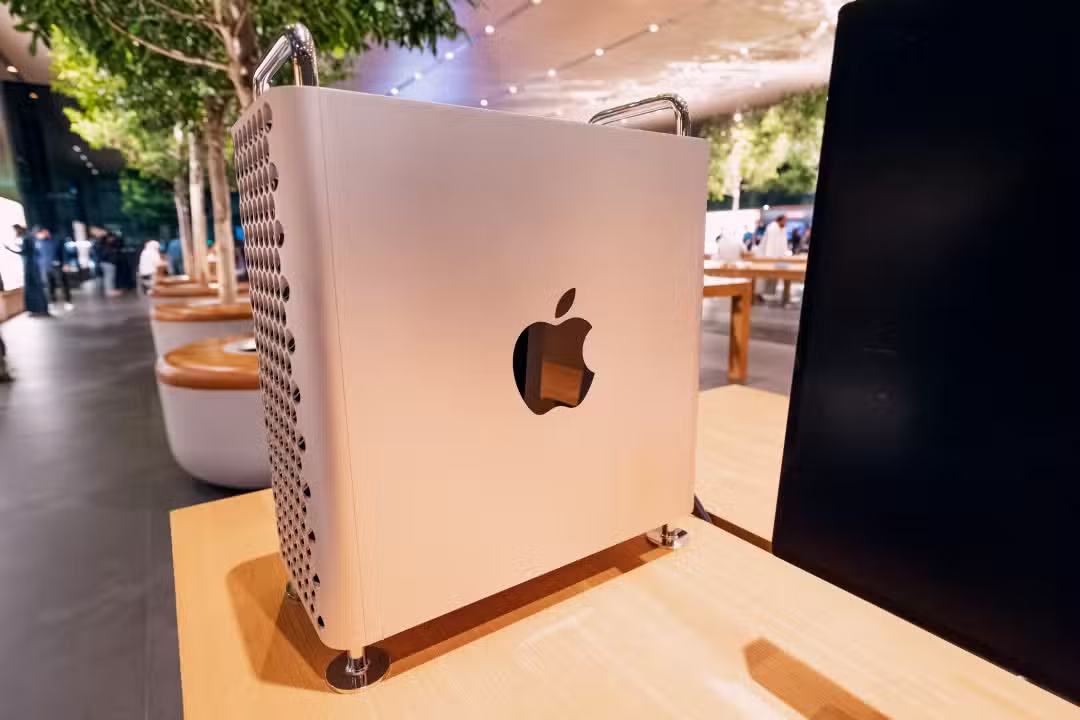
The technology giant headquartered in Cupertino officially closed production of one of its computers aimed at the corporate and high-performance market. Após Two decades of continuous manufacturing, the line of modular desktops known for their physical expandability has been discontinued, marking the end of an era in the company’s hardware design. The strategic decision involves the immediate interruption of sales of customized models and the complete restructuring of the portfolio of professional machines. Simultaneamente, the manufacturer has implemented stringent changes to the configurations available for the series of high-performance compact computers, reducing unified memory options and adjusting technical specifications for the new generation of processors based on proprietary silicon architecture.
The restructuring movement directly affects creative studios and video production companies that depended on modular architecture for gradual updates to internal components. The sales halt covers all variants of the tower desktop.
In addition to the end of the historical line, the company removed the maximum unified memory configuration option for compact computers aimed at workstations. New acquisitions are limited to capacities lower than those offered in the previous generation.
Adjustments to unified memory capabilities
The most significant change to the compact desktop lineup is the removal of the 512-gigabyte unified memory option. New devices equipped with the M series of processors now have a configuration ceiling set at 256 gigabytes.
Hardware sector professionals indicate that the limitation is directly linked to production costs and the global shortage of very high-density memory chips. The manufacturer chose to prioritize supply chain stability over offering extreme capabilities.
Technical requirements for local processing
The amount of random access memory available on a machine dictates the ability to perform complex tasks without having to resort to disk storage. The restriction imposed by the manufacturer directly affects rendering time in large-scale projects.
Companies focused on three-dimensional animation and development of virtual environments use these machines to avoid the costs associated with renting cloud servers. Hardware limitations require readjustment in the workflows of these studios.
The demand for components capable of processing large language models and content generation tools locally has caused a rapid absorption of global stocks. The manufacturer has adjusted its catalog to reflect the actual availability of parts on the international market.
Updates to the notebook line
The high-performance notebook catalog also underwent structural revisions, specifically in models with 14 and 16-inch screens. The new versions, equipped with the M5 Pro and M5 Max processors, present changes to the logic board architecture.
The solid-state storage option with an initial capacity of one terabyte has been removed from the entry configurations directly from the factory. Consumers now encounter a different structure of hard drive options than the previous generation.
The 14-inch base model, which uses the standard M5 chip, has had its internal architecture redesigned to solder the storage modules directly to the main board. Essa change prevents any type of future expansion by the user or independent technical assistance, requiring that the choice of capacity be definitive at the time of purchase.
The hardware changes were accompanied by a price repositioning in the North American market. The initial 14-inch model with the M5 processor now retails for $1,699, while versions with reduced specifications are offered for $1,599, reflecting a slight increase over the previous generation.
Transfer speed on media files
Despite the reduction in maximum capacity options, the new solid-state storage architecture delivers measurable gains in read and write speeds. The manufacturer started using multiple NAND chips operating in parallel on the logic board. Esta configuration allows data to be distributed simultaneously between modules, eliminating transfer bottlenecks that occurred in previous years’ input models. The result is smoother operation of the operating system and heavy applications.
The technical change directly benefits professionals in the audiovisual sector who work with video files in 4K and 8K resolutions. The increased speed of internal storage reduces the time required to import raw media and speeds up the export of finished projects, partially offsetting restrictions imposed on the amount of unified memory available on the system.
Transition in the professional monitor segment
The catalog redesign process extended to visual display peripherals, resulting in the end of production of the 32-inch monitor originally launched in 2019. The equipment, which offered 6K resolution and operated at sustained brightness levels of 1,600 nits, was widely adopted by colorists and directors of photography due to its color accuracy. Comercializado for $4,999, the monitor ends a seven-year cycle in the technology market, a period in which it served as the main display reference for the brand’s high-performance desktop computers. The product’s removal from shelves indicates a change in the manufacturer’s approach to studio equipment.
Specifications of the new display equipment
To fill the gap left by the discontinued model, the company has introduced a new 27-inch display based on mini-LED technology. The device reaches brightness peaks above 2,000 nits and offers variable refresh rates, being sold for US$3,299 on the international market.
Advanced connectivity and cable management
The new 27-inch monitor integrates 120 Hz refresh rate technology, providing more fluid viewing of graphical interfaces and video playback. The inclusion of protocol Thunderbolt 5 represents a leap in the bandwidth available for data transfer.
Adopting the new connection standard allows users to connect multiple high-speed external storage peripherals directly to the monitor. A single cable is enough to transmit power, data and video signal between the computer and the screen, simplifying the organization of work desks in professional studios.
Standardization of processing architecture
The elimination of the 20-year-old modular desktop and the upgrade of compact and portable computers represents the final step in the manufacturer’s transition to its own ARM-based processor architecture. The company removed from its catalog the last vestiges of products developed in the era of chips supplied by third parties, consolidating a closed ecosystem of hardware and software. The current strategy prioritizes energy efficiency, deep integration between components soldered on the logic board and optimization of the operating system to extract maximum thermal performance. With these changes, the brand’s line of professional computers takes on a standardized identity, where physical scalability gives way to raw processing power integrated into reduced-dimension chips.