
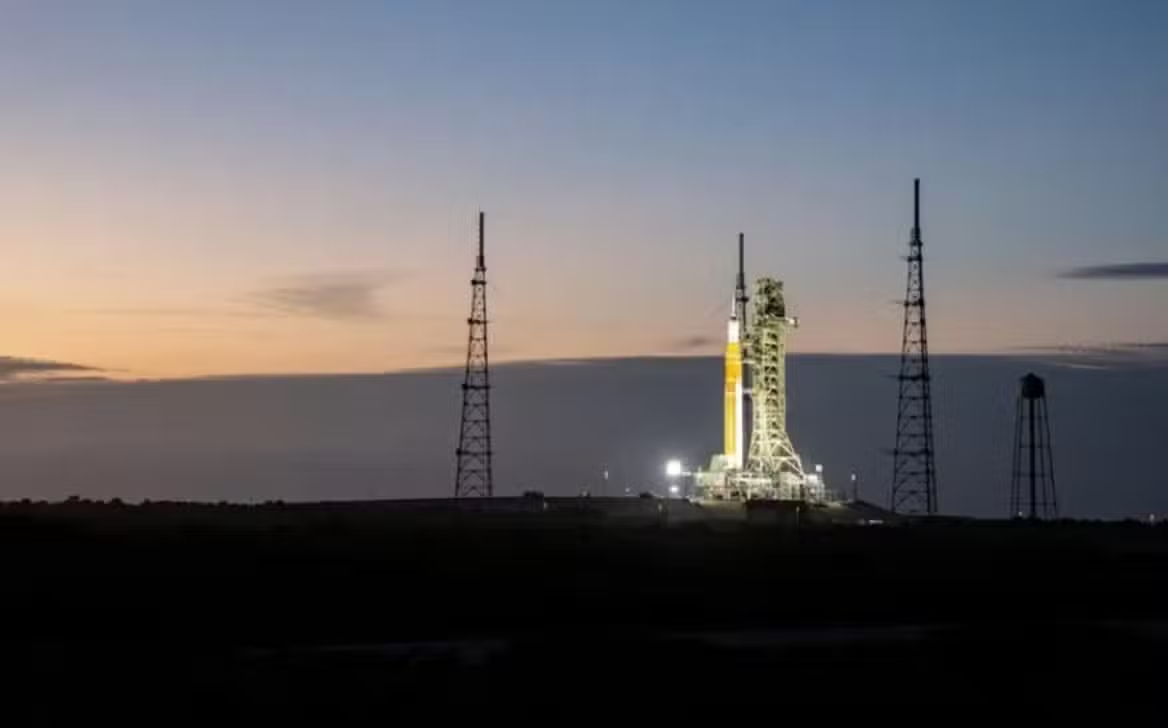
Mission Artemis II made history on Wednesday, April 1, 2026, with its successful launch into space, departing from Flórida. On board, four crew members set off towards Lua for a journey that marks the return of humans to the vicinity of the natural satellite after more than five decades of absence of manned lunar flights.
This manned flight’s main objective is to make a complete revolution around Lua, testing all of the Orion spacecraft’s systems and ensuring safety for future surface landing missions. It’s a crucial step towards Agência Espacial Norte-American (NASA)’s ambitious long-term lunar exploration plans.
The trip is expected to last approximately 10 days, partly replicating the feat of the last manned mission that took humans to Lua, Apollo 17, carried out in 1972. The event is closely followed by science, technology and space enthusiasts around the world.
The crew and the lunar path
Astronauts Reid Wiseman, Victor Glover, Christina Hammock Koch and Jeremy Hansen make up the historic crew of Artemis II. Eles are the first humans to travel towards Lua since the Apollo era, and their journey will not only test the Orion spacecraft, but also expand the boundaries of space exploration.
Artemis II’s flight plan involves a complex trajectory that will take capsule Orion to a distance of approximately 10,200 kilometers beyond Lua, before returning to Terra. Esta lunar “circumnavigation” maneuver is designed to collect critical data about the spacecraft’s performance in a deep space environment and the impact on crew life support systems.
Overcoming technical obstacles
The path to the successful launch of Artemis II was not without challenges. The mission suffered from successive delays in its initial schedule, which scheduled departure for February and, later, for March. Estes postponements were directly linked to critical operational problems on the ship, requiring a series of meticulous checks and repairs.
Major obstacles included failures in the vehicle’s fueling system and complex issues in the flow of helium to the upper stage of rocket Space Launch System (SLS). Engenheiros and Nasa technicians worked tirelessly to resolve each issue, ensuring all components were in perfect condition before giving the go-ahead for takeoff. Resolving these issues not only ensured the success of the launch, but also reinforced confidence in the robustness and security of the technology used.
Scientific and technological objectives
Mission Artemis II transcends its merely historical character, having fundamental importance for the scientific and technological advancement of space exploration. One of the main objectives is to perform practical and comprehensive testing of the Orion capsule and SLS launch vehicle systems. Estes tests are crucial to validating the performance of the spacecraft, designed by Nasa specifically for deep space missions, in a real-world environment.
Collecting data during the ten days of flight will allow the space agency to identify any anomalies, optimize procedures and refine essential technologies. Isso includes the assessment of the thermal protection of the capsule during re-entry into the Earth’s atmosphere, the functioning of communication systems over long distances and the effectiveness of astronaut life support subsystems. Cada The data collected will be vital for planning the next phases of the Artemis program, targeting more complex and longer-lasting missions.
The Orion capsule and deep exploration
Capsule Orion represents the cutting edge of Nasa’s technology for transporting humans beyond low Earth orbit. Projetada To withstand the rigorous conditions of deep space, it is equipped with advanced navigation, communication and life support systems, essential for the safety and well-being of astronauts on extended journeys.
Its ability to operate autonomously and withstand the challenges of lunar and, eventually, Mars missions, positions the Orion as the cornerstone of future Estados Unidos space endeavors. Testing of the Artemis II will serve to prove the effectiveness and resilience of this spacecraft in a real operational environment, providing invaluable information for its continued improvement and the design of new technologies.
The overview of the global space race
The success of mission Artemis II also assumes strategic significance in the geopolitical scenario of space exploration. Ele represents a significant step forward for Estados Unidos amid growing global competition, especially with China, in the so-called new space race. Ambos countries show a growing interest in “dominating” Lua, with ambitions ranging from resource exploration to the potential construction of permanent lunar bases.
The ability to return humans to the vicinity of Lua and demonstrate the operability of its space infrastructure, such as the Orion capsule and the SLS rocket, gives the US a leadership position and reaffirms its commitment to the cutting edge of interplanetary exploration. Este is a movement that not only drives technological innovation but also projects power and influence into the global space domain.
Next steps for Nasa on Lua
A successful trip and return of Artemis II will bring the North American agency closer to its main objective: landing humans on the lunar surface. The success of this crucial mission is a clear indication of the capacity and safety to carry out future manned missions, minimizing the risk of serious accidents during the journey to space.
The Artemis program, in its entirety, envisages a series of progressive steps that include:
– The Artemis III, which will take the first woman and the next person to the lunar surface.
– The establishment of base camp Artemis on the surface of Lua.
– The construction of space station Gateway in lunar orbit to serve as an outpost.
Essas initiatives are fundamental to the development of technologies and strategies that will enable long-term human exploration in Lua and, in the future, in Marte.
Legacy and impact of exploration
Mission Artemis II, with its successful launch and the historic journey of its four astronauts around Lua, is already established as a milestone in the history of space exploration. Este event not only fills a gap of more than half a century since the last human visit to the vicinity of the natural satellite, but also lays the foundation for a new era of discovery and ambition.
The knowledge gained from testing capsule Orion and the SLS rocket will be invaluable. Ele will enable Nasa and its international partners to develop safer and more efficient technologies, paving the way for longer and more complex missions, including the eventual landing on Marte. Além Furthermore, the inspiration generated by the sight of humans returning to deep space has a profound cultural and educational effect, encouraging new generations to pursue science, engineering and astronomy. With each step towards Lua, humanity reaffirms its incessant search for knowledge and its ability to overcome limits, driving innovation and progress in various technological and scientific areas.