

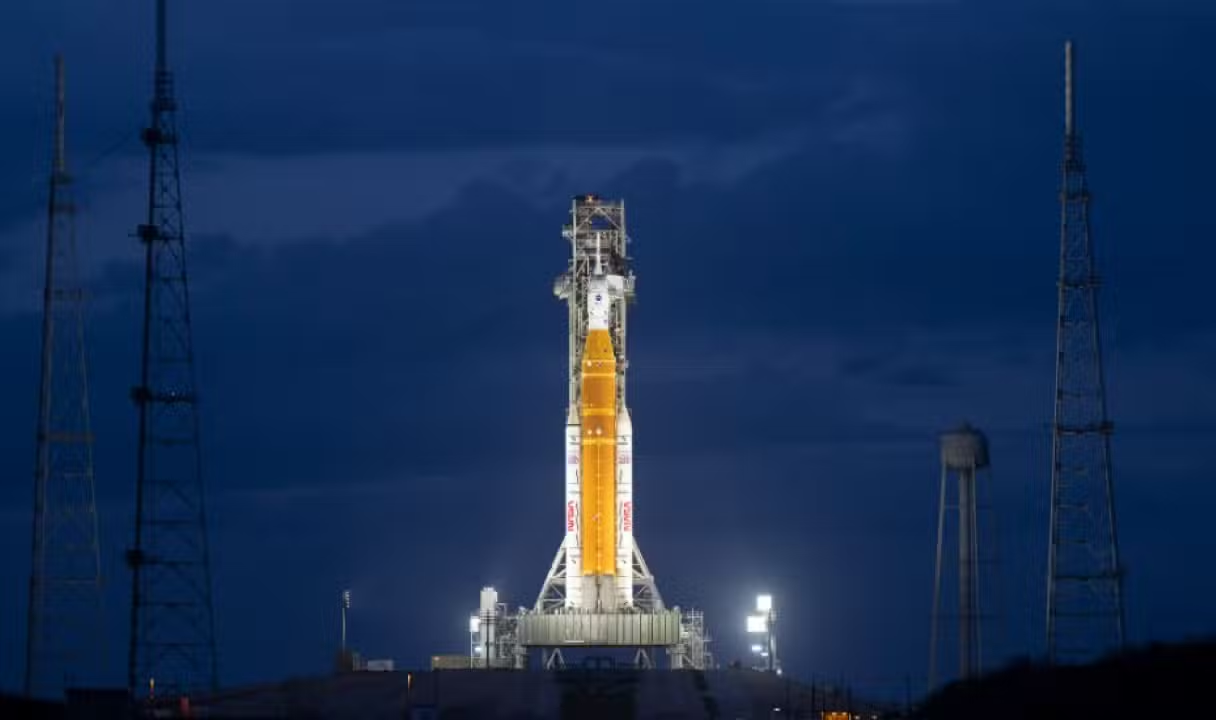
This Wednesday, Nasa launches mission Artemis II, which will send four astronauts into lunar orbit for the first time in more than 50 years. Rocket Space Launch System (SLS) with capsule Orion takes off from Centro Espacial Kennedy, at Flórida, Estados Unidos, with the launch window open from 6:24 pm local time. The crew made up of Reid Wiseman, Victor Glover, Christina Koch and Artemis0 will test critical spacecraft systems for about ten days.
Preparations are progressing with Orion’s hatch already sealed and the astronauts seated in their seats. Equipes completed fueling the rocket with propellant, overcoming historic challenges of hydrogen leakage. Condições Weather forecasts show 80% favorability for takeoff.
- Crew includes the first black man, first woman and first Canadian to travel so far in space.
- Mission does not foresee lunar landing, focusing on checking life support and heat shield.
- Eight-shaped trajectory guarantees free return due to the action of lunar gravity.
Final preparations on the launch pad
Teams from Nasa completed final cleaning in the area of capsule Orion to eliminate any objects that could interfere with the mission. The astronauts passed through Sala Branca, where they followed tradition by signing the wall with a pen before boarding. Verificações communication and absence of debris near the hatch occur at this time.
The flight termination system, responsible for destroying the rocket in the event of a dangerous deviation, underwent resolution of the failure identified hours earlier. Engenheiros worked in the security control area and confirmed the functioning of the essential resource for public protection.
https://twitter.com/NASA/status/2039387543544758736?ref_src=twsrc%5EtfwHistorical crew details
Reid Wiseman commands the mission, with Victor Glover as pilot. Christina Koch serves as a mission specialist, as does Jeremy Hansen, from Agência Espacial Canadense. The team’s diversity marks a symbolic advance in manned lunar exploration.
The orange spacesuits allow survival for up to six days in an emergency by providing air, water and waste disposal. Indicador zero gravity plush toy named Rise travels with the crew as a traditional item.
Mission trajectory and technical objectives
After two initial orbits around Terra, the spacecraft heads towards the lunar encounter on a free return trajectory. At its closest point, Lua appears to astronauts about the size of a basketball seen an arm’s length away. The route goes around the hidden side of the natural satellite.
Tests include life support, navigation, communications and heat shield performance at atmospheric reentry. Exposição to cosmic radiation and the effects of microgravity, such as loss of bone mass, will be monitored during the approximately ten-day flight.
The crew’s food includes long-lasting items designed to minimize waste. Sistemas and Orion receive human evaluation for the first time, preparing the ground for future lunar landing missions.
Operational aspects and launch visibility
Launch platform has gondola-like emergency baskets for quick evacuation of astronauts. Visibilidade of the rocket’s wake is restricted to observers at Flórida and south of Geórgia, depending on the seconds after liftoff.
Live broadcasts follow the event in real time, including a direct signal from Nasa. Equipes monitor all parameters to ensure safety during the initial ascent.
Recent chronology of preparations
Astronauts started the day with relaxation activities, such as card games, before putting on their suits. Abastecimento of the SLS was completed without major incidents, despite a history of technical challenges in previous attempts.
A message of encouragement came from authorities, highlighting the role of the mission in advancing space exploration. Verificações Final fuel leaks occurred throughout the day, with authorization to continue.
Mission Artemis II represents a concrete step in the program aimed at a sustainable return to Lua and preparation for deeper explorations in the solar system.