

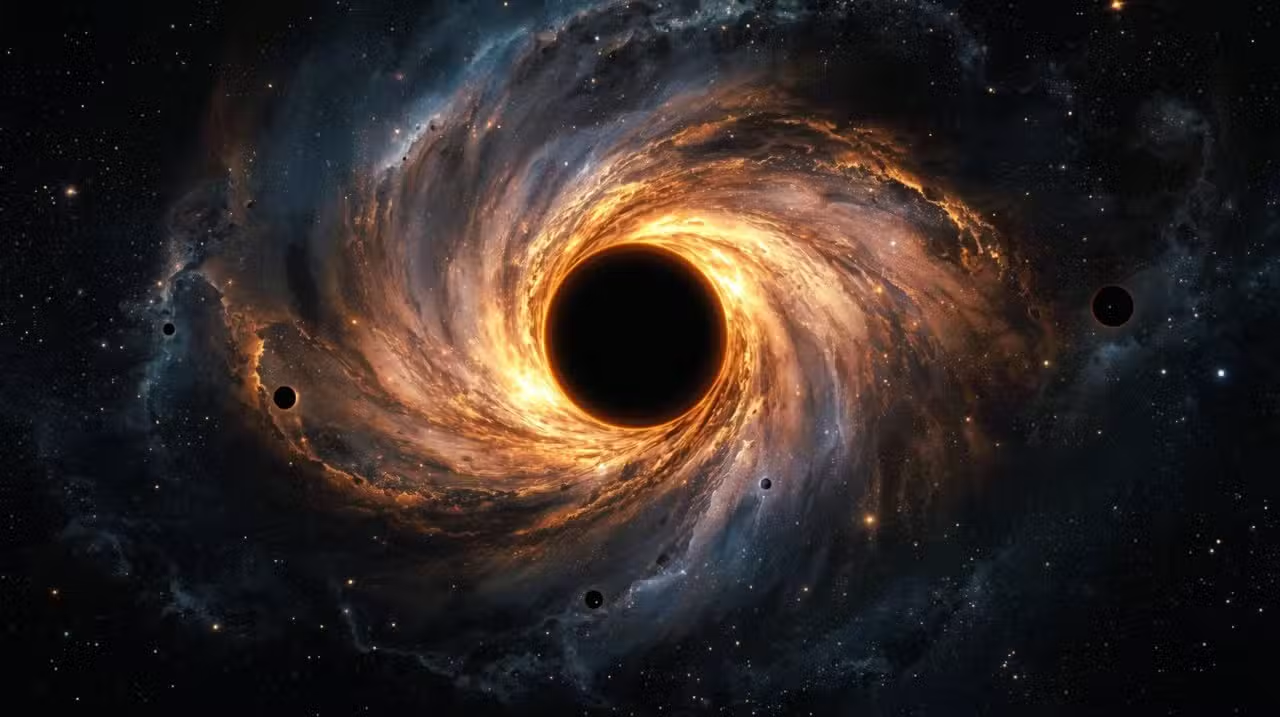
The detection of a first-of-its-kind gravitational wave signal, identified as S251112cm, has raised the possibility that moon-like objects could orbit black holes and neutron stars in dense regions of the universe. The event was recorded by the international LIGO-Virgo-KAGRA collaboration in late 2025, indicating the merger of an extremely low-mass object with a much more massive companion. Technical analysis suggests that this “moon” would be composed of neutron star matter, the result of violent head-on collisions or the collapse of parent stars. Localizado approximately 300 million light-years from Terra, the phenomenon opens new fronts of study on the evolution of binary systems in globular clusters.
- Three-body systems in globular clusters favor rare head-on collisions between neutron stars.
- The mass of the detected smaller object lies predominantly in the range between 0.1 and 0.87 solar masses.
- Stable neutron stars can exist with minimum masses up to 0.09 times the mass of Sol.
- The main object of the binary system has an estimated mass of between 1 and 3.5 solar masses.
Dynamics of formation in globular clusters
The configuration of dense star clusters, known as globular clusters, plays a key role in the origin of these recently detected exotic systems. Nessas regions, about a million stars interact gravitationally, causing a segregation where massive remnants, such as black holes and neutron stars, migrate towards the center. Esse movement is comparable to the separation of heavy suspended dust particles, concentrating dense objects in a reduced space and drastically increasing the chances of close encounters.
At the center of these clusters, the population density of neutron stars is abundant, often manifesting themselves as pulsars or X-ray sources. Esses remnants have a density comparable to that of an atomic nucleus, concentrating up to twice the solar mass in a diameter of just 12 kilometers. Quando these objects approach each other, they can form stable binary pairs or dynamically unstable triple systems that culminate in catastrophic merger or mass ejection events.
Neutron moon creation mechanism
The hypothesis for the formation of a moon composed of neutron matter resembles the process that gave rise to the Earth’s Lua billions of years ago. Naquele period, a giant impact between the protoplanet Theia and the proto-Earth ejected debris that clumped together in our planet’s orbit. In the extreme astrophysical environment, a head-on collision between two neutron stars can generate a similar effect, where most of the mass forms a central black hole while a fraction is expelled.
This ejected debris has the ability to clump together under its own gravity, forming a low-mass satellite that orbits the new central object. Modelos Theorists confirm that equilibrium configurations for neutron stars remain stable even at reduced subsolar masses. Alternativamente, the collapse of the core of a single massive progenitor star can form a debris disk that condenses into a moon, establishing an uneven binary system.
Technical details of event S251112cm
The gravitational wave signal called S251112cm was reported with a high level of statistical reliability due to its low false alarm rate. Estimativas point out that an event with these characteristics would occur naturally only once every 6.2 years, which reinforces the real nature of the detection. Apesar of the accuracy of the gravitational signal, searches for electromagnetic counterparts, such as flashes of light or radiation, have not yielded positive results to date.
Analysis of the source’s chirp mass indicates, with 99% confidence, the presence of a subsolar-mass object participating in the final collision. Esse data is crucial, as it suggests that the smaller component was not a conventional full-mass neutron star, but rather a smaller fragment. The interaction resulted in the emission of gravitational waves that shortened the moon’s orbit until its complete merger with the companion black hole or neutron star.
Distance and location of the spatial source
The source of the signal is located in the local universe, at a luminosity distance of approximately 93 megaparsecs, which is equivalent to 300 million light years. Essa relative proximity allowed interferometry instruments on Terra to capture ripples in spacetime clearly enough to extract mass data. The absence of visible light suggests that the system may be immersed in dense environments that block radiation or that the merger did not generate a detectable kilonova explosion.
Studies on the duration of these systems indicate that the lifetime of a black hole moon depends strictly on the initial separation and the masses involved. Pela continuous emission of gravitational radiation, the satellite irreversibly loses orbital energy, approaching the center in a downward spiral. The record of event S251112cm captures precisely the final moments of this process, before the moon’s total absorption by the primary object.
Collision processes and orbital evolution
The orbital dynamics that govern these exotic satellites are dictated by the laws of general relativity, where moving mass accelerates the fabric of space-time. Diferente from Lua Earth, which gradually moves away due to tides, a neutron moon is doomed to collide with its host due to the loss of wave energy. Esse fate is inevitable for any compact object in orbit close to a black hole, resulting in a characteristic signal picked up by ground-based sensors.
The observation of such low masses challenges some assumptions about the distribution of compact objects in the cosmos and validates theories about head-on collisions. Antes of this detection, most of the recorded events involved objects of similar masses, such as two black holes or two massive neutron stars. The existence of a subsolar satellite confirms that the fragmentation of dense matter is a possible and observable phenomenon through new gravitational wave astronomy.
Physical characteristics of stellar debris
- Neutron matter maintains extreme density even at reduced volumes and low masses.
- The characteristic size of these subsolar objects may be less than the 12 kilometers of a standard star.
- Structural stability is maintained by neutron degeneracy pressure against gravitational collapse.
- Fragments resulting from collisions can orbit the center of mass for millions of years before merging.
Future of Subsolar Mass Observations
The identification of candidates like S251112cm motivates the scientific community to improve search algorithms for low-amplitude signals. Espera It is expected that future updates to the LIGO and Virgo observatories will make it possible to detect even more distant events or events with smaller masses. Understanding these systems helps reconstruct the history of collisions in globular clusters and the physics of ultra-dense matter under extreme gravity conditions.
Each new detection of a subsolar object provides data on the equation of state of nuclear matter, revealing how it behaves under immense pressures. The possibility that black hole moons exist in abundance in the universe transforms the classical view of binary systems of compact objects. Science now seeks to catalog more similar events to determine whether the formation of neutron moons is a common byproduct of violent stellar encounters.