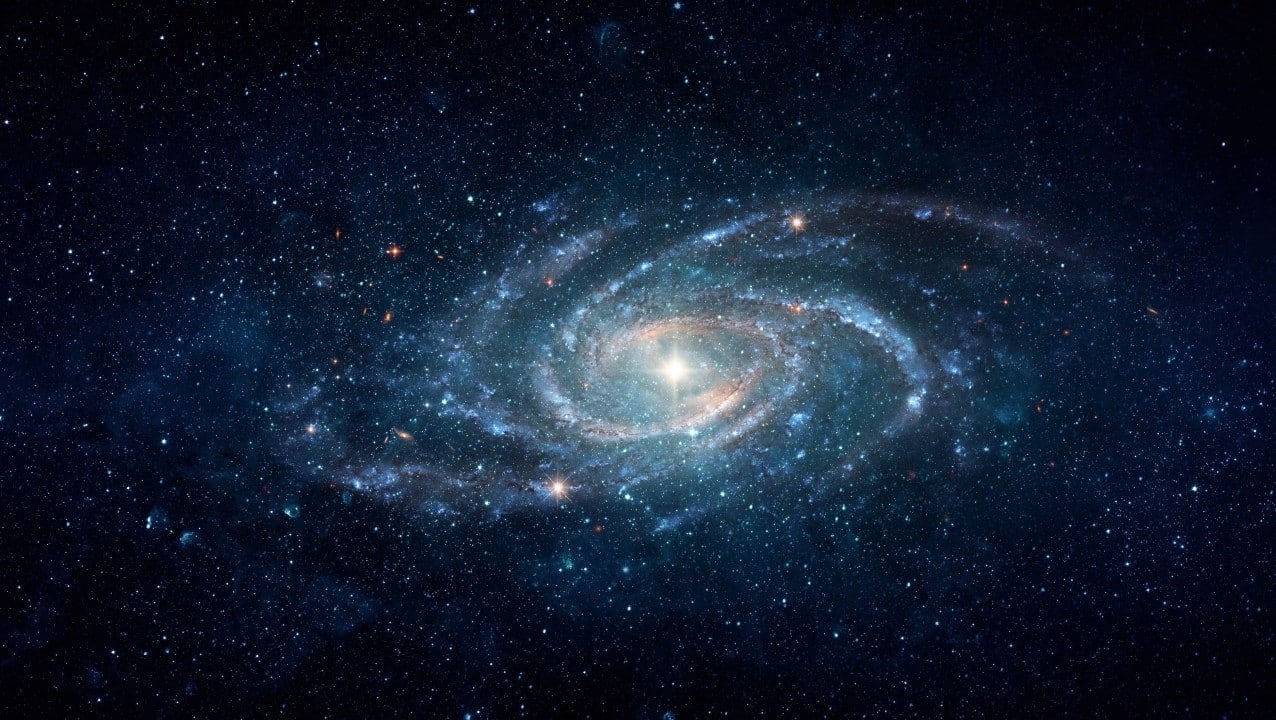
Astronomers linked to deep space monitoring programs have identified an extraordinary triple galactic system, located at a distance of approximately 7.5 billion light years from Terra. The discovery reveals a structure composed of three massive galaxies that are in the process of gravitational interaction, forming one of the largest clusters ever recorded at this distance scale. The phenomenon allows researchers to analyze how large structures consolidated when the universe was only about half its current age.
This space complex was detected using sensitive instruments that operate at multiple wavelengths, capturing radiation emitted billions of years ago. Scientists observed that the three entities share a common halo of gas and stardust, suggesting that the merger process is at an advanced stage of development. The combined mass of this system significantly exceeds that of conventional clusters, challenging previous models about the speed of galactic growth in the young cosmos.
- The exact location was confirmed by high-precision redshift measurements.
- The system presents a rate of new star formation considered above average for isolated systems.
- The gravity between the three cores is distorting the original spiral shapes of the galaxies involved.
- The glow emitted by the array facilitates the study of chemical components present in the distant interstellar medium.
Structure and composition of the triple galactic system
The configuration identified by the researchers presents a density of dark and baryonic matter that impresses the international scientific community. Cada One of the three galaxies has an active nucleus, which indicates the presence of supermassive black holes that influence the internal dynamics of the entire ensemble. The interaction between these gravitational centers causes vast clouds of hydrogen to shift, resulting in stellar nurseries that span thousands of light years.
Thermal mapping of the region revealed that the gas between the galaxies is extremely heated due to high-energy collisions and shock waves caused by the proximity of the celestial bodies. Essa high temperature prevents, in certain areas, the gas from cooling enough to form stars immediately, creating a complex balance between destruction and creation. Analysis of this data provides unprecedented insight into the physical mechanisms that govern the large-scale architecture of the universe.
Detailed observations on detected stellar mass
Preliminary calculations indicate that the total mass of this triple system is equivalent to hundreds of times the mass of Via Láctea. Essa’s massive concentration at such a remote point in space-time suggests that the system is a precursor to the current giant galaxy clusters we see in the local universe. Detailed study of the orbits of these galaxies allows us to estimate how long it will take for them to become a single supermassive elliptical galaxy.
The light captured by the telescopes shows the system as it was 7.5 billion years ago, acting as a time capsule for modern astronomy. By observing the behavior of light as it passes through the trio’s gravitational field, physicists can also test theories of general relativity in extremely dense environments. The variations in luminosity detected in recent months confirm that the activity in galactic nuclei is constant and highly energetic.
Dynamics of fusion and interaction between nuclei
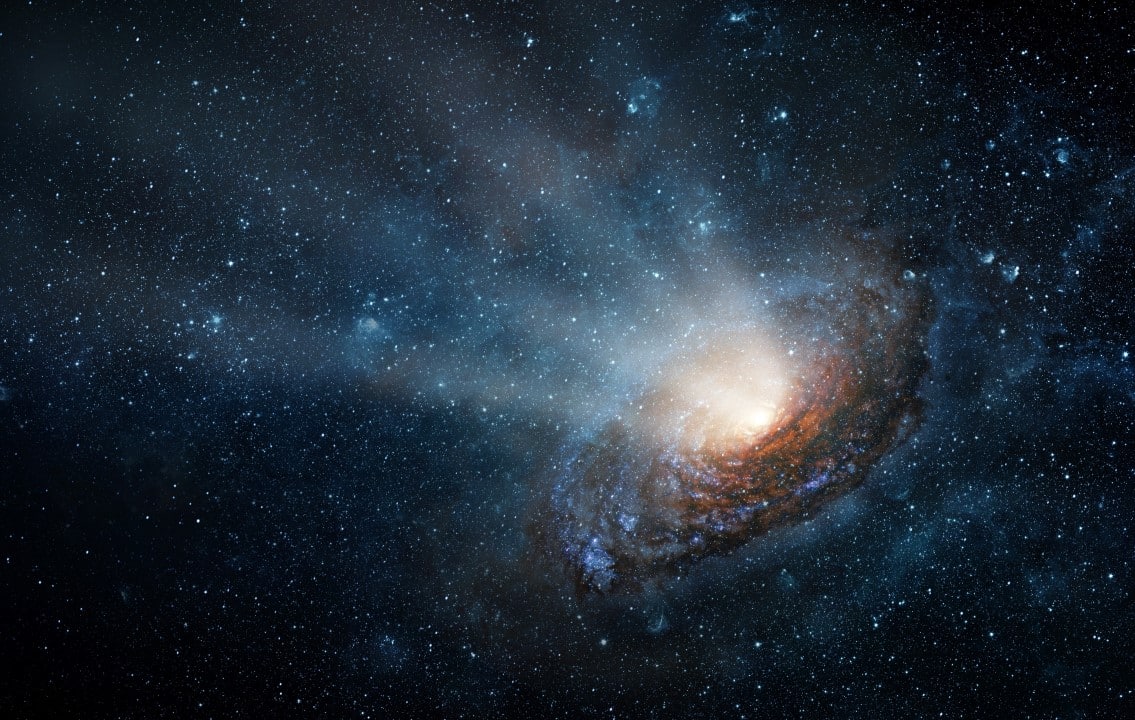
The movement of the three galaxies follows a complex pattern of “gravitational dance” where tidal forces rip stars from their original orbits and launch them into intergalactic space. Esse process creates chains of stars and bridges of matter that connect the three centers, making the individual boundaries of each galaxy difficult to define. Computer models suggest that the nuclei will meet at the system’s center of mass in the near astronomical future, generating an unprecedented burst of energy.
The turbulence generated by this approach accelerates particles to speeds close to that of light, emitting radio jets that cross the space void. Astrônomos use these signals to measure the intensity of the magnetic field that permeates the triple system. Tais measurements are fundamental to understanding how magnetism influenced the organization of matter from the first moments after Big Bang.
The total integration of the masses will result in a structure so dense that it could influence the orbit of other smaller galaxies located on the outskirts of this cluster. Continued observation aims to identify whether there are smaller satellite galaxies being consumed during this large-scale event.
Importance for the study of the evolution of the universe
The existence of such a massive system at such an early time indicates that matter came together more quickly than many theoretical models suggested. Este fact opens new discussions about the efficiency of gravity and the role of dark energy in expanding the fabric of space. Compreender How this system survived phases of accelerated expansion helps refine the cosmological constants used in global scientific calculations.
This system serves as a natural laboratory to study conditions that no longer exist in the vicinity of Terra, where the universe is colder and more stable. The heavy chemical elements detected in the system suggest that previous generations of stars had already enriched the environment even before this merger began. Isso proves that the chemical evolution of the cosmos was already at an advanced stage just a few billion years after everything began.
Technology used in deep space mapping
To obtain clear images of an object 7.5 billion light-years away, it was necessary to combine data from space telescopes and high-altitude ground-based observatories. Interferometry, a technique that combines signals from several receptors, was crucial to distinguish the three galactic nuclei that, at this distance, appear very close. Correction of optical distortions allowed the details of the matter bridges to be visualized with mathematical clarity.
Perspectives for future research in the field of astrophysics
The discovery of this triple system is just the beginning of a new phase of exploration that will use next-generation telescopes to search for even more distant structures. The expectation is that, by finding more examples of triple mergers, science will be able to establish a statistical standard for these rare events. Cada new data collected helps fill in the gaps in the historical map of our own existence in the cosmos.
