
Blue Origin, an aerospace company founded by entrepreneur Jeff Bezos, has made official ambitious plans for the construction of a network of orbital data centers through the so-called Projeto Sunrise. The initiative envisages the launch of 51,600 satellites into low orbit Terra (LEO), establishing a computing infrastructure capable of processing information directly in space. Esta strategic move occurs simultaneously with SpaceX’s requests to expand its own constellation, signaling a new phase in the space technology race.
The project is not only seen as an immediate reaction to competition, but as a natural evolution of the architecture that Blue Origin has been developing over the last few years. Especialistas in the sector indicate that the company seeks to consolidate a robust presence in the corporate and government market, differentiating itself from broadband services aimed at the end consumer. The integration between reusable launchers, logistics vehicles and new optical communication networks forms the technical basis for sustaining this digital ecosystem outside the atmosphere.
- The Sunrise constellation will use heliosynchronous orbits between 500 and 1,800 kilometers in altitude.
- The system will depend on intersatellite optical links to guarantee data routing without constant dependence on terrestrial bases.
- Rocket New Glenn will be the main vector for delivering computing payloads into orbit.
- The strategy focuses on meeting growing demands for artificial intelligence and high-value fixed connectivity.
Integration of space technologies
Blue Origin structured Projeto Sunrise as the final piece of a technological puzzle that involves several fronts of internal development. The use of the reusable rocket New Glenn, which has a payload capacity of more than 45 metric tons for low orbit, is essential to enable the necessary scale of the constellation.
In-orbit logistics will be managed by hybrid spacecraft Blue Ring, which acts as a hosting and transport platform for other satellites and payloads. Complementando hardware, the TeraWave network will ensure high-capacity connectivity, allowing processing performed in space data centers to be efficiently transmitted to customers in Terra.
Strategic differentiation in the market
Unlike Starlink’s business model, which focuses on delivering internet to residential and mobile users, Blue Origin directs its efforts to the corporate sector. The use of higher spectrum frequencies allows for a significantly higher data transfer rate, although these waves are more sensitive to interference from Earth’s atmospheric conditions.
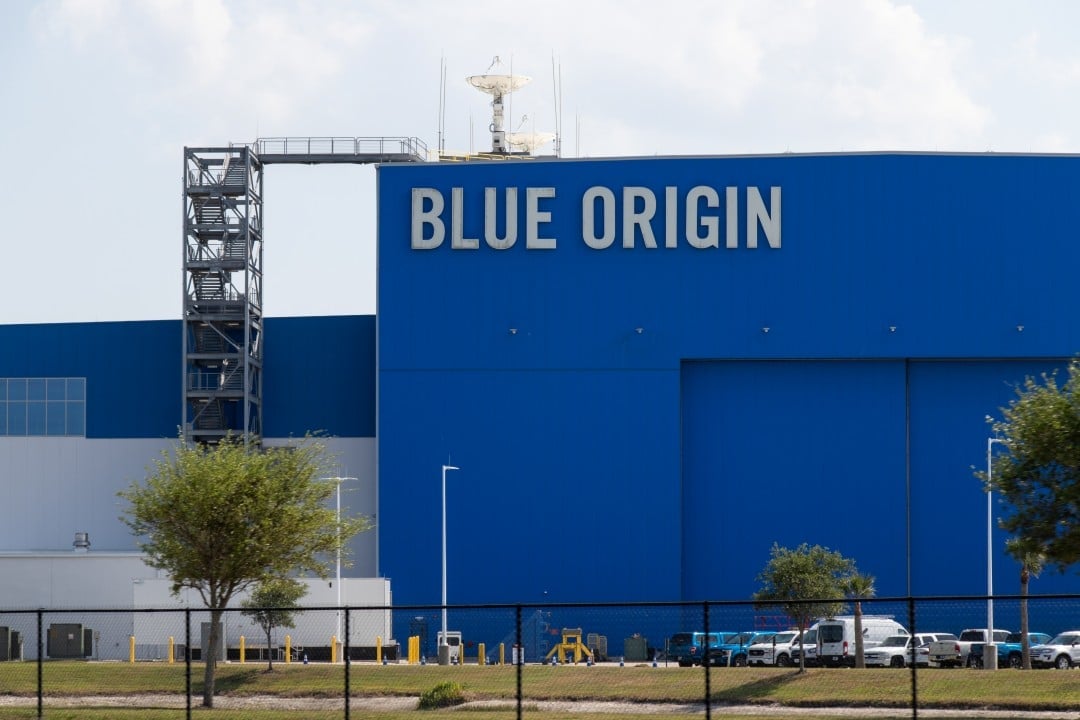
By focusing on companies and terrestrial data centers as terminal points, the company avoids direct competition for user volume and positions itself in a niche with high added value. Esta architectural choice reflects Jeff Bezos’s vision that space should become an extension of global economic infrastructure, supporting the power and cooling needs that artificial intelligence demands and that become increasingly costly on the ground.
Operational challenges and release cadence
Although the theoretical capacity of New Glenn is a positive difference, the viability of the project depends on the regularity with which these flights can occur in the coming years. SpaceX currently holds the undisputed lead due to its proven launch frequency and years of experience managing massive constellations.
Building a network of more than 51,000 satellites requires unprecedented manufacturing and launch logistics for Blue Origin, which is still in the early phases of operating its heavy orbital vehicle. The success of Projeto Sunrise is linked not only to the technological success of the satellites, but to the company’s industrial maturity in replicating large-scale production models.
Orbits and energy efficiency
The choice of a range between 500 and 1,800 kilometers for positioning the satellites was strategic to balance signal latency and solar energy capture. Nestas altitudes, the equipment can maintain almost continuous exposure to the sun, which is vital for powering servers that perform complex AI tasks.
In addition to the energy issue, positioning in a heliosynchronous orbit allows consistent coverage of specific areas of Terra, facilitating service to large industrial and government centers. Reducing dependence on ground stations through purely spatial routing promises to increase the security and resilience of global data networks.
Long-term economic viability
Currently, the cost of sending computing hardware into space remains the main barrier to orbital data centers becoming an immediate commercial reality. Executivos from the cloud sector admit that, although the strategic vision is consistent with the future of technology, the prices charged today still do not justify the mass migration from terrestrial processing to the vacuum.
For Projeto Sunrise to break even financially, it will require a drastic reduction in costs per kilogram transported and a significant advance in the durability of electronic components in the space environment. Blue Origin operates with a schedule that prioritizes the construction of fundamental assets, understanding that orbital infrastructure is a bet for the next decades of global computing.
The role of artificial intelligence in strategy
The explosive demand for computing power to train and operate artificial intelligence models is the driving force behind Jeff Bezos’s interest in taking servers outside Terra. Data Earth-based centers face growing challenges related to water consumption for cooling and the impact on local electrical grids, problems that could be mitigated in space.
The proposal of Blue Origin is that, in the future, large volumes of raw processing take place in orbit, sending only the processed results to the surface, optimizing the use of bandwidth. Essa paradigm shift transforms the satellite from a simple signal repeater into an active node of a globally distributed intelligence network.
Technical perspective on interconnected networks
The transition to a fully space-based data routing model represents a technological leap from traditional satellite communications that rely on constant hops to Terra. With optical interconnection, data can travel thousands of kilometers between satellites before being transmitted to the end user, alleviating bottlenecks in saturated terrestrial infrastructures.
This model creates a more scalable and persistent network, capable of maintaining operations even in scenarios where terrestrial connectivity is interrupted by natural disasters or conflicts. Blue Origin invests in the standardization of these communication protocols to ensure that your constellation can seamlessly integrate with existing cloud systems, such as those from AWS.
Chronology and next operational steps
The official announcement and filing with the FCC are just the initial bureaucratic steps in a process that will take years to fully implement in the space environment. The company must now meet strict launch deadlines to maintain its spectrum licenses, which will put pressure on the development of rocket New Glenn to achieve regular flights in 2026 and beyond.
Experts are closely watching hardware testing and the first TeraWave network validation missions, which will serve as a proof of concept for Projeto Sunrise. Enquanto SpaceX moves forward with Starship to launch its own data centers, Blue Origin focuses on the precision of its integrated infrastructure to ensure that when the market is ready, its network will already is operational and established.
