

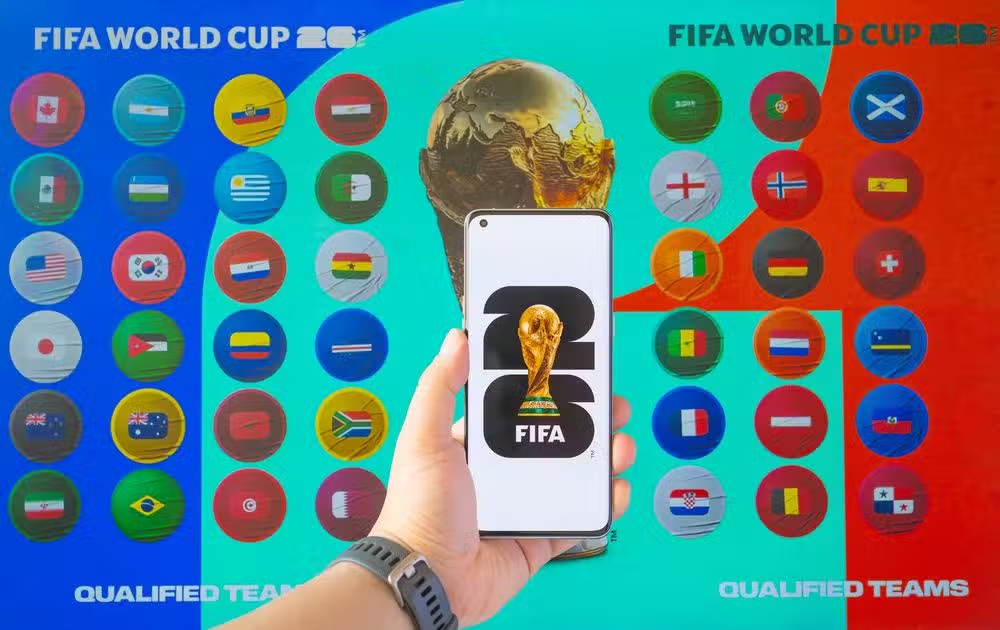
The organization of the next global football tournament has established the definitive guidelines for the competition that will take place jointly on Estados Unidos, México and Canadá. The sporting event marks a profound structural change implemented by the highest football entity, increasing the number of participants to an unprecedented total of forty-eight national teams. The fight for the sport’s most coveted trophy will take place between June 11th and July 19th, moving the infrastructure of sixteen metropolises spread across the North American continent and requiring unprecedented logistical planning in the history of the sport.
The new regulation directly changes the dynamics of the initial phase and the path taken by the delegations until the very final. The teams will be divided into twelve groups made up of four members each, which guarantees a greater number of clashes during the first seventeen days of the tournament. Essa expansion aims to integrate more consumer markets into the event and provide a global showcase for developing federations.
The group stage will require rigorous planning due to the continental distances between the chosen venues. Para to facilitate the understanding of the initial schedule and the organization of fans, the following milestones of the competition stand out:
– Abertura official scheduled for Mexican territory on June 11th, with the duel against África and Sul.
– Estreia of the American team on June 12th against the Paraguayan team in local prime time.
– Início of the Brazilian journey scheduled for June 13th against Marrocos, valid for Grupo C.
– Distribuição simultaneous matches in the decisive rounds considering the different time zones in the region.
Unprecedented structure of the group stage and regionalization
The organizing committee prioritized a regionalization model for allocating the keys in the first phase of the international tournament. Essa operational strategy aims to reduce the physical exhaustion of athletes with long air travel and facilitate the land travel of fans who will accompany their countries of origin during the initial weeks of competition.
The established division creates twelve distinct brackets, allowing the best-performing teams to advance with a greater mathematical safety margin to the following stages. The format also provides concrete opportunities for nations with less tradition in the sport to compete at high-level matches on international stages with great commercial and media visibility.
Logistical planning for the Brazilian team
The technical committee of Brasil has already started mapping the facilities and evaluating the climatic conditions of the cities where the team will work in the first phase. The main focus of the preparatory work involves the biomechanical adaptation to the synthetic pitches present in some of the arenas selected for the event Estados Unidos and Canadá.
The South American team’s schedule foresees the first clash against the Moroccan team, followed by clashes against Haiti on June 19th and Escócia on June 24th. The order of games requires intense physical preparation to withstand the variation in temperature and the tactical intensity of the opponents drawn in the group.
Sports performance professionals closely monitor the players’ status at their respective European and South American clubs to avoid injuries on the eve of the final call-up. The depth of the bench is considered the determining factor in supporting the expanded calendar and the physical demands of the competition.
Distribution of departures and local times
The preparation of the game schedule considered the need to meet global broadcast contracts and the public present in large-capacity stadiums. The initial rounds feature matches spread from early afternoon to evening, progressing into the early hours in certain Asian and European time zones.
México will host the inaugural game, while Canadá will make its first appearance against Bósnia on June 12th. Os Estados Unidos, as the main hosts in terms of total game volume, debuts against Paraguai, setting the pace for the local public’s engagement with the sporting event.
From the third round of the group stage onwards, clashes in each bracket will take place simultaneously to preserve the sporting integrity of the tournament. Essa Regulatory measure prevents teams from entering the field knowing the exact results necessary for early classification, forcing competitiveness until the final whistle.
Meteorological monitoring will be constant in headquarters located in regions with extreme climate during the summer in the northern hemisphere, such as Miami and Monterrey. Protocolos hydration doctors and mandatory technical stops are provided for in the general regulations to guarantee the health of professionals involved in matches played during the day.
Dynamics of the knockout stage and high-tech stadiums
The introduction of the round of 32 stage represents the main innovation in the knockout format of the international tournament. From June 28th, the volume of eliminatory matches will require a maximum level of concentration from the delegations, as any tactical failure will result in immediate disqualification. The winners of this initial stage will advance to the round of 16, scheduled for the beginning of July, maintaining a fast pace of competition that will test the physical, tactical and mental limits of the squads involved in the fight for the world title.
The arenas designated to host the decisive clashes have cutting-edge infrastructure, including advanced climate control systems and fully biometric access control. The quarter-finals and semi-finals will take place in sports complexes with a capacity of over sixty thousand spectators, designed to offer thermal comfort regardless of external conditions. The organization projects that the grand final, scheduled for July 19th, will record historic audience records on digital and television broadcasting platforms on a global scale, consolidating the success of the new format.
Government investments and impact on the local economy
Preparation for the mega sporting event required a significant injection of capital from the governments of the three host countries, encompassing the modernization of airport terminals, accelerated expansion of the hotel network and extensive reinforcement of public security systems. Long-term financial planning aims to transform the chosen cities into highly capable tourist hubs to absorb the massive flow of international visitors during the thirty-nine days of continuous competition. Operational integration between border authorities will facilitate the transit of accredited fans, while official entertainment zones will generate thousands of temporary jobs in the gastronomy, transport and digital services sectors. The structural legacy promised by the organizing committee encompasses the revitalization of community training centers and the implementation of rigorous sustainability policies, such as the operation of stadiums powered by renewable energy and solid waste management programs, establishing a new standard of environmental responsibility for the holding of large-scale sporting competitions on the continent.
Innovations in arbitration and technological support
The officiating department will utilize updated semi-automatic offside detection tools and real-time encrypted communication between the field team and the video booth. The objective of technological implementation is to reduce the downtime of matches and minimize the margin of human error in the capital decisions that define the direction of the teams in the tournament.
Security and urban mobility protocols
Security forces from host countries established a unified command center to monitor the movement of delegations and the flow of fans around sports arenas. Tactical planning includes the use of artificial intelligence to control crowds and prevent incidents in areas of high concentration of people during the days of decisive games.
The public transport system in the host cities will operate with expanded fleets and exclusive lanes to ensure punctual access to sports complexes. Ticket sales remain linked to strict digital registration on official platforms, blocking attempts to exchange tickets and ensuring that the environment in the stands is monitored and safe for all audience profiles present.