

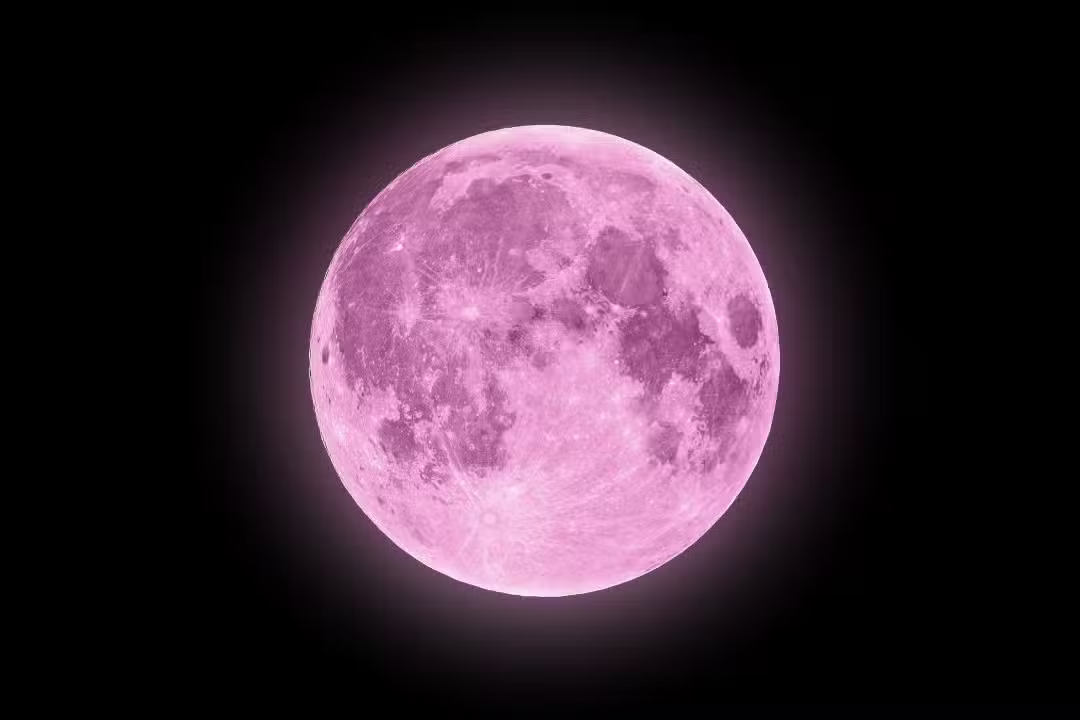
Ilhas Canárias organizes the tourist and scientific infrastructure to follow the peak of luminosity of the natural satellite Terra at the beginning of April. The Spanish archipelago, internationally recognized for its low light pollution and strict airspace protection laws, annually attracts thousands of researchers and astronomy enthusiasts. The astronomical phenomenon coincides with the Christian liturgical calendar, marking the period of long holidays and boosting the local hotel chain. The privileged geographical position of the islands allows clear viewing from the moment the star appears on the eastern horizon until it reaches the highest point in the night sky.
The peak of lunar illumination occurs in the early hours of the first Thursday of April. Experts indicate that the atmospheric conditions in the region favor the capture of high-resolution images and the collection of precise photometric data.

The organization of observation routes requires attention to the exact transition times of the star in the sky. Monitoring by astrotourism teams begins shortly after sunset on the Wednesday before the luminous peak.
- Main date of the astronomical phenomenon: Madrugada from April 1st to 2nd.
- Peak brightness time: Exatamente at 03:11 in the local time zone of Ilhas Canárias.
- Start of observation window: Pôr from Wednesday’s sun, on the eastern horizon.
- Recommended locations: Áreas at high altitude, far from coastal urban centers.
Visual dynamics and full time of the satellite
Technical coordination for monitoring the astronomical event requires precision in relation to the moments of greatest incidence of brightness on the lunar surface. Embora the satellite remains visible for several consecutive nights, the moment of maximum fullness occurs specifically in the early hours of the morning, requiring logistical planning from observers.
Photographers and researchers consider the beginning of the previous night to be the most suitable period for visual recordings. The interaction of the sun’s rays with the Earth’s atmosphere creates an optical effect that expands the perception of the star’s size as it appears on the horizon, generating a direct contrast with the local volcanic relief.
Historical origin of astronomical nomenclature
The term used worldwide to describe this specific event has historical roots in the traditions of native peoples of América and Norte. The name has no direct relationship with any physical or chemical change in the color of the surface of the natural satellite, being a cultural convention maintained over the centuries.
Astronomical and historical records indicate that the name derives from the flowering of a specific species of creeping plant, common in early spring in the Northern Hemisphere. The botanical phenomenon served as a time marker for ancient agricultural communities, which based planting and harvesting on lunar phases.
During its passage through the night sky at Ilhas Canárias, the star displays its characteristic intense white glow. Variações Warmer colors occur only under specific atmospheric conditions, such as the presence of suspended dust from the African continent or when the satellite is very close to the horizon.
Meteorological conditions and atmospheric stability
Agência Estatal of Meteorologia monitors the movement of air masses to guide the public to areas with the highest probability of clear skies. Spring in the archipelago presents a generally stable weather pattern, favorable for space observation activities and the continuous operation of large telescopes.
The presence of trade winds usually generates the accumulation of clouds at low altitudes, forming a natural barrier known in the region. Este Weather blocking prevents artificial lighting from coastal cities from reaching mountainous areas, functioning as a high-efficiency light insulator.
The transparency of the air at high altitudes represents a determining factor in capturing lunar light without distortions caused by excess humidity. Climate forecasts point to a period of high stability in the upper atmospheric layer, ensuring the necessary clarity for observation with the naked eye and optical instruments.
The absence of polluting particles of industrial origin in environmental preservation zones guarantees the visual purity of the event. The astrophysical centers installed in the region depend on this clarity to carry out precise photometric measurements, consolidating the islands as one of the best observation points in the northern hemisphere.
Relationship of the lunar cycle with the liturgical calendar
The occurrence of this specific astronomical event maintains a direct link with the structuring of the calendar of religious holidays in much of the Western world. Guidelines established in historical councils determine that the main celebrations take place on the first Sunday following the first full moon after the spring equinox in the northern hemisphere. Esta astronomical calculation rule aligns celestial events with centuries-old cultural traditions, influencing logistical planning, the organization of public events, and the distribution of days off in several European and American nations.
The coincidence of the luminous peak with the recess period boosts the observation tourism sector in the Spanish archipelago. Travel agencies and specialized guides structure night itineraries that combine scientific knowledge about the solar system with the exploration of national parks. The intense natural lighting facilitates the safe movement of groups of visitors along the volcanic trails, replicating the routes used before the expansion of modern electrical networks and allowing complete immersion in the islands’ natural environment during the early hours of the morning.
Infrastructure and observation sites in the archipelago
Ilhas Canárias consolidated a global leadership position in the astrotourism segment through the implementation of strict legislation to protect the night sky, which limits the emission of artificial light. Visitors and researchers primarily seek observation points located above the cloud layer, where the rarefied air provides ideal clear conditions. Parque Nacional do Teide, located on the island of Tenerife, offers a complete infrastructure with signposted viewpoints that guarantee an unobstructed view in all directions. On the island of La Palma, the region of Muchachos is home to one of the most important international telescope complexes in the world, benefiting from absolute darkness and thermal stability. Áreas more isolated areas, such as the high areas of El Hierro and Maciço of Famara in Lanzarote, also receive contingents of observers looking for the visual contrast between the volcanic geological formations and the reflection of the silvery light on the waters of the Oceano Atlântico, creating an environment conducive to both academic research and landscape photography.
Optical equipment for monitoring the event
Visual monitoring of lunar fullness eliminates the need for investment in highly complex optical equipment. The satellite’s intense brightness allows the identification of the main topographic formations, such as the vast dark basalt plains, directly with the naked eye from any elevated point on the islands.
The use of field binoculars or small amateur telescopes increases the ability to observe craters in the transition zone between light and shadow. Professional photographers use specific glare reduction filters and stabilized tripods to capture the Earth’s landscape illuminated by the star without overexposing the image.
Economic impact on the local services sector
The convergence of the astronomical phenomenon with the period of extended holidays generates a substantial increase in hotel reservations and the contracting of transport services on the islands. Local administrations reinforce security and guidance teams in national parks to guarantee the orderly flow of vehicles and pedestrians during early morning observation periods, maintaining the integrity of environmental preservation areas.