

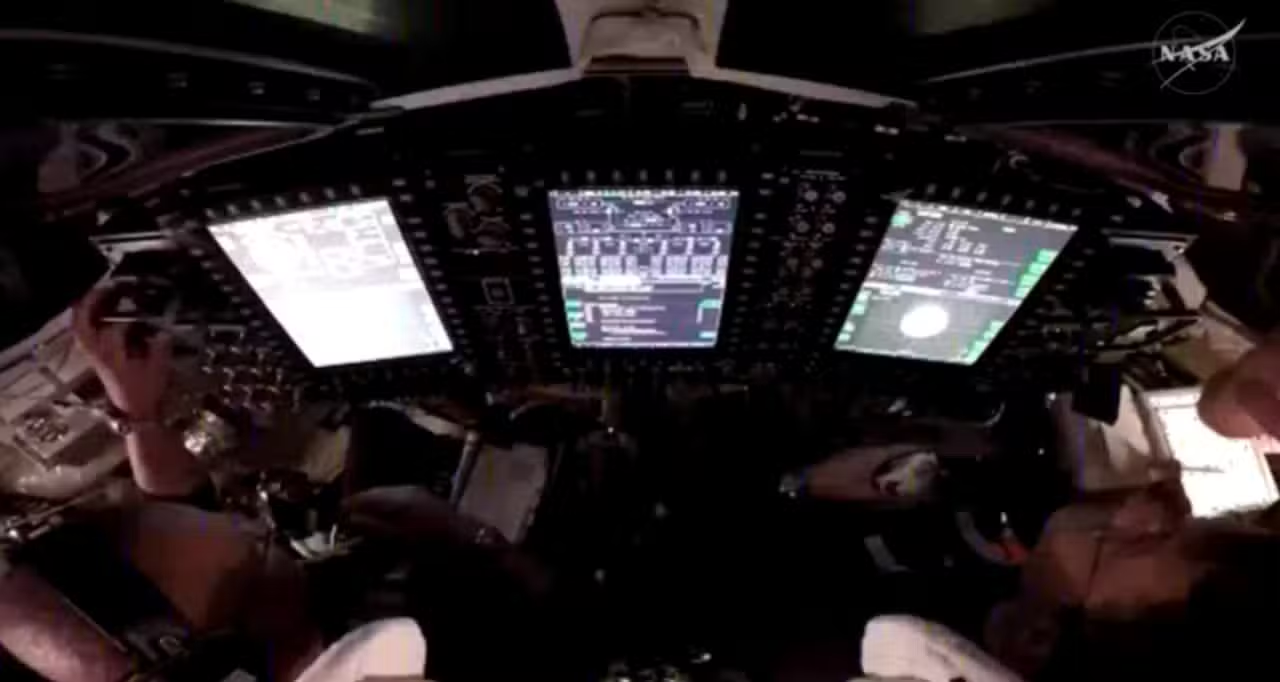
The crew of mission Artemis II successfully restored normal operation of spacecraft Orion’s sanitary system following an unexpected failure alert. The incident required immediate coordination between the astronauts in orbit and the mission control center located at Houston, ensuring continuity of scheduled operations.
The anomaly was detected shortly before a critical orbital maneuver, when a warning light indicated a malfunction in personal hygiene equipment. Engineers on the ground quickly analyzed the telemetry data to formulate a diagnostic plan in conjunction with the flight team.

The quick resolution of the technical issue allowed the continuation of proximity operations demonstrations without compromising the flight schedule. The event highlighted the operational readiness required for long-duration space travel and the effectiveness of crew training.
Proximity operations and orbital adjustments
The failure occurred during a phase in which the team was actively testing the manual maneuvering capabilities of spacecraft Orion. Pilot Victor Glover and commander Reid Wiseman were responsible for executing these specific flight control demonstrations.
These tests are essential to benchmark the onboard navigation sensors and reaction control thrusters. The procedures took place shortly after the separation of the intermediate cryogenic propulsion stage, a determining moment for the vehicle’s trajectory.
In-flight diagnosis and technical intervention
Real-time problem solving is a fundamental requirement for the safety of deep space exploration missions. Direct communication between capsule Orion and the ground control team proved effective in isolating the cause of the malfunction in the sanitary system.
Maintenance of the hygiene system is directly linked to the physical well-being and operational efficiency of astronauts. Qualquer Prolonged defect in this sector could affect the health of the team and require drastic changes to the flight plan established by the space agency.
The joint intervention demonstrated the robustness of the established security protocols. Engineers provided detailed instructions, allowing astronauts to perform necessary repairs using tools available aboard the spacecraft.
Preparations for raising perigee
After restoring the equipment, the four crew members were given a four-hour rest period to recover. Esta pause was strictly scheduled before the next critical phase of the orbital flight.
The subsequent step involved the perigee-raising maneuver, designed to raise the lowest point of the spacecraft’s orbit around the Esta action is calculated mathematically to position the capsule in the correct navigation vector.
Combined with the apogee lift performed previously, this maneuver shapes the initial parking orbit. The accuracy of the thrusters’ activation is continuously monitored by ground stations spread across the globe.
These orbital adjustments are the final steps before translunar injection, the definitive push that sends the vehicle toward Lua. The success of these initial phases validates the performance of the spacecraft’s main propulsion systems.
Capsule life support systems
Spacecraft Orion was developed with a complex life support systems architecture designed to sustain a crew of four for prolonged periods in deep space. The European service module, provided by Agência Espacial Europeia (ESA), plays a central role in this infrastructure, being responsible for supplying electrical power, thermal control, drinking water and breathable oxygen. The integration between the crew module and the service module is monitored by thousands of internal sensors that transmit real-time data to mission control.
The sanitation incident served as an unscheduled practical test of the redundancy of these vital components. The engineering philosophy behind the vehicle dictates that critical systems must have backup mechanisms or allow manual repairs in flight. The ability of astronauts Victor Glover, Reid Wiseman, Christina Koch and Jeremy Hansen to interact directly with the hardware reinforces the importance of the extensive technical training carried out over the years leading up to launch.
The role of manned flight in space exploration
Mission Artemis II operates as a definitive dress rehearsal for returning humans to the lunar surface, marking the first time spacecraft Orion carries a crew beyond low-Earth orbit. Embora the flight plan does not include a landing on Lua, the trajectory around the natural satellite exposes the vehicle and astronauts to the rigorous radiation and temperature conditions of deep space. Durante During the approximately ten days of the journey, each procedure carried out on board aims to validate the operational concepts that will be applied in subsequent missions. The presence of a diverse crew, including international participation with Agência Espacial Canadense (CSA), highlights the collaborative nature of the current space program. Successfully managing unexpected technical anomalies, such as equipment repair, provides valuable empirical data for engineering teams to refine the design of future spacecraft and lunar habitats.
Continuous trajectory monitoring
With internal systems stabilized, mission control maintains continued focus on translunar trajectory telemetry. Communication networks ensure that any slight deviation in the flight path is immediately detected and corrected by navigation computers.
Importance of international cooperation
The execution of complex maneuvers and the resolution of problems on board highlight the synergy between different global space agencies. The partnership between NASA, ESA and CSA ensures that resources and technical expertise are shared to maximize operational safety.
The European contribution to the service module and Canadian participation in the crew demonstrate a unified model of exploration. Esta Collaborative structure is considered the standard for future long-duration missions in the solar system.
Validation of operational protocols
Every action taken by the crew during the flight is meticulously recorded to update the space program’s standard operating procedures. The quick response to the warning light on the sanitary system panel proved that emergency manuals and troubleshooting guides are accurate and easy to perform in a microgravity environment. Engineers on the ground use this practical feedback to simplify maintenance processes on next generations of spacecraft.
Completion of proximity demonstrations and orbital adjustments confirms that capsule Orion responds accurately to manual and automated commands. Transitioning between different flight modes is a fundamental capability for the docking operations that will be required in the construction of the future lunar space station. The mission continues to collect essential data that will dictate the pace of human expansion in space.