

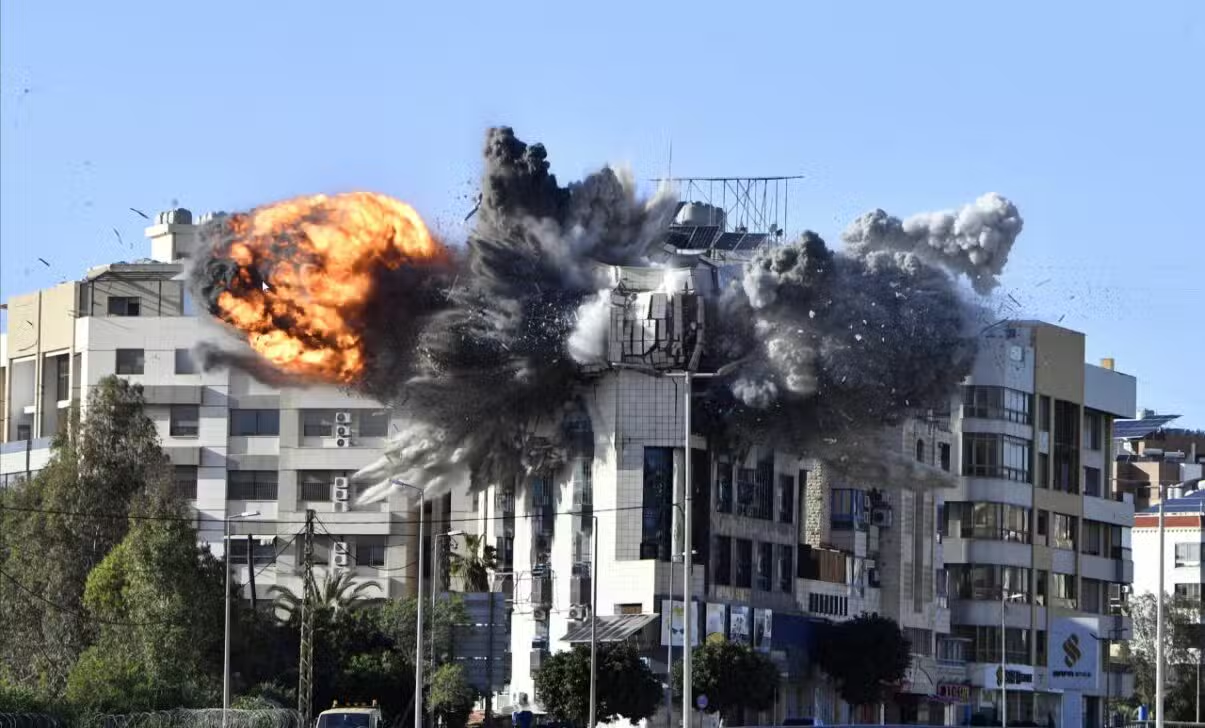
Forças of Defesa of Israel confirmed the death of Hajj Yusuf Ismail Hashem, a senior commander of group Hezbollah, during a military operation carried out in the Lebanese capital. The offensive was conducted by Israeli naval troops and struck specific targets in Beirute, marking an expansion of the radius of military action beyond traditional border areas.
The attack occurs at a time of high intensity in Oriente Médio, entering the fifth consecutive week of a military conflict between Israeli forces and Shiite militia. The region records daily operations that alter local security dynamics and mobilize defense resources on multiple fronts.
Hashem occupied a central position in the group’s military hierarchy, leading the unit known as Frente Sul. Ele had assumed the strategic post in September of the previous year, replacing Ali Karaki, who was also killed in a similar Israeli military assault, highlighting an ongoing campaign to dismantle the organization’s leadership.
Naval strategy and dismantling of leadership
The operation that resulted in the death of the commander was detailed by military authorities as an action carried out from the sea, demonstrating the ability of Israeli forces to project military power directly into the urban and political center of Líbano. The choice of Beirute as the scenario for this elimination highlights a tactical change, indicating that the high command of Hezbollah is targeted even far from the line of contact in the south of the country. The central objective of this maneuver is to weaken the militia’s chain of command and control, making it difficult to coordinate responses and organize new battle fronts.
The Frente Sul unit, under the direction of Hashem, was classified by the Israel intelligence apparatus as the operational nucleus responsible for planning and executing hostile activities on the border. The accusations weigh on the commander for orchestrating thousands of projectile launches and raids against civilian targets and Israeli Exército positions. The neutralization of his figure is treated by defense authorities as a fundamental step to mitigate immediate threats and dismantle the logistical infrastructure that supports the group’s operations in the border region.
Historical context of the current military escalation
Lebanese territory became one of the main theaters of operations in a broader regional conflict, which took on even more severe contours after the beginning of March, when Hezbollah multiplied its rocket launches in retaliation for the losses of prominent figures in Oriente Médio’s alliance axis. The death of Hajj Yusuf Ismail Hashem gains particular attention because he was the highest-ranking officer eliminated since the outbreak of this new phase of hostilities, which represents a change in the operational structure of the militia. Este event provokes a reevaluation of engagement tactics by the armed group, while at the same time raising the level of alert in Israeli defenses for possible large-scale retaliation. The international community, through various foreign ministries and monitoring bodies, is monitoring the deterioration of the scenario, warning of the risk of an spillover of the conflict that could involve other state and non-state actors, affecting global security broadly.
Night offensives and impact on the capital
The Lebanese capital has recorded a sequence of nightly bombings that have drastically altered the routine of its inhabitants. Dados recent reports provided by local health authorities indicate that one of the latest waves of attacks resulted in nine confirmed deaths and left at least twenty-nine people injured in residential areas.
The frequency and intensity of these air and naval operations keep the civilian population in a state of permanent alert. The urban infrastructure of Beirute, already weakened by previous economic crises, is now suffering from physical destruction and the overload of emergency medical services.
Post-conflict territorial control plans
Military dynamics in the region took on new contours after official statements by Ministério of Defesa of Israel about the long-term objectives of the campaign. Minister Israel Katz indicated that the armed forces are preparing a structured plan to establish a physical presence in parts of southern Líbano once direct combat operations are completed.
The project involves the creation of a deep security zone, extending from the current border to the natural line formed by the river Litani. The central argument for this territorial occupation is the need to create a physical and military obstacle against the launch of anti-tank missiles and short-range rockets aimed north of Israel.
This strategic formulation marks the second occasion on which high-ranking members of the Israeli government have openly discussed the occupation of Lebanese lands. The proposal has generated debate in diplomatic forums, with several nations expressing opposition to any unilateral change to internationally recognized borders.
Demographic restrictions and demolitions on the border
One of the aspects of the security plan outlined by Israeli authorities concerns the future of the civilian population that inhabited the south of Líbano. The proposed guidelines indicate that hundreds of thousands of local residents will be prevented from returning to their homes in the short and medium term.
The condition imposed for any repopulation of the area is the guarantee of security for the northern communities of Israel, a criterion that could prolong the displacement for an indefinite period of time. Essa territorial exclusion policy aims to create an uninhabited buffer zone to facilitate military monitoring.
In addition to blocking the return of civilians, the planning includes the systematic demolition of infrastructure in villages adjacent to the dividing line. The model cited by the authorities is based on military engineering actions carried out in locations such as Rafah and Beit Hanoun, where areas were leveled to eliminate hiding places and tunnels.
The evacuation orders issued preventively by Israeli forces already affect a significant portion of the Lebanese map. Estima It is estimated that around fifteen percent of the entire national territory is under some type of movement restriction or abandonment order, reconfiguring the country’s demographic distribution.
Collapse of reception infrastructure
The massive movement of civilians fleeing combat zones caused an immediate bottleneck in the reception capacities of Líbano’s central and northern regions. Escolas gyms and public buildings were hastily converted into temporary shelters, operating well beyond their maximum capacities and facing critical shortages of drinking water, medicine and basic hygiene supplies.
Humanitarian emergency numbers
The prolongation of hostilities results in a severe structural crisis in the Líbano. Levantamentos carried out by Nações Unidas agencies, including UNICEF, detail the demographic impact of the conflict on civilian populations.
– The number of Lebanese fatalities has exceeded the mark of one thousand and two hundred people since the beginning of the current offensive.
– Records indicate that one hundred and twenty-one children lost their lives as a result of the attacks.
– The volume of internally displaced people broke the barrier of one million individuals seeking refuge.
– Essa Moving population represents one fifth of all inhabitants of the country.
– Entre homeless, there are approximately three hundred and seventy thousand minors living in temporary shelters.
International assistance efforts
Humanitarian aid organizations face severe logistical barriers in distributing essential supplies to the most affected areas. The blockage of land routes and the destruction of bridges and roads limit the access of relief caravans, leaving several families isolated and dependent on scarce reserves.
The international donor community has begun mobilizing emergency funds to try to stabilize the Lebanese health network. Hospitais campaign are being planned to ease the pressure on Beirute medical centers which are operating under a continuous triage regime due to the uninterrupted flow of injured people.