

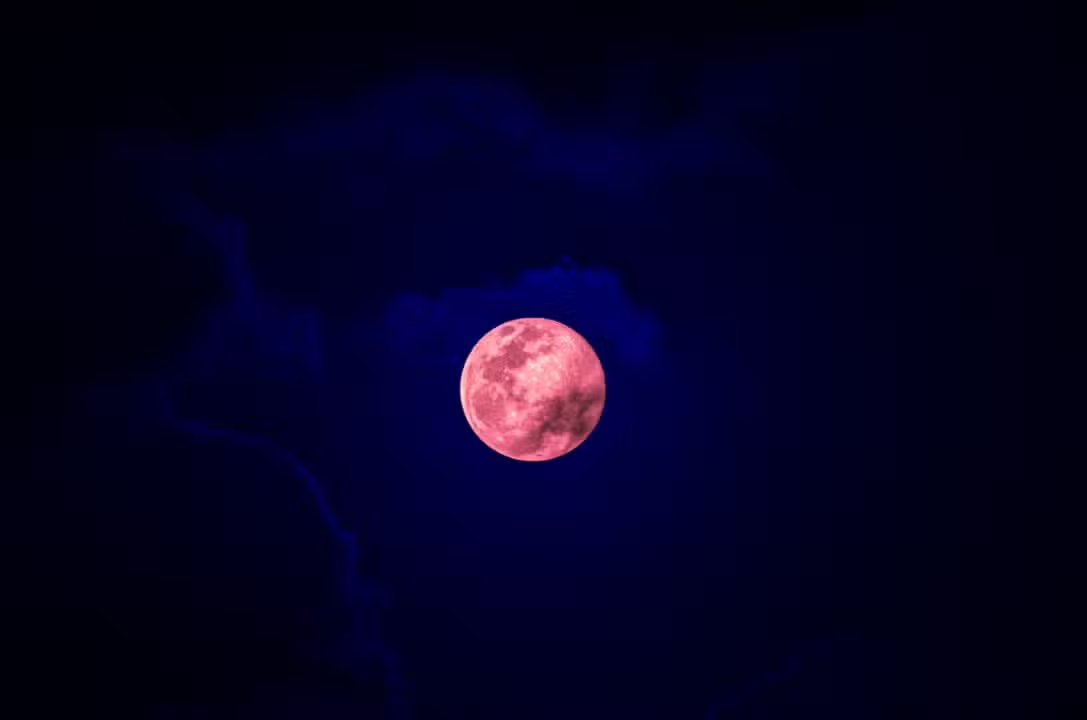
The April full moon appears in the night sky this Thursday, April 2, 2026, and maintains the traditional name of Lua Rosa. The phenomenon occurs at a time when the satellite reaches its complete phase, with the disk fully illuminated by sunlight seen from Terra. Observadores in different regions registers good visibility, especially in areas with clear skies.
Several locations report favorable conditions for contemplating the star. To the east and west of Japão, for example, clear skies allow for a beautiful view of the full moon throughout the night. Transmissões live via weather channels capture the event in real time and make it easier to follow for those who prefer to observe from home or specific points.
- A full moon occurs when Sol, Terra and Lua align so that the satellite is opposite Sol.
- The name Lua Rosa comes from traditions that associate the month with flowers such as mossy phlox, without changing the real color of the star.
- The event helps define dates in agricultural and religious calendars in various cultures.
Origin of the names given to full moons
The native peoples of América created names for full moons based on the seasons and events in nature. The April full moon was named Lua Rosa because it coincided with the flowering of light-toned plants in the spring of Hemisfério Norte. Almanaque of Velho Fazendeiro popularized this term, which refers to mossy phlox or phlox, one of the first flowers of the season.
Other tribes use variations such as Lua of Gelo Quebrando or Lua of Sapo for the same period. Esses names were used to track agricultural cycles and seasonal changes. April’s full moon is not pink in color, but the traditional title remains in use today in publications and calendars.

Connection between the full moon and the date of Páscoa
April’s full moon serves as a reference for calculating Páscoa on the Western Christian calendar. The rule states that Páscoa occurs on the first Sunday after the full moon that follows the vernal equinox. In 2026, this configuration results in the celebration on Sunday, April 5th.
The vernal equinox marks the beginning of spring at Hemisfério Norte and autumn at Hemisfério Sul. The following full moon defines Easter Sunday. Essa tradition combines astronomical observations with the religious calendar and maintains consistency over the years.
Scientific explanation of the full moon phenomenon
The full moon results from the alignment between Sol, Terra and Lua, with the satellite positioned at an ecliptic longitude opposite to that of Sol. Da terrestrial perspective, the difference of 180 degrees makes the entire face of the moon visible. Lua Receive direct solar lighting. Esse cycle repeats every approximately 29.5 days.
Lunar phases arise from variation in the relative position of the three celestial bodies. At new moon, the alignment occurs with Lua between Terra and Sol. At full moon, Terra is between the two. The waxing and waning quarters correspond to angles of 90 and 270 degrees, respectively.
How to observe the April full moon
The best viewing happens just after sunset, when the moon rises over the eastern horizon and appears larger due to the illusory effect. Locais with low light pollution offer ideal conditions to appreciate the detail of the lunar disk. Binóculos or simple telescopes sharpen lunar craters and maria.
Live cameras broadcast by weather portals allow you to follow the event in different time zones. The peak of the full phase occurs at varying times depending on location, but the moon remains visibly full for several nights around the date.
Difference between appearance and traditional name
Many people expect to see the moon with a pinkish tone, but the phenomenon does not change the satellite’s real color. The name derives exclusively from the association with spring flowers in Hemisfério Norte. In regions of Hemisfério Sul, the April full moon coincides with autumn, but the term Lua Rosa remains in global use.
The intense brightness of the full moon can outshine nearby stars in the sky. On clear nights, the contrast allows you to identify constellations even with the presence of the star. Observation contributes to public interest in astronomy and natural cycles.
Agricultural traditions linked to the lunar calendar
Historical farmers used full moons to plan plantings, harvests and seasonal activities. The name Lua Rosa marked the early blooming period and signaled the advance of spring in the north. Outros monthly names followed similar patterns, such as Lua from Grama or Lua from Peixe in some cultures.
These denominations helped communities record time without modern calendars. Alignment with natural events reinforced practical knowledge about seasons and biological cycles. Hoje, interest persists in astronomical almanacs and guides.
Visual aspects and visibility conditions
A full moon lights up the night sky evenly when the sky is clear. In urban areas, light pollution reduces contrast, but the star still stands out. Regiões Rural or coastal areas offer clearer views and allow for higher quality photographs.
Live broadcasts complement direct observation and reach viewers in multiple countries. The April event attracts special attention due to its proximity to religious dates and its striking name. The full moon remains visible for hours, with gradual movement across the sky until dawn.
Astronomical alignment and precise calculation
The exact moment of the full moon is determined by calculations of relative positions between Sol, Terra and Lua. The ecliptic longitude difference of 180 degrees defines the moment of the apex. Pequenas variations occur due to Lua’s elliptical orbit and the inclination of the orbital plane.
This data makes it possible to predict phases in advance on astronomical calendars. Modern precision confirms traditional dates and supports applications in navigation, science and culture. The April 2026 phenomenon follows the expected pattern for the month.
Cultural importance of the full moon over the centuries
Various societies have associated full moons with rituals, festivals, and seasonal milestones. The April moon gained prominence for its connection with the rebirth of nature after the winter in the north. Nomes Alternatives reflect local observations of animals, plants, or weather phenomena.
These traditions enrich human understanding of heaven. The continuity of the name Lua Rosa demonstrates how ancient knowledge remains present in contemporary discussions about astronomy. Simple observation remains accessible to anyone interested.
Technical details about lunar phases
The complete sequence includes new, waxing, full and waning moon. Cada phase lasts about seven days and reflects the visible illuminated portion of the Terra. The full moon represents the maximum point of illumination and contrast in the monthly cycle.
Factors such as the distance Terra-Moon influence the apparent size. Quando closer, the moon may appear slightly larger, a phenomenon known as a supermoon in some cases. In April 2026, conditions follow the average pattern for the year.
Benefits of observation for the public
Contemplation of the full moon stimulates interest in science and the environment. Famílias and groups gather in parks or balconies to enjoy the event. Aplicativos and astronomy websites provide accurate times and location tips.
Live streaming expands reach and allows real-time sharing. The phenomenon reinforces the connection between human beings and celestial cycles. In 2026, April’s full moon offers yet another opportunity for collective observation.