

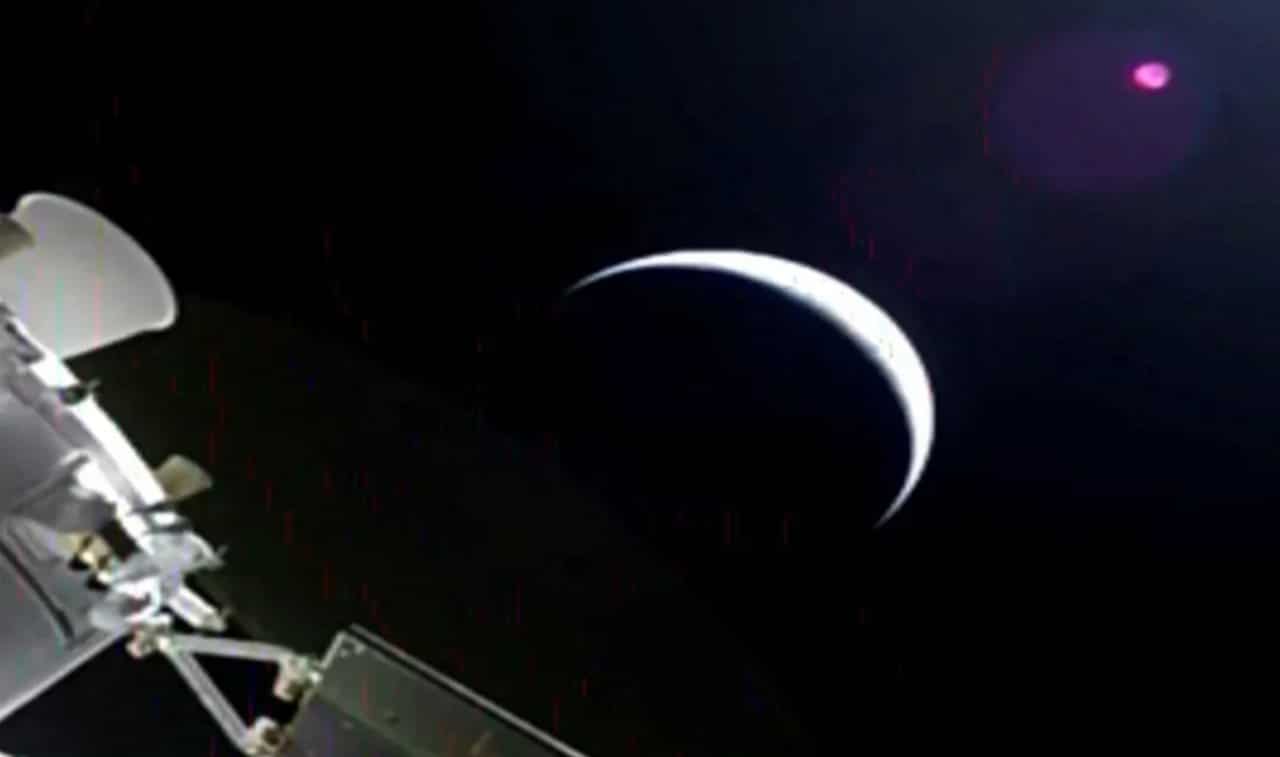
In a remarkable feat for human space exploration, mission Artemis II began its pivotal phase, leaving Terra’s orbit and propelling spacecraft Orion toward Lua. Este advance represents a significant step forward for humanity, propelling four astronauts beyond previously explored limits, in a journey that will take them approximately 7,500 kilometers from the far side of the moon. The Injeção Trans-lunar maneuver (TLI), which lasted about five minutes and fifty seconds, was executed with impeccable precision, as confirmed by NASA’s Dra. Lori Glaze, paving the way for the return of human presence in the vicinity of the natural satellite.
From inside capsule Orion, the crew expressed enthusiasm and confidence. Canadian astronaut Jeremy Hansen, the first non-American to participate in a lunar mission, reported to mission control that they felt “very good up here, on the way to Lua”. Artemis II’s current trajectory is a carefully calculated circular route that will skirt the far side of Lua before directing the capsule back home. Este moment marks the first time since mission Apollo 17 in 1972 that humans have traveled outside low Earth orbit, reviving the spirit of discovery and innovation that powered the space age.
Hansen emphasized the collective impact and dedication behind this endeavor, stating that the crew “strongly felt the power” of those who worked tirelessly on the mission. “Humanity has demonstrated once again what it is capable of,” he said, highlighting that “hopes for the future” are the fuel that drives this journey. The sight of Terra progressively diminishing in the distance, broadcast live from Orion, served as a visual reminder of the magnitude of the distance traveled and the audacity of the undertaking.
The essential translunar injection maneuver
After spending about a day in a high, elongated orbit around Terra, spacecraft Orion underwent rigorous checks on its engines, navigation systems and life support equipment. The team on the ground evaluated each data and each functionality, ensuring that all components were operating within the expected parameters for the next stage of the mission.
Only after final approval of all inspections could the command to burn the engine be initiated. Este was the decisive step in freeing Orion from Earth’s gravity and placing it on the correct trajectory towards its lunar destination.
The service module, positioned at the rear of the crew seats, fired its main engine in a continuous, powerful thrust. Este drive added thousands of kilometers per hour to Orion’s speed, a key boost to reaching Lua.
Translunar fuel injection (TLI) is the driving force that will take the spacecraft on an unprecedented journey. The crew of Artemis II is expected to travel more than 7,600 km beyond Lua, surpassing the record set by Apollo 13 in 1970, before lunar gravity pulls them back to Terra.
Crew perspectives and stunning visuals
The first public video conference with the crew since launch revealed the astronauts’ admiration. Commander Reid Wiseman described the “spectacular view” they had as the spacecraft moved away from the home planet, a visual privilege reserved for few.
Wiseman reported that they were able to “see the entire globe from pole to pole”, an experience that left the four crew members “transfixed” by the beauty and grandeur of the cosmic scenery. Tais moments reinforce the human and emotional dimension of exploration, which transcends mere technological prowess.
Robust security and contingency plans
Despite the magnitude of Injeção Translunar (TLI), this maneuver does not represent a “point of no return” for Orion. Mesmo After the significant increase in speed toward Lua, NASA flight controllers maintain the ability to perform corrective maneuvers.
These maneuvers, analogous to a “handbrake” in space, could redirect the capsule and bring the crew back to Terra if a serious emergency occurs. Essa Flexibility of action is crucial for mission safety and astronaut confidence.
In emergency situations, rapid return is a priority within the first 36 hours after TLI. Depois of this period, it may be as efficient, or even simpler, to maintain the trajectory around Lua and use gravitational assistance to return to Terra, explained Howard Hu, program manager Orion, before launch.
Hu highlighted that the team performed “hundreds of thousands of [simulations]” to ensure the ability to bring the crew home safely in any scenario. Meticulous preparation and exhaustive contingency plans are pillars of NASA’s safety philosophy.
The Artemis program and its objectives
Mission Artemis II is a key step in NASA’s Artemis program, whose primary goal is to establish a sustainable human presence on Lua. The program’s strategy involves a series of increasingly complex missions, paving the way for the exploration of Marte.
The Artemis program distinguishes itself from the Apollo missions by seeking a return not just to visit, but to stay. Este Ambitious plan includes the development of advanced technologies such as Lunar Gateway, a space station in lunar orbit, and new spacesuits optimized for the lunar surface. International collaboration is also a pillar, with partners such as Agência Espacial Europeia (ESA) providing crucial components such as Orion’s service module.
Preparations and tests for future missions
Prior to the launch of Artemis II, the unmanned Artemis I mission was a resounding success, proving the effectiveness of the Space Launch System rocket (SLS) and Orion capsule. Esta test mission validated critical systems and provided valuable data on the spacecraft’s performance in a real space environment. Engineers were able to analyze telemetry, thermal protection and communication capacity.
The results of Artemis I were essential to refine procedures and improve the safety of the manned mission. Cada detail, from Orion’s heat shield to the functionality of the parachutes for Oceano Pacífico’s landing, was evaluated. Artemis I’s experience ensured that Artemis II could proceed with a solid foundation of trust and proven data.
The role of Canadá in lunar exploration
The addition of Canadian astronaut Jeremy Hansen to the Artemis II crew underscores the growing international nature of space exploration. Agência Espacial Canadense (CSA) has been a key partner with NASA in developing technologies for the Artemis program.
Hansen’s participation symbolizes the shared commitment of diverse nations to expanding the frontiers of knowledge and human presence in space. Essa global collaboration is critical to long-term efforts to establish lunar bases and, eventually, missions to Marte sharing technological and scientific costs, risks, and benefits.
Next steps and the future of humanity in space
Following the successful completion of mission Artemis II, NASA and its partners will prepare for Artemis III, which aims to deliver astronauts to the lunar surface, including the first woman and first person of color to set foot on Lua. Esta mission will mark humanity’s return to the lunar surface after more than half a century, with the ambition to explore ice-rich polar regions. The success of Artemis II is therefore an indispensable springboard for these future and even more ambitious endeavors, solidifying the path to a renewed era of space exploration.



