

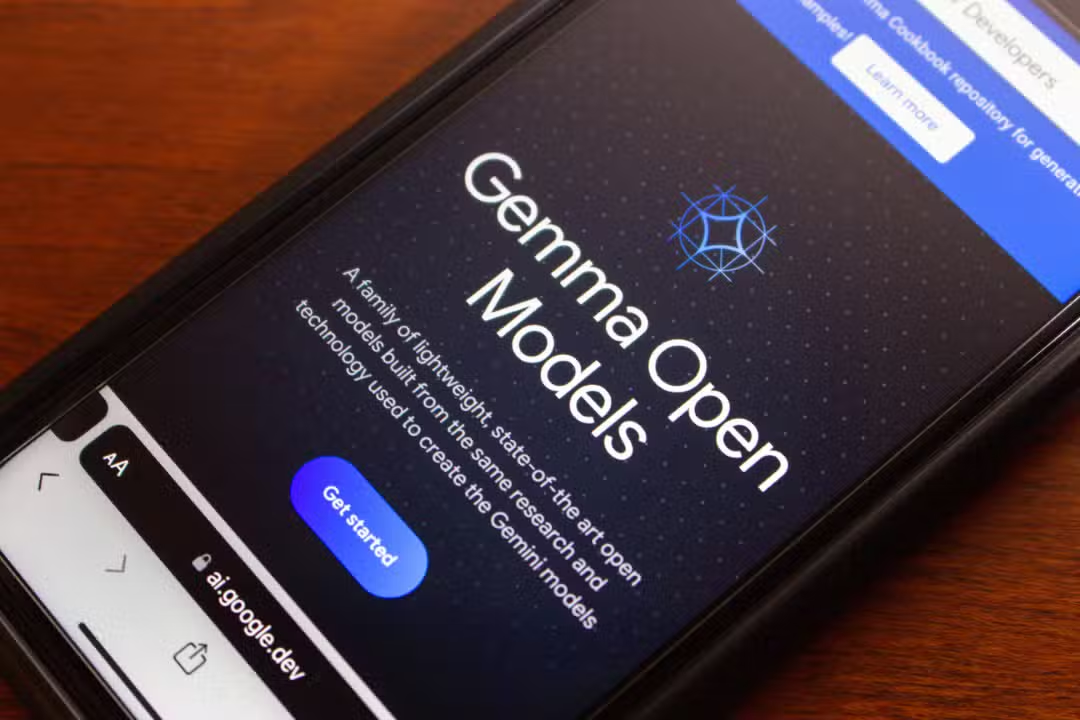
Google officially announced this Friday the launch of Gemma 4, the newest generation of its family of open-weight artificial intelligence models. The central objective of this initiative is to provide developers with advanced tools capable of performing multi-step reasoning and managing highly technically complex tasks across diverse hardware environments. The new architecture was developed to operate efficiently on both powerful laptops and regular smartphones, allowing cutting-edge technology to move beyond large processing centers.
This launch represents a strategic step to consolidate the company’s presence in the free software and decentralized development ecosystem. The Gemma 4 uses the same research bases applied in the Gemini series, but offers the flexibility of Apache 2.0 licensing for broad use. The proposal is to democratize access to systems that previously depended exclusively on the cloud to function satisfactorily on mobile devices.
- The model supports more than 140 different languages on its native processing base.
- The framework allows the execution of so-called agentic workflows for independent actions.
- The system is multimodal, processing images, videos, audio and programming codes simultaneously.
- Four different model sizes were available to suit everything from cell phones to servers.
Open weights architecture increases autonomy for local developers
The decision to keep the weights open allows users to directly download the tool and operate it independently of Google’s infrastructure. Diferente from other proprietary systems, Gemma 4 can be customized for specific corporate or personal data privacy and security needs. Esta feature attracts professionals who seek to reduce latency in responses and ensure applications function even without an active internet connection.
The technology has been optimized to deliver robust performance without the need for constant high-performance computing. By running artificial intelligence functions directly on the device, the developer guarantees an immediate response to the end user’s commands. Tal approach eliminates dependence on paid APIs and complex remote server infrastructures, lowering the cost of innovation for small and medium-sized technology companies.
Evolution in multi-step reasoning and creation of agentic workflows
The great technical difference of Gemma 4 lies in its native ability to perform so-called multi-step reasoning for logical problems. Enquanto Previous models focused on direct and simple responses, this version can decompose complex instructions into sequences of coordinated actions. Isso facilitates the creation of agents that interact with external tools and complete end-to-end tasks with minimal human intervention during the execution process.
The integration of native multimodal resources allows the model to understand and generate varied content in a fluid and integrated way. The system simultaneously processes lines of code, interprets video frames and transcribes speech with high technical precision. Essa Versatility is key to the new wave of productivity apps that require a deep contextual understanding of the user’s environment.

Mobile performance and computing resource efficiency
Google states that efficiency is the central pillar of this new family, allowing smaller models to compete with gigantic systems on the market. Versões compact devices were designed specifically to run on Android devices and other mobile ecosystems without excessively draining the battery. Mathematical optimization ensures that RAM memory consumption is kept within acceptable limits for mass consumer devices.
Despite significant advances, running advanced artificial intelligence locally still requires specific hardware configurations and keen technical knowledge. The market is closely watching how these open models will be regulated to prevent large-scale misuse. Especialistas point out that the ease of access to such powerful tools raises ongoing debates about cybersecurity and digital ethics in software development.
Impact on data privacy and real-time responses without internet
The ability to process sensitive information without sending data to the cloud is one of the most celebrated attractions among the global technical community. The Gemma 4 allows virtual assistants and image editors to perform complex tasks locally, keeping user information protected within the device. Esta functionality is essential for sectors that deal with professional secrecy, such as law and medicine, which require secure automation tools.
In addition to security, the end of dependence on external servers solves the latency problem that often harms the user experience. In locations with unstable connectivity, the device maintains its functional intelligence, ensuring critical workflows are not interrupted. Google projects that this edge artificial intelligence trend will be the standard for the next decade of smart devices and Internet of Coisas.
Linguistic expansion and support for translating complex codes
Support for more than 140 languages makes Gemma 4 a truly global tool for developers across geographies. The ability to understand regional dialects and nuances allows local apps to be much more precise in their interactions. In the programming area, the model demonstrates superior ability to detect errors and suggest structural improvements in various languages.
- Intelligence can convert programming logic between different languages in an automated way.
- The integrated simultaneous translation system takes advantage of the multimodal basis to understand cultural contexts.
- Accessibility tools gain new features with real-time audio and video processing.
- Implementation documentation has been simplified to speed adoption of the technology by new programmers.
Perspectives for the open software ecosystem and collaborative innovation
By making Gemma 4 available under license Apache 2.0, Google encourages a culture of collaborative innovation that benefits the entire technology sector. Pesquisadores Academics and enthusiasts can study the layers of the model to propose improvements and optimizations that feed back to the community. Esse The open development model has proven to be more agile than closed production cycles in large isolated corporations.
The market now awaits the emergence of new applications that explore the potential of independent agents in industrial and educational sectors. Integration with specific hardware tools should generate a new class of smart home devices that don’t rely on large broadband connections. The focus on energy efficiency and local performance sets a new benchmark for competitors operating in the artificial intelligence segment.
Technical challenges and hardware requirements for full implementation
While the promise of running artificial intelligence locally is attractive, practical implementation requires compatible graphics processing units. Usuários of conventional laptops may require specific driver or component updates to extract the full potential of Gemma 4. Google continues to work on technical documentation to make the installation and initial configuration process easier for less experienced users.
The issue of responsible use of open models continues to be a priority issue for developers and international regulatory bodies. Como the software can be freely modified, creating robust security filters becomes a shared responsibility between the company and whoever implements the technology. Balancing creative freedom and protecting against misinformation is the next big challenge for the evolution of this product line.
Integration with the Android ecosystem and new generation devices
Deep integration with the Android operating system promises to transform the way users interact with their phones in the coming years. Funções that were previously processed remotely can now be done instantly in the system interface. Isso includes everything from intelligent file organization to advanced media editing without uploading data to external servers.
Hardware manufacturers are already starting to adapt their new chipsets to optimize the execution of Gemma 4 instructions. The expectation is that the next smartphone launches will bring compatibility seals with high-performance local artificial intelligence. The strengthening of this edge technology cements the role of mobile devices as primary intelligent processing centers in everyday life.
Optimization for enterprise-grade workflows and cybersecurity
Companies looking for internal automation see Gemma 4 as an opportunity to create personalized systems with high security control. By avoiding the exposure of trade secrets in public APIs, companies ensure additional protection against data leaks. The model allows administrative routines to be automated with precision, from document screening to the generation of complex technical reports.
Model training in multi-step reasoning is particularly useful for diagnosing failures in cybersecurity systems. The agent can analyze system logs, identify attack patterns and proactively suggest fixes. Essa deep analytics capability makes Gemma 4 a valuable tool for technology departments that need constant, intelligent surveillance over their digital infrastructures.