

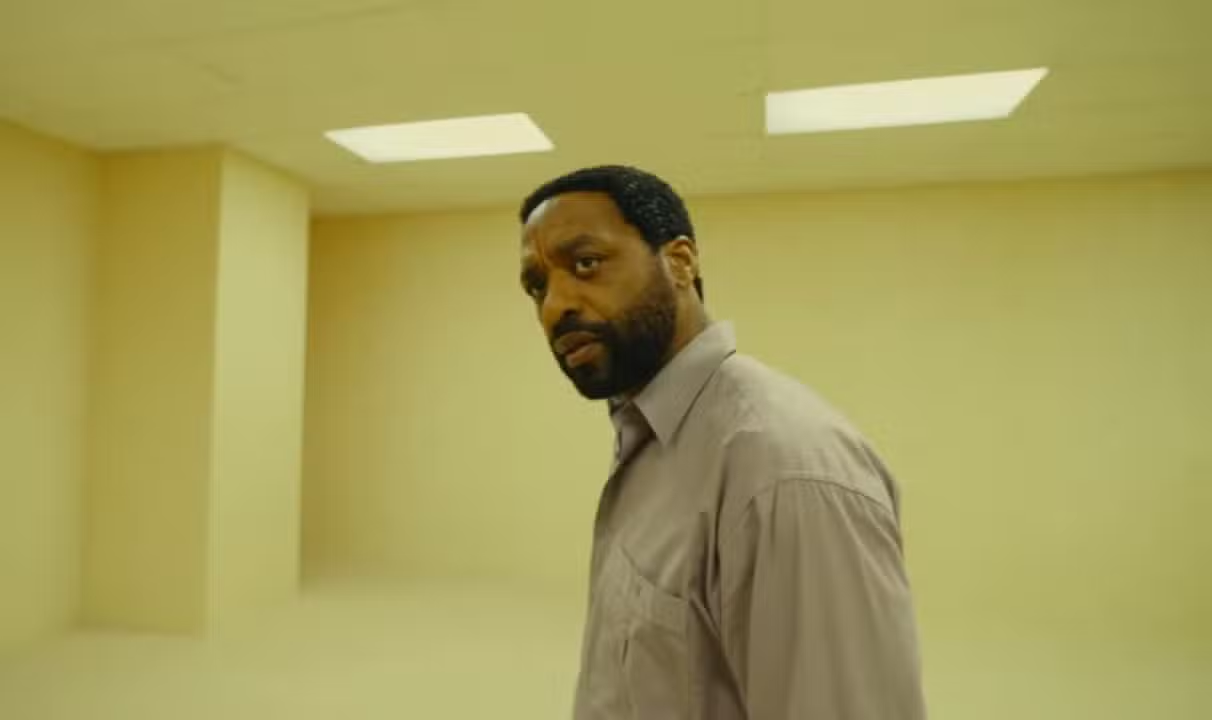
Independent production company A24 has made the first images of its new entry into the horror genre available to the public, based on a far-reaching digital phenomenon. The promotional material presents the film adaptation of a narrative focused on liminal spaces, characterized by empty environments and constant artificial lighting. The work marks the transition of content creator Kane Parsons to directing feature films in Hollywood. The official release in cinemas is scheduled for May 29, 2026.
The plot follows the journey of a man who finds a hidden passage in the basement of a furniture store called Cap’n Clark’s Ottoman Empire. Based on this discovery, the protagonist gathers a specialized team to investigate the spatial anomaly. The group ends up entering a parallel dimension made up of monochromatic corridors that seem to stretch infinitely. The narrative uses the handheld camera technique to record the exploration of the unknown location.
The main cast includes actors recognized in the international film industry. Chiwetel Ejiofor takes on the role of the expedition leader, while Renate Reinsve plays a character who offers a complementary perspective on events. The team of explorers is completed by Mark Duplass, Finn Bennett and Lukita Maxwell. The production relies on dramatic performances to sustain the tension generated by extreme isolation.
Film production details and main cast
The casting choice reflects the studio’s intention to elevate the source material to the level of dense psychological drama. Chiwetel Ejiofor, with his history in highly dramatic roles, guides the narrative through the perspective of an ordinary individual faced with the impossible. The dynamics between the characters become the guiding thread for the exploration of the hostile environment, where the absence of immediate visible threats is replaced by the oppression of the physical space itself and continuous disorientation.
Renate Reinsve adds a layer of complexity to the plot, possibly acting as a rational counterpoint to the search party’s inexplicable discoveries. The interaction between the members of the investigation team serves to anchor the viewer’s experience, transforming the vast emptiness of the scenarios into a maze where the explorers’ mental resistance is tested with each new corridor. The itinerary, signed by Will Soodik, prioritizes the development of interpersonal relationships in the face of the absolute isolation imposed by the architecture of the place.
Visual elements and atmosphere of tension in the published material
The recently released trailer highlights the production’s fidelity to the aesthetics that popularized the original urban legend. The images reveal kilometers of rooms carpeted with yellowish wallpaper, lit exclusively by fluorescent lamps. The photography direction uses tight angles and sudden camera movements to simulate the spatial disorientation faced by the characters.
During the preview, physical anomalies begin to manifest in the seemingly static environment. One of the sequences shows store mannequins that appear to melt or emerge directly from the floor structure, breaking the visual monotony with reality-distorting elements. Esses Visual details are inserted in a punctual manner, avoiding the excessive use of computerized graphic resources in favor of practical effects.
Sound design plays a key role in building the atmosphere of the feature film. The non-stop electric hum of the overhead lights acts as an oppressive soundtrack, filling the silence of the empty rooms. The audio mix emphasizes the explorers’ footsteps on the damp carpet, amplifying the feeling that the group is completely isolated from the outside world.
Origin of the digital phenomenon and expansion of the narrative
The central concept of the work emerged on internet discussion forums in 2019, from the sharing of images that evoked a feeling of uncomfortable familiarity. A specific photograph of an empty office under renovation served as the catalyst for the creation of a vast collaborative mythology. Usuários went on to describe the location as a gap in reality, accessible only through a positioning error in the physical world.
The basic premise established an environment of hundreds of millions of square meters of randomly segmented rooms. The original narrative focused on the smell of mold, monochromatic yellow and the absence of exit, creating a subgenre focused on the fear of the infinite and the unknown. The seminal text warned about the danger of wandering these corridors forever without encountering another human presence.
Over time, the online community expanded the universe by adding different levels, hostile entities, and fictional corporations that attempted to map the dimension. Essa collective construction transformed a simple image into one of the richest unofficial intellectual properties in contemporary digital culture. The transition from this fragmented mythology to a cohesive script required the selection of specific elements to maintain narrative coherence.
The film adaptation chose to focus on the essence of isolation and initial exploration, leaving aside the more fanciful additions created later by the community. The objective is to rescue the pure discomfort generated by the original image, using professional cinematographic resources to materialize the feeling of being trapped in a transitional space that leads nowhere.
Independent director’s journey to commercial cinema
Kane Parsons achieved global notoriety in 2022 when he began publishing a series of animated short films on his internet channel under the pseudonym Kane Pixels. Using 3D modeling software, the young creator simulated old cassette recordings that documented scientific expeditions to the parallel dimension. The videos featured the fictitious foundation Async, responsible for investigating the portal in the 1990s.
The resounding success of independent productions, which have racked up tens of millions of views, has caught the attention of Hollywood studio executives. Aos 20-year-old Parsons was given the opportunity to helm a big-budget project while maintaining creative control over the visual aesthetic he helped popularize. The transition from digital format to the big screen represents a milestone in the way the audiovisual industry recruits new talent.
Involvement of established producers in the project
The feature film was made viable with the structural support of influential figures in the entertainment industry, ensuring that the debutant director’s vision was executed with technical excellence. James Wan, a producer with an extensive CV in successful franchises of the genre, assumed a central role in organizing the project. The partnership between the producer of Wan and A24 created an environment conducive to narrative experimentation, combining expertise in commercial distribution with the appreciation of authorial cinema. The presence of experienced producers secured the necessary funding for the physical recreation of the vast labyrinthine sets, allowing the production design team to build complex modular structures in the studio, reducing reliance on green backgrounds and ensuring a realistic texture to the liminal environments captured by the main camera lens.
Characteristics of the found footage subgenre
The technique of simulating amateur recordings, known in the audiovisual world as found footage, is the aesthetic pillar of the adaptation. The format allows the public to take the direct perspective of the investigators, limiting the field of vision and increasing vulnerability to the unknown. The camera becomes an extension of the characters’ bodies, recording their reactions in real time.
To maintain verisimilitude, the photography team used equipment that emulates the texture and imperfections of old portable cameras. Image grain, compression artifacts and motion blur are intentionally applied to give the work a documentary look. Essa aesthetic approach distances the film from traditional polished productions, bringing it closer to the rawness of the viral videos that originated the project.
Architectural impact on the construction of fear
The terror explored in the work derives directly from the oppressive and purposeless architecture of the scenarios. Espaços Thresholds are transitional places, such as hotel corridors, waiting rooms or empty parking lots, that cause discomfort when devoid of human presence. The film capitalizes on this psychological response, transforming the repetitive geometry and lack of landmarks into silent antagonists that wear down the explorers’ mental stamina.
Audiovisual market expectations for the premiere
The announcement of the release date and the release of the trailer positioned the film as one of the most anticipated titles on the cinematic calendar. Analistas of the exhibition market project a strong performance at the box office, driven both by young audiences familiar with the internet phenomenon and by adult viewers attracted by the production company’s seal of quality. The marketing strategy focuses on maintaining the mystery about the true nature of the dimension.
Exhibitors have already started planning to allocate the film in theaters equipped with high-fidelity sound systems. The intention is to maximize the impact of the immersive audio design, ensuring that the distinctive hum of fluorescent lamps completely envelops the audience. The work has the potential to establish a new standard for adaptations of intellectual properties born in the digital environment.
Expansion of the franchise’s fictional universe and mythology
The narrative structure of the feature film was designed to function as a closed work, but with room for future expansions. The introduction of the furniture store as an entry point establishes that failures can actually occur in everyday locations, expanding the scope of possible incidents. The script suggests that the parallel dimension has its own physical rules that defy conventional scientific understanding.
Some central elements of mythology were organically integrated into the main plot of the investigation:
– Temporal disorientation affects the characters’ perception of the elapsed time.
– The architecture of the place changes subtly when it is not being directly observed.
– Objetos from the real world appear displaced from their original context in the corridors.
The consolidation of this mythology on cinema screens represents the legitimization of a new form of urban folklore. The project demonstrates how collaborative internet narratives can be refined and structured by professional teams, resulting in cultural products with high added value that speak to contemporary fears of isolation and loss of control over the physical environment.