NASA has released new images captured by the crew of mission Artemis II during the lunar flyby on Monday, April 6. Capsule Orion passed about 6,547 kilometers from the lunar surface, allowing astronauts to observe details of the far side of the natural satellite for the first time with human eyes.
The four crew members reached a maximum distance of approximately 406,700 kilometers from Terra, surpassing the record set by Apollo 13 in 1970. Durante seven hours of observation, they worked in shifts to record around 10,000 photographs of the lunar surface and celestial phenomena.
- Images show lunar craters and basins illuminated from unprecedented angles
- Visualization included clouds over Austrália and Oceania on the daytime side of Terra
- Communications with the control center were interrupted for approximately 40 minutes
Flyover reveals details of the hidden side of Lua
Astronauts Reid Wiseman, Victor Glover, Christina Koch, and Jeremy Hansen identified specific features trained by the program’s science team Artemis. Eles observed ancient lava flows, impact craters, and the Bacia of Hertzsprung, which appeared as two concentric rings.
Bacia Orientale, one of the youngest impact craters in Lua, was also seen in full for the first time by human eyes. Dois Small nearby craters were given names suggested by the crew. One of them was named Integrity, in reference to spacecraft Orion, and the other Carroll, in honor of the late wife of commander Reid Wiseman.
After the baptism of crater Carroll, the astronauts embraced each other in a moment of shared emotion. A minute’s silence was observed on Centro, Controle, Missão, and Houston.
For the first time in over 50 years, humans saw the Moon from up-close. 🌕✨ Science is beautiful!
— Canadian Space Agency (@csa_asc)April 7, 2026
More photos here:https://t.co/Lvypcj6CbL pic.twitter.com/79e2HgN75l
Solar eclipse observed from the lunar perspective
During the passage, the crew witnessed a total solar eclipse lasting close to an hour, much longer than that observed in Terra. Lua completely blocked Sol, revealing the solar corona and structures described as streamers or hairs.
The astronauts spotted planets such as Vênus, Marte, and Saturno, as well as stars and the glow reflected by Terra. Lua appeared significantly larger through Orion’s windows compared to the terrestrial view.
Part of Lua remained visible while Sol was occulted, and sunlight gradually reappeared at the end of totality. The crew wore special glasses for eye protection during observation.
Crew records Earthset history
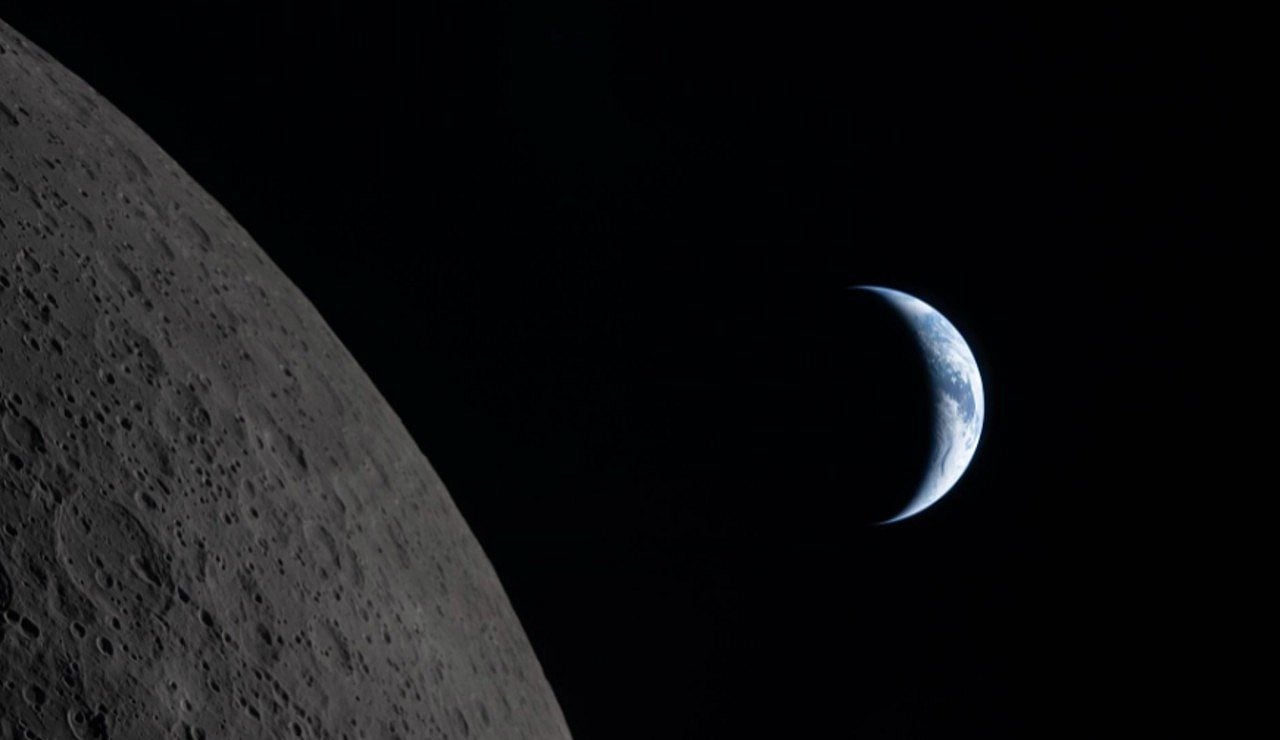
Capsule Orion recorded the moment Terra set behind the lunar horizon at around 6:41 pm Estados Unidos Eastern Time. The image shows clouds over Austrália and Oceania on the illuminated portion of the planet, while the night side remained dark.
Lunar craters with embanked rims and central peaks appeared in the foreground of the photograph. The phenomenon echoes historic images from Apollo, but was captured with updated technology and higher resolution.
Astronauts reported the sensation of being transported to the far side of Lua as they watched Terra disappear over the horizon.
Scientific observations advance preparations for future missions
The team identified the eastern edge of Bacia Polo Sul-Aitken, considered the largest and oldest of Lua. The photographs will help scientists better understand the lunar composition, its origins and geological processes.
Commander Reid Wiseman thanked the ground team for preparing the scientific observation program and providing meaningful moments. Ele highlighted teamwork as a central element of mission success.
Science Officer Kelsey Young expressed gratitude for the crew’s contribution to lunar knowledge and the inspiration brought to the global scientific community.
Images reinforce program objectives Artemis
Photographs captured during the flyby provide valuable data for planning manned missions to the lunar surface. The astronauts trained specifically to identify geological features of scientific interest.
The flyby lasted approximately seven hours and included observations from both the near and far sides of Lua. Cerca 21% of the far side was illuminated from the crew’s perspective during the flyby.
The images will be analyzed to support the development of technologies and strategies for future explorations on the natural satellite.
Mission Artemis II represents an important step in testing the Orion spacecraft in a lunar environment with a human crew. The data collected validates communication, navigation and life support systems over record distances.
The astronauts continue their return to Terra after successfully completing the lunar flyby phase. The photographs released by NASA already generate preliminary analyzes of lunar geology.