
Planet Terra recently reached the point of closest proximity to the trajectory followed by the interstellar object 3I/ATLAS in space. The globe passed at a distance of approximately 54.6 million kilometers from the trail left by the space visitor, who now heads towards deep space.
This orbital approach, precisely recorded in the second half of March, coincides with an unusual increase in the observation of small meteorites. Diversas space agencies and independent research centers have begun to cross-reference atmospheric reentry data with the celestial body’s route.
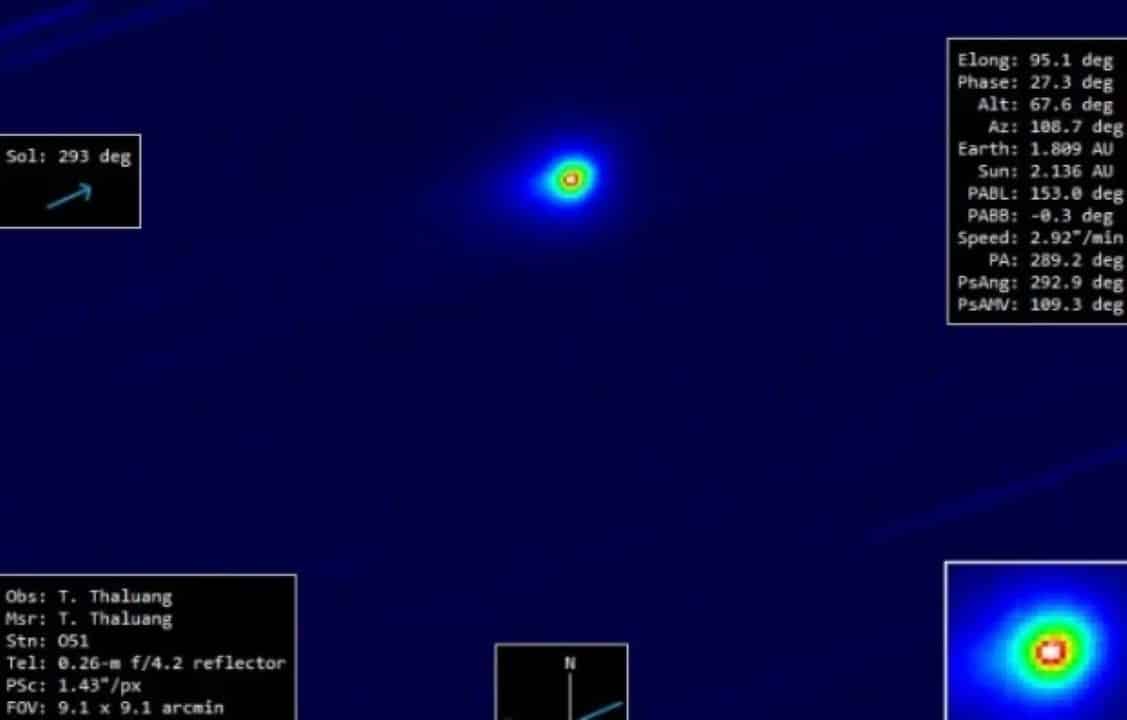
Scientists investigate the direct relationship between these phenomena, noting specific patterns in recent observations that have caught the attention of the academic community:
– Significant growth in luminous events witnessed by the general public in various regions of the planet.
– An average of 142.7 witnesses per event, largely breaking historical records for civil monitoring.
– Focus on the entry trajectory to confirm the interstellar origin of particles and discard space debris.
The field teams’ primary objective at this time is to recover physical fragments for detailed laboratory analysis. Collecting intact samples could provide the first tangible evidence of the chemical composition of stellar systems beyond our cosmic neighborhood.
Investigation into the gas plume and debris ejection
Data collected by the SPHEREx space observatory in August of the previous year revealed that the celestial body had a dense plume of carbon dioxide. Essa cloud extended for thousands of kilometers in the vacuum of space. The presence of this extensive gas formation strongly suggests that solid particles and miscellaneous debris were ejected from the surface of the object. Cálculos Astronomical scientists indicate that the thermal agitation of gas molecules could provide the force necessary to detach these fragments. If this ejection occurred approximately a decade ago, the particles would have had the exact time needed to intercept Terra’s orbit at this time. Essa Orbital dynamics explains in detail how material from a distant star system can reach our planet.
The speed required for a fragment to travel the distance between the trail left and Terra is considered relatively low. Esse specific scenario makes it physically feasible that interstellar debris is colliding with the Earth’s atmosphere during this period of closest approach. Pesquisadores point out that fluid dynamics and solar radiation pressure play fundamental roles in driving these small particles. Continuous monitoring of this interaction provides unprecedented data on the behavior of foreign matter in the solar system. The scientific community remains attentive to variations in the density of this particle cloud over the weeks. Equipamentos high-precision technology continues to scan the night sky for light anomalies.
Estimates of particle mass and dispersion in space
Detailed studies of the mass of the celestial body estimate that its main structure contains approximately one billion metric tons. Esse colossal volume of matter provides a vast source for generating smaller fragments during your journey. Mesmo A tiny fraction of this total mass is enough to create a dense trail of debris.
If a small portion of this material fragmented into particles just one centimeter long, trillions of pieces could be dispersed throughout the vacuum. Modelos statistical probability indicates that up to 34,000 of these specific particles may have entered Earth’s atmosphere recently. Essa Massive entry results in the small fireballs that have become visible to the naked eye on different continents.
The visual spectacle reported by thousands of people is a direct consequence of this wide cosmic dispersion. Observatórios around the world are intersecting the entry points of these meteors with the projected path of the interstellar trail. Esse Rigorous mapping is crucial to validating mathematical particle dispersion models developed by space agencies.
Analysis of recent energetic explosions in the atmosphere
Recent events of high visual impact, such as the explosions recorded over Houston and Lago Erie, have undergone rigorous kinetic energy analysis. On March 21, a one-ton meteoroid exploded over the territory of Texas with a force equivalent to 26 tons of TNT.
Just days earlier, on March 17, a seven-ton space rock generated a sonic boom picked up by regional sensors at Ohio. Essas Specific occurrences mobilized defense and space monitoring agencies to determine their exact origins and potential risks.
Differentiation between local rocks and distant visitors
Experts say these massive explosions are too energetic to be directly linked to the interstellar visitor. The object does not have enough mass to release so many fragments larger than one meter in diameter simultaneously.
Therefore, although the increase in small meteors is a strong candidate for interstellar origin, the large fireballs likely originate from the local asteroid belt. Essa Technical distinction is essential to direct current scientific research accurately and avoid false correlations.
Technical reports and public surveillance engagement
Recently published technical reports confirm that the volume of small, bright meteors has undergone an impressive quantitative jump. The data shows a clear deviation from the historical average expected for this specific period of the year.
Almost half of all events recorded in March had direct observation of at least 50 people per event. Esse high level of public engagement reflects the actual frequency with which these objects are penetrating the upper layers of the atmosphere.
Systematic analysis of the direction and speed of these meteoroids will allow the separation of ordinary space debris from possible interstellar fragments. Plataformas of citizen science have been essential in collecting these visual reports widespread throughout the territorial extension.
If the chemical composition of a recovered meteorite matches the 3I/ATLAS spectral signatures, science will have its first physical sample of a distant star system. Field work now focuses on collecting samples in areas mapped by high-sensitivity meteorological radars.
Importance of collecting physical samples in the soil
Search teams were quickly mobilized in regions where trajectories indicated the possible survival of fragments during atmospheric reentry. The identification of isotopes not found in Earth rocks or common solar system meteorites would be definitive proof of the connection to the interstellar visitor, marking the beginning of a new era in space exploration and cosmic mineralogy.
Continuous monitoring and processing of orbital trajectories
The trajectory of the celestial body has been constantly monitored since its original detection, serving as a fundamental basis for current impact calculations. Moving the object beyond five times the distance between Terra and Sol does not prevent its wake from continuing to influence the nearby space environment. Monitoring remains highly active, since the window of closest proximity to the interstellar path can generate new atmospheric events. Integrating data from civil and military satellites is absolutely essential to accurately triangulate entry points. Essa technology allows refining mathematical models of large-scale debris dispersion. Embora Most ten-gram particles disintegrate completely upon re-entry, larger fragments can leave metallic residue in desert areas. The location of these materials by specialized teams directly depends on the agility in processing the fall coordinates. Science awaits the final processing of velocity trajectories to confirm whether the solar system is being bombarded by external cosmic dust. Essa confirmation would drastically change the understanding of how matter is exchanged between different stars in the galaxy. Observatórios continue to collect data uninterruptedly to validate whether temporal coincidence is a cause and effect relationship proven by orbital physics.
