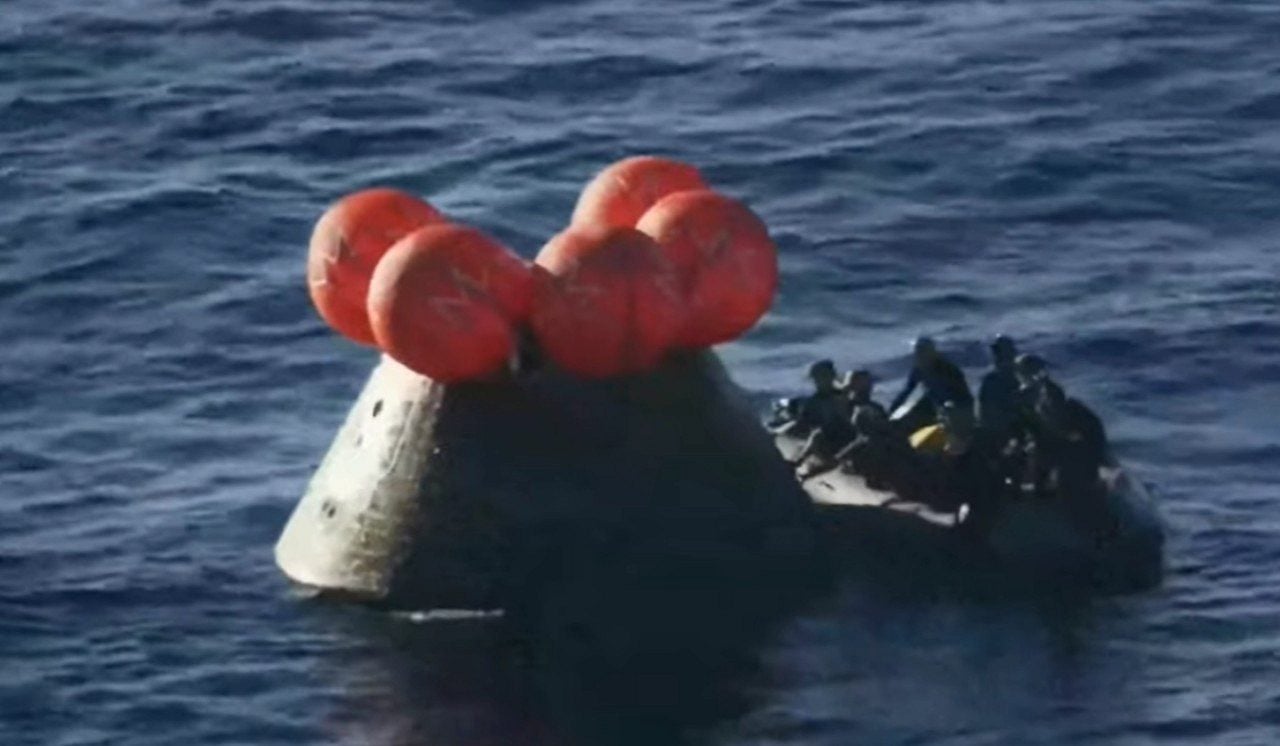
The historic journey of Nasa that marked humanity’s return to lunar orbit was successfully completed on Friday night (10). The four astronauts aboard capsule Orion returned to the planet in a controlled landing at Oceano Pacífico, which occurred at 6:07 pm local time on San Diego (9:07 pm local time on Brasília). The completion of the expedition represents a fundamental milestone for the Estados Unidos deep space exploration program.
The return involved a complex logistical operation to guarantee the physical integrity of the crew after ten days of confinement and exposure to microgravity. Equipes from the space agency and Marinha took about an hour to extract Reid Wiseman, Victor Glover, Christina Koch and Jeremy Hansen from the interior of the vehicle. According to the first medical bulletins released by the agency, the health status of all professionals is considered stable and positive.
Thermal challenges and speed of atmospheric reentry
The re-entry phase into the Earth’s atmosphere was classified by flight engineers as the most critical and dangerous section of the entire schedule. Capsule Orion reached the upper layers of the air at a speed of more than 38,400 km/h, which is equivalent to more than 30 times the speed of sound. Esse displacement generated an accumulation of plasma and extreme heat, causing the external temperature of the protective shield to reach 2,760º C.
During the descent process, communication between the control center and the spacecraft was interrupted for a period of six minutes, as expected due to signal blocking caused by the plasma. The capsule’s internal systems were configured to withstand forces of nearly four Gs on the astronauts’ chests. The success of the heat shield at this stage was vital, especially after the partial failures observed on unmanned mission Artemis 1.
Rescue logistics and immediate medical protocols
- The recovery ship USS John P. Murtha served as the main base for hosting the crew.
- Helicopters from Marinha airlifted the astronauts from the capsule directly to the deck of the aircraft carrier.
- The landing board confirmed that extraction was completed within the two-hour window following water impact.
- A preliminary medical assessment was carried out at sea before the final deployment to Centro Espacial Johnson.
The recovery procedures were meticulously trained by the ground teams to avoid any unforeseen events during the floating of Orion. The astronauts received specific instructions for ingesting liquids and electrolytes moments before the impact, aiming to minimize the effects of the sudden return to Earth’s gravity. Além Additionally, the transition diet included specific requests from the crew, such as sealed sandwiches, delivered shortly after rescue.

Space records and scientific data collection
Expedition Artemis 2 not only validated the life support systems of the new generation of spacecraft, but also established new parameters for manned flight. The crew reached the greatest distance ever traveled by human beings in space, surpassing marks established in the Durante era. Durante the trajectory, the astronauts had the unprecedented opportunity to observe and photograph the hidden side of Lua in high resolution.
Data collected by Orion’s internal sensors and direct observations from mission specialists Christina Koch and Jeremy Hansen will be analyzed extensively in the coming months. Essas information is crucial for improving spacesuits and navigation systems that will be used in future landings on the lunar surface. The agency seeks to ensure that prolonged exposure to radiation and weightlessness is mitigated on longer duration missions.
Technical preparation for the next lunar stages
The success of this stage paves the way for mission Artemis 3, which is scheduled to launch in 2027. The next objective will be to improve docking maneuvers in lunar orbit before the definitive return of man to the ground of the natural satellite. The expectation of the scientific community is that the first human landing of this new era will occur during Artemis 4, planned for 2028.
During the nine-day mission, the crew carried out several trajectory correction maneuvers and propulsion tests. Mesmo with sensor alerts that indicated inconsistencies in oxidizer pressurization data, mission control at Houston confirmed full systems integrity. Commander Reid Wiseman reported that Orion behaved like a robust machine throughout the journey back.
Orbital mission completion procedures
The separation between the command module and the service module occurred punctually according to the established technical schedule. Este disposal was necessary so that only the manned capsule, protected by the heat shield, faced atmospheric friction. Após the initial deceleration, a set of nine parachutes were deployed sequentially to reduce the speed of fall until smooth contact with the ocean surface.
After stabilization in the water, divers from Marinha ensured that the capsule did not suffer dangerous tilts before opening the floodgates. The agency administrator highlighted that strict adherence to schedules and protocols demonstrates the technological maturity of the space program. The wreckage and discarded components were monitored in an exclusion zone to ensure the safety of civilian vessels in the region of San Diego.
Monitoring the effects of microgravity on astronauts
The four professionals will undergo a period of light quarantine and constant physiological monitoring over the next few weeks. The transition from weightlessness to full gravity can cause dizziness, loss of bone density, and changes in vision, which need to be treated immediately. Especialistas in space medicine will monitor the motor readjustment process of Victor Glover and the other team members.
This phase of studies is essential for planning the stay of humans in permanent lunar bases in the future. The analysis of the behavior of the human body after traveling thousands of kilometers in the vacuum of space will provide information for the safety of even longer trips, such as those planned for Marte. The space program reaffirms its position at the forefront of technology by completing this stage without serious incidents.
