

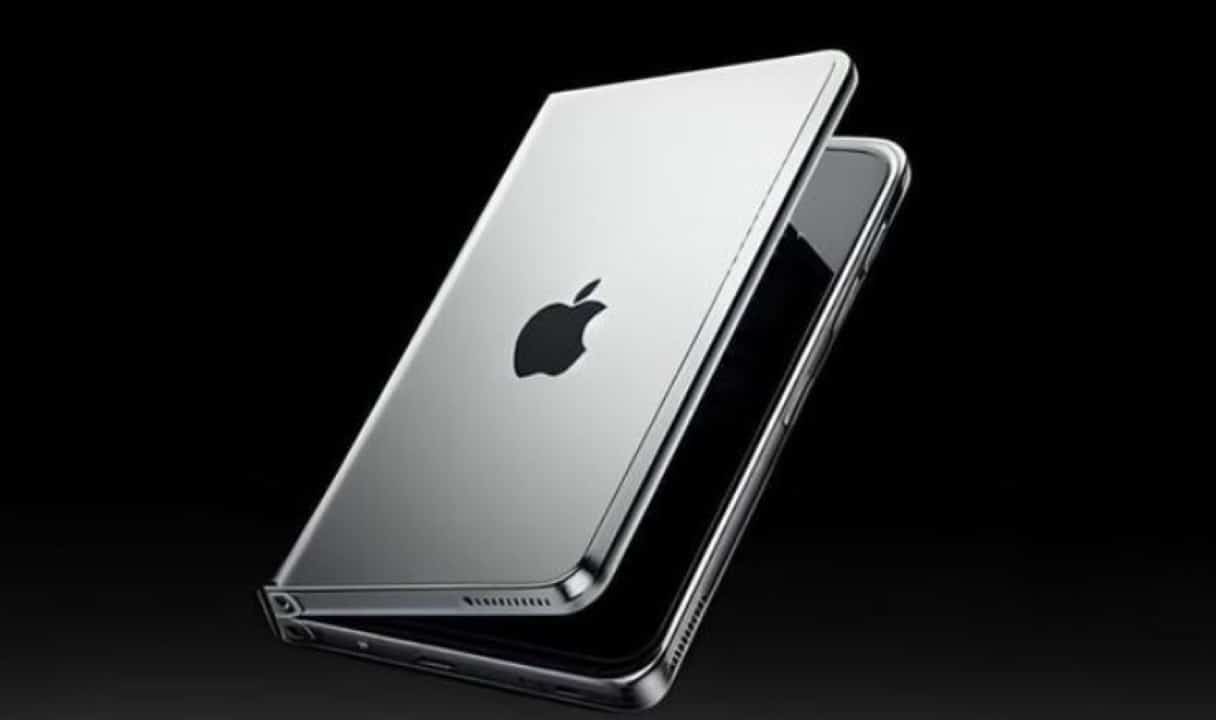
A render released by Jon Prosser shows the possible iPhone Ultra, the first foldable smartphone from Apple. The video published on the fpt channel. highlights the device’s discreet crease, reduced thickness and other design details. The launch is expected to take place alongside the iPhone 18 Pro line.
The YouTuber presented images that depict the device in book format. Quando closed, it measures about 9.5 mm thick. Aberto, the thickness drops to approximately 4.5 mm. Essas measurements place the model as a slim option in the foldable segment.
Barely noticeable crease on foldable display
The hinge uses liquid metal with 3D printed parts. Essa choice helps reduce the crease depth to about 0.15 mm. Para comparison, current competitor models have a larger crease.
The render suggests that Apple applied a metal plate under the display to distribute the bending pressure. The result appears as a more uniform surface when the device is open. The internal screen is 7.8 inches, a size close to that of a small tablet.
The external screen measures 5.5 inches. Ela allows basic use of the device without opening the device. The renders show the iPhone Ultra with a finish reminiscent of the brand’s other premium models.
Thickness and internal space management
The design prioritizes volume reduction. The thickness of 9.5 mm closed slightly surpasses the iPhone 17 Pro Max, which is 8.75 mm. Já the open measurement of 4.5 mm is below the iPhone Air thickness of 5.6 mm.
This balance of dimensions makes room for larger components. The drums are one of the highlights. Ela should reach 5,800 mAh with high-density cells. The value represents the highest ever seen on an iPhone to date.
Internal management allows you to accommodate the larger screen without excessively compromising portability. Ainda Therefore, the device maintains proportions that make it easy to carry in your pocket.
- 5.5-inch external screen
- 7.8-inch internal screen
- Closed thickness 9.5 mm
- Open thickness 4.5 mm
- Battery of around 5,800 mAh

Absence of ID Face and return of ID Touch
The engineering of the Face ID does not adapt to the current foldable form factor. Therefore, the render indicates the return of ID Touch. The sensor is integrated into the side button.
This solution simplifies interior space and maintains fingerprint security. The button is positioned accessible both with the device open and closed.
The render also shows variations in the front camera. One version includes a camera under the screen on the inside. Outra option maintains a discreet hole in the upper left corner.
Camera suite and performance specs
The rear system has two 48 megapixel lenses: a wide-angle and an ultra-angle. The render does not include a telephoto sensor.
The front camera appears under the screen in one of the tested configurations. Essa choice seeks to keep the surface clean, but still generates discussions about image quality.
The processor must be the A20 chip Pro. RAM memory reaches 12 GB. The connectivity modem is proprietary C2 model Apple.
These components follow the standard expected for a high-profile launch in 2026. The device runs the latest version of iOS adapted for the foldable format.
Launch and market positioning
The video from Prosser reinforces the expectation that the iPhone Ultra will hit the market in September 2026. The date coincides with the announcement of the iPhone 18 line Pro.
The name Ultra suggests premium positioning within the Apple catalog. The device represents the company’s entry into the foldable smartphone segment, dominated until now by manufacturers such as Samsung.
The renders help visualize the final set, although the product is still in the development phase. Detalhes as exact pricing and configurations remain without official confirmation.
Apple tends to keep quiet about future products. Informações leaked by channels such as Jon Prosser serve as a basis for public expectations until the launch event.
The current engineering focus appears to be on hinge durability and the flat-screen experience. Esses Advances can differentiate the model from options already available on the market.
(Long paragraph for deeper context: Developing a foldable iPhone involves specific technical challenges. Integrating components into a flexible body requires new materials and manufacturing processes. The choice for the liquid metal hinge seeks to increase resistance over time. At the same time, crease reduction improves immersion in videos, games and reading. The larger battery compensates for the consumption of the large screen. However, concessions such as changing Face ID to Touch ID show the current limits of the technology. Analistas accompany these details because they indicate the level of maturity that Apple wants to reach before putting the product in stores.)
What changes with the foldable design
The book format allows you to use the device in two main ways. Fechado, it works like a traditional smartphone. Aberto, the large screen favors multitasking and content consumption.
This flexibility may attract users looking for a versatile device. The render shows smooth transitions between modes.
The absence of a telephoto sensor simplifies the rear camera module. The two 48 megapixel lenses cover the most common photography uses.
The return of the Touch ID on the side button represents a practical adaptation. Ele maintains biometric authentication without requiring additional space for the TrueDepth system.
Renders do not reveal all final colors or materials. Eles focus on the structural and functional aspects that define the concept.
Apple must continue internal testing until the commercial version is defined. Qualquer Change may still occur before the official announcement.