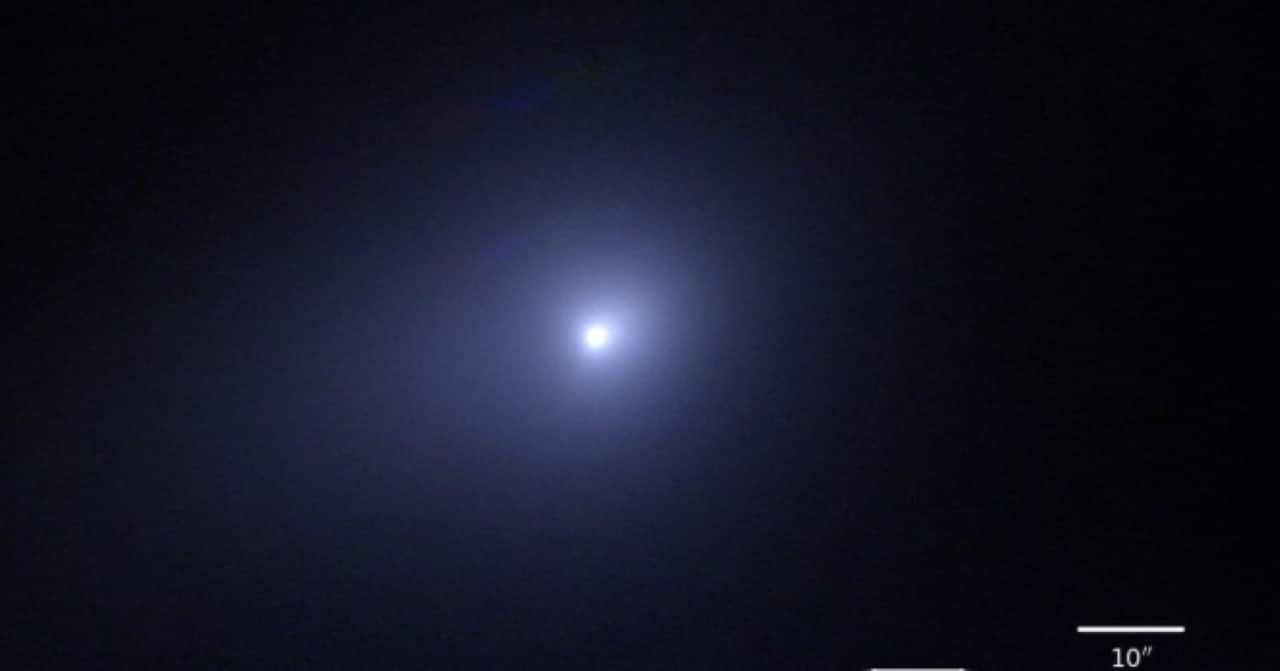
Telescópio Subaru recorded images and data of the interstellar comet 3I/ATLAS in December 2025 and January 2026. Observations indicate that the ratio of carbon dioxide to water in the gas cloud around the object varied after the closest pass by Sol. The comet, originating from outside the solar system, was the third interstellar object confirmed to date.
The research team used Telescópio Subaru’s FOCAS spectrograph and imager to capture images in the V, R, and I bands on December 13, 2025, at the time of Havaí. The combined images show the comet’s tail clearly. On January 7, 2026, Espectrógrafo of Alta Dispersão recorded the emission of gases when the object was 2.87 astronomical units away from Sol. Nessa phase, the comet was already moving away after perihelion on October 29, 2025, at 1.35 astronomical unit.
Images captured by Telescópio Subaru
The FOCAS equipment produced colored compositions from the observed bands. The V band, with a central wavelength at 550 nanometers, was assigned the color blue. The R band, at 660 nanometers, was colored green. Band I, at 805 nanometers, appeared in red. The result reveals structures in the comet’s coma and tail at different wavelengths. Essas images were obtained in the morning twilight and allowed analysis even with a short exposure time.
The observations took place at a time when the comet was visible to a limited extent due to its position in the sky. The object was about 270 million kilometers from Terra around December 2025. The record helped document cometary activity after warming near Sol.

Analysis of the ratio between carbon dioxide and water
The team estimated the CO₂/H₂O ratio at values between approximately 0.3 and 2.1 based on data from Subaru. Previous Observações images performed with infrared space telescopes indicated higher carbon dioxide concentrations before perihelion. The difference suggests that the composition of the gas released by the comet did not remain constant.
Carbon dioxide sublimates at lower temperatures than water. Therefore, the proportion between these components serves as an indicator of the comet’s formation environment and the changes during its passage through the solar system. In the case of 3I/ATLAS, post-perihelion values are lower than those recorded in previous phases.
- Observations focused on the main gases that drive cometary activity
- The CO₂/H₂O ratio helps distinguish materials on the surface and inside the core
- Solar heating changes the area of gas release along the trajectory
- Data from Subaru were compared with measurements from other instruments
This variation may occur because the comet first releases more volatile materials from the outer layer. As the object approaches Sol, deeper layers begin to contribute to the coma. The process reveals differences in the internal structure of the interstellar comet.
Context of interstellar objects
Comet 3I/ATLAS was discovered on July 1, 2025 by the ATLAS system no. Chile. Ele follows a hyperbolic trajectory, which confirms its origin outside the solar system. Até At the moment, only three interstellar objects have been identified: 1I/’Oumuamua, 2I/Borisov and 3I/ATLAS.
These celestial bodies function as direct samples of material formed in other stellar systems. Eles travel through interstellar space and occasionally enter the solar system. The study of its composition makes it possible to compare the formation processes of planetesimals and planets in different stellar environments.
3I/ATLAS achieved closest approach to Terra on December 19, 2025, at about 1.8 astronomical units. Após perihelion, the object continues its path out of the solar system. Ground and space observations continue to provide data on its activity even as it drifts away.
Contribution of research to the understanding of comets
The team led by Yoshiharu Shinnaka of Universidade Kyoto Sangyo applied methods developed for solar system comets to the interstellar object. The approach allowed us to analyze 3I/ATLAS from the same perspective used in local comets. The results highlight similarities and differences in composition and evolution.
Future observations with new research telescopes should increase the number of interstellar objects detected. Cada new case offers opportunity to expand knowledge about the diversity of materials in stellar systems. The work with Telescópio Subaru represents a step in this systematic comparison.
The data obtained reinforces the importance of monitoring changes in cometary activity throughout the orbit. Eles contribute to models on how small celestial bodies form and change under different conditions. Comet 3I/ATLAS continues to provide valuable information even after its closest pass by Sol.
