

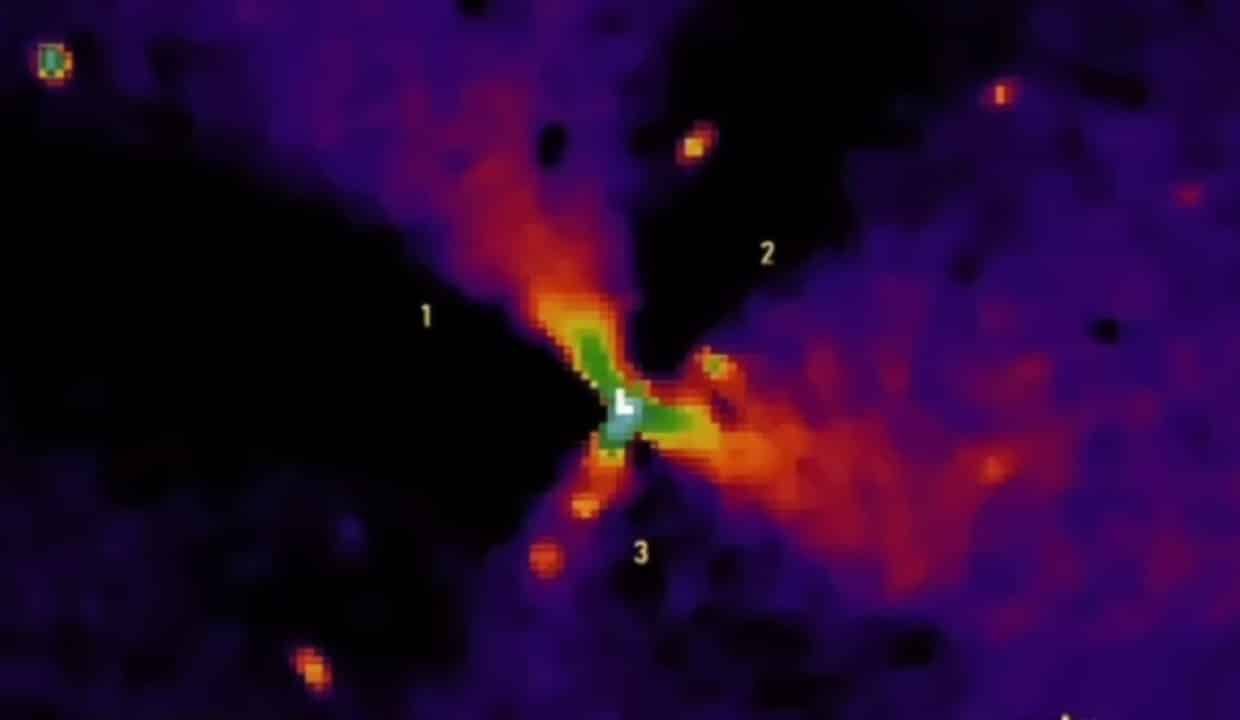
Novas NASA analyzes of comet 3I/Atlas deepen the scientific community’s understanding of this rare visitor from outside Sistema Solar. The latest data, released by space agency researchers, offers detailed insight into the composition, orbit and likely origin of this intriguing celestial body. The research is an important step towards deciphering the mysteries of interstellar objects, which carry valuable information from other star systems. Recent discoveries help to draw a clearer profile of 3I/Atlas, differentiating it from other already known comets.
The study indicates that 3I/Atlas, discovered in 2019, has distinct characteristics that reinforce its extrasolar nature. Its trajectory and unusual chemical composition suggest it did not form in the protoplanetary cloud that gave rise to our own Sol and its planets. Scientists are using this data to create more accurate models of the formation and evolution of stellar systems beyond our own, enriching the field of astrophysics. Essa investigation represents a significant advance in the quest to understand the diversity of the cosmos and the presence of materials from other stars in our cosmic neighborhood.
Novos data reveals unique composition of 3I/Atlas

The new NASA data provides a clearer picture of the composition of comet 3I/Atlas, highlighting elements and isotopes that differentiate it from native Sistema Solar comets. Spectral analysis revealed the presence of complex organic molecules in unusual proportions, suggesting a distinct star formation environment. Essa’s discovery is crucial, as the chemical “fingerprint” of comets is a direct indicator of the conditions in which they were born. Researchers believe these molecular patterns could be traces of gas and dust clouds around other stars. The identification of these exotic chemical components further validates the hypothesis that 3I/Atlas traveled long distances, traversing interstellar space for millennia before arriving here. Scientists continue to decipher the complexity of this data, searching for elements that could indicate the age or type of the comet’s parent star.
The orbit of 3I/Atlas is also a key point for its classification. With a pronounced hyperbolic trajectory, the comet demonstrates that it is not gravitationally linked to our Sol, confirming its nature as a visitor. Esse type of orbit is irrefutable evidence that the object came from outside and is just passing through our system. Continuous monitoring of its trajectory allowed astronomers to calculate its speed and direction with great precision, helping to project its exit route.
Cosmic Trajetória points origin outside of Sistema Solar
The trajectory of comet 3I/Atlas, which moves at a speed greater than that necessary to remain attached to solar gravity, is the main proof of its interstellar origin. Ele follows an open path that will take it away from Sistema Solar, unlike the periodic comets that orbit Sol. Essa’s orbital feature leaves no doubt about its provenance from another star system, making it a valuable study object to compare with the other famous interstellar visitor, Oumuamua. Scientists are using computer simulations to try to retrace the comet’s path and, perhaps, identify the stellar region from where it may have been ejected.
Features that confirm the interstellar origin of 3I/Atlas include:
- Órbita hyperbolic:Não is gravitationally bound to Sol.
- Excessive Velocidade:Mais faster than objects orbiting our system.
- Composição unusual chemistry:Moléculas organic with atypical proportions.
- Ausência periodicity:Não returns to Sistema Solar on a regular basis.
- Single pass Trajetória:Sem evidence of previous interactions.
Studying visitors like 3I/Atlas offers crucial clues about the processes that shape planetary systems across the galaxy. By examining raw material from other systems, astronomers can better understand cosmic diversity.
NASA observation Técnicas improves tracking
Para To obtain this detailed data, NASA used a combination of advanced ground- and space-based telescopes, employing cutting-edge observation techniques. Telescópio Espacial Hubble, for example, was instrumental in capturing high-resolution images of the comet’s nucleus and its coma, allowing spectral analysis. Além Additionally, telescopes such as the W. M. Keck Observatory on Havaí and the Very Large Telescope (VLT) on Chile contributed long-term observations, tracking the trajectory and physical changes of the 3I/Atlas. Integrating data from different instruments and observatories is essential to build a complete and accurate image of such distant and dynamic objects. Essa’s multifaceted approach allowed scientists to overcome the challenges of observing a small, fast-moving object against the vast backdrop of space, ensuring the collection of crucial information for research.
The methodology used involved the analysis of brightness, light spectrum and behavior of the comet’s tail, which are indicators of its activity and composition. Observing its volatilization and the release of gases and dust helped determine the presence of different chemical elements. The ability to discern these nuances in an object traveling at millions of kilometers per hour is a testament to the sophistication of today’s astronomical technology.
Impacto of Discoveries in Global Planetary Science
The revelations about comet 3I/Atlas have a significant impact on planetary science, expanding our knowledge about the formation of other star systems and the distribution of matter in the universe. By studying these objects, scientists can infer the conditions prevailing in other stellar nurseries, comparing them with those in our own Sistema Solar. The presence of complex organic molecules, for example, can offer insights into the origin of life elsewhere in the cosmos, given the importance of these compounds for terrestrial biology. Essas discoveries open new frontiers for astrobiology and the search for extraterrestrial life, as well as deepening understanding of planetary building blocks. Continued research into interstellar objects is critical to answering some of the biggest questions in contemporary astronomy and cosmology.
3I/Atlas, together with Oumuamua, serves as a window into the distant universe, offering samples of material we could never obtain otherwise. The opportunity to study these messengers from other suns is rare and invaluable, driving new theories and scientific models. NASA’s Terra near-object monitoring program remains vigilant, searching for more of these cosmic travelers who could reveal secrets from other galaxies.