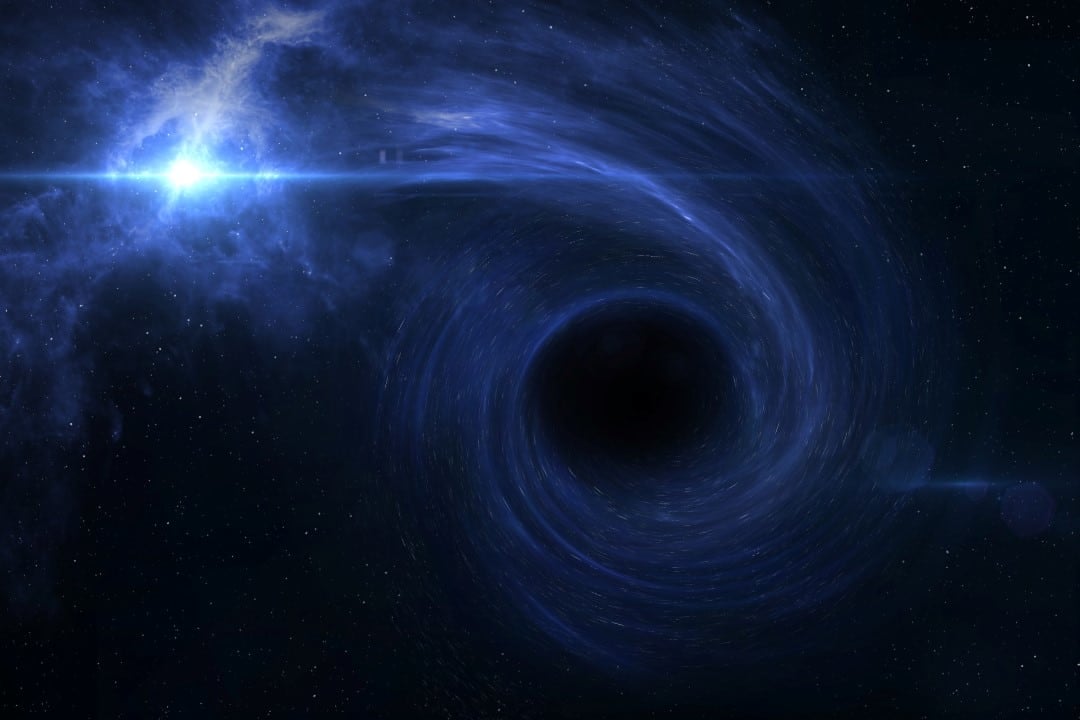
The international scientific community is abuzz with a bold new theory about dark matter, one of the greatest mysteries in the universe. Pesquisadores suggest that this invisible and undetectable substance may be composed of primordial black holes, remnants of a universe before ours. Essa radical proposal challenges established cosmological models, opening new avenues for understanding the fundamental structure of the cosmos.
The idea arises from the growing complexity of identifying dark matter using conventional methods, driving the search for alternative explanations that fill this observational gap. If confirmed, the hypothesis not only rewrites much of what is known about the formation of the universe, but also the nature of gravity on cosmic scales. Ela suggests a continuity between different cosmic cycles, adding deep layers to our understanding of existence. The discussion promises to intensely move debates in astrophysics and global cosmology, instigating new lines of research and experiments.
Origem of Buracos Negros Relíquias
The essence of the theory lies in the conception that, before Big Bang — the event that gave rise to our universe —, another cosmos already existed and had come to its end. Esse previous universe, when collapsing under its own gravity in a process of cosmic implosion, would have left behind a vast array of black holes of varying masses, acting as cosmic “seeds”. Tais objects, known as primordial or relic black holes, would be the majority components of the dark matter that permeates the universe today, explaining its ubiquity and elusive nature. Dark matter, in turn, has never been directly observed by any instrument, a fact that has intrigued scientists for decades. Ela does not interact with light or other forms of electromagnetic radiation. Sua’s presence is inferred only from the gravitational effects it exerts on visible matter in galaxies and clusters. The widely accepted standard cosmological model postulates that dark matter is composed of exotic particles, such as WIMPs (Partículas Massivas or Interagem Fracamente). However, despite decades of intense experiments in underground laboratories and observatories, no concrete evidence of these particles has been found to date, creating a significant impasse in fundamental physics.
The new theory therefore offers an elegant explanation for the persistent lack of detection of these hypothetical particles, as it argues that dark matter is not a new, as-yet-undiscovered form of subatomic particle. Pelo otherwise, it would be composed of a form of matter already known and relatively well understood: black holes. But these black holes would have very different characteristics from stellar black holes, which form from the collapse of massive stars. Relic black holes would be much smaller, some with masses equivalent to an asteroid or even a mountain, and incredibly older than any star or galaxy we currently observe. The idea of primordial black holes contributing to dark matter is not entirely new in the scientific literature, having been considered by eminent physicists for many decades. Contudo, this recent formulation elevates them to the status of the main component of dark matter, a crucial distinction that offers a promising path to unifying the physics of gravity with that of primordial cosmology and the evolution of the entire universe.
Impactos on Modelos Cosmológicos Atuais
The relic black hole proposal represents a significant departure from Modelo Lambda-CDM, the standard cosmological model that describes the universe. Este model, widely accepted and supported by vast amounts of observational data, describes the universe as a composition of dark energy, cold dark matter (CDM) and ordinary baryonic matter. Dark matter, within Lambda-CDM, is imagined as an elementary particle that interacts only gravitationally and perhaps through the weak nuclear force. The new theory, by replacing hypothetical dark matter particles with black holes, requires substantial revisions to our understanding of cosmic structure. Essa change redefines the nature of about 27% of the universe’s mass-energy, requiring a reevaluation of calculations and predictions.
Essa fundamental change has profound implications for the formation of cosmic structures. The way galaxies, galaxy clusters and the cosmic web form critically depends on the distribution and interaction of primordial dark matter. If dark matter is made up of black holes of varying size, this would affect numerical simulations. Poderia alter the rate of galaxy formation and the distribution of dark matter halos. Primordial black holes do not interact in the same way as WIMPs, for example; they would not have the same pressure or particle scattering properties.
Pistas Observacionais and Desafios to Validação
Cientistas around the world are already investigating ways to test this new theory of relic black holes. The detection of gravitational waves by observatories such as LIGO and Virgo, for example, has strengthened research into stellar and intermediate mass black holes, and can indirectly support hypotheses involving black holes of different sizes. The merger of these primordial black holes could generate a background of gravitational waves. Esse signal would be a unique and detectable signature.
Principais Métodos from Busca by Evidências:
- Ondas Gravitacionais:Análise of a stochastic gravitational wave background generated by primordial black hole mergers.
- Micro-Gravitacionais Lenses:Observação of temporary distortions in the light of distant stars caused by the passage of small black holes.
- Emissões of Raio-X and Gama:Busca for signatures of annihilation or accretion of matter around these black holes, although less likely for smaller ones.
- Perturbações on Cinturão of Kuiper:Análise of orbital patterns of trans-Neptunian objects that could be influenced by invisible masses.
- Simulações Cosmológicas:Desenvolvimento of computational models that incorporate primordial black holes and compare their predictions with real observations of the large-scale structure of the universe.
The technical challenges and complexity of detecting these objects are immense, requiring cutting-edge instrumentation and new analytical approaches. Pequenos black holes are extremely difficult to detect because they are dark and compact. Sua’s gravitational influence is the only clue to its existence, which makes the search an endeavor of extreme precision.
Futuro of Pesquisa and Entendimento of Cosmos
Theoretical research will also advance significantly with this new hypothesis. Será requires developing more robust and detailed models that accurately predict the astrophysical and cosmological consequences of primordial black holes. Isso would help compare the predictions with real observations of galaxies, clusters and the cosmic microwave background. International collaboration will be crucial, with physicists, cosmologists and astronomers from different institutions joining forces. Eles will seek to see whether this bold idea is just a fascinating speculation or the next big breakthrough in science that redefines our understanding of the universe.
The answer to the question about the true nature of dark matter will fundamentally shape our understanding of the universe and its origins. It is a continuous journey that promises to surprise us with its complexity, inexhaustible beauty and the constant revelation of cosmic mysteries that still await us. The quest continues to unlock the deepest secrets of the cosmos.
