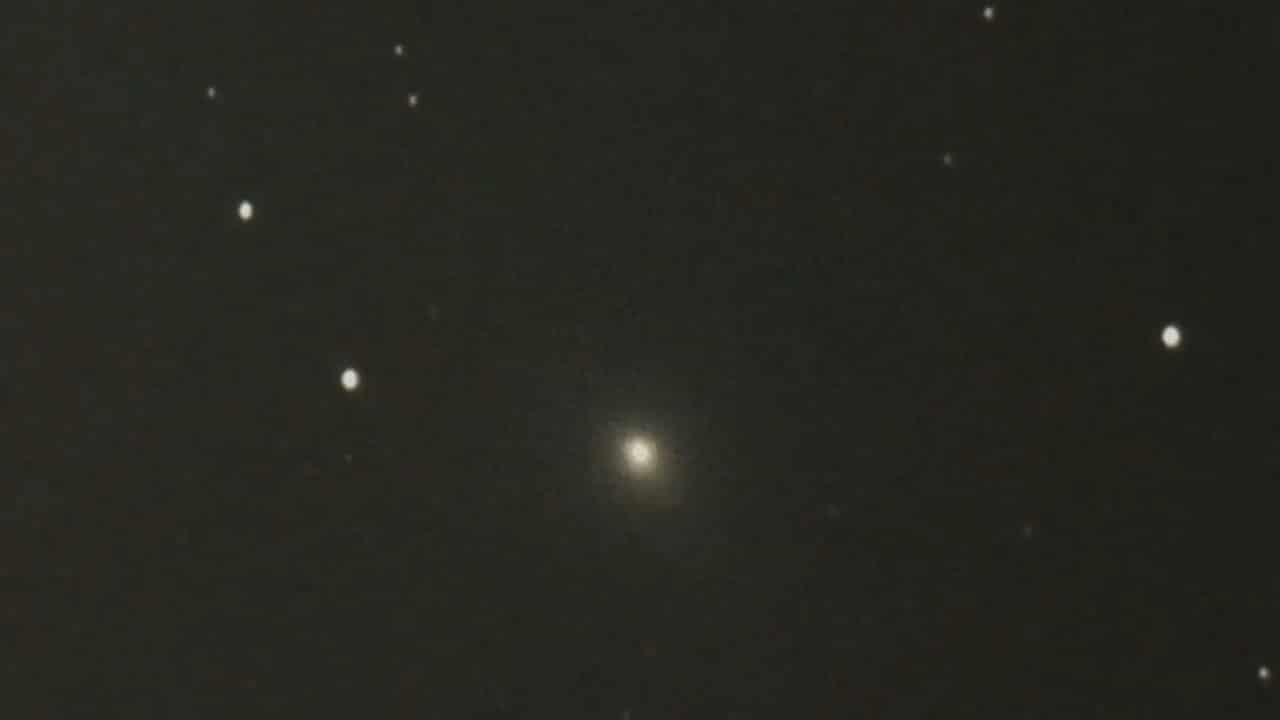
The Subaru telescope recorded changes in the composition of the coma of the interstellar comet 3I/ATLAS after it passed through perihelion. Observations occurred on January 7, 2026 in Observatório from Mauna Kea, in Havaí. Previous Dados from the James Webb space telescope from August 2025 indicated an elevated ratio of carbon dioxide to water.
The most recent measurements point to a significant reduction in this proportion. Comet 3I/ATLAS was discovered in July 2025 by the ATLAS system on Chile. Trata is the third interstellar object confirmed to visit Sistema Solar. Ele reached the closest point to Sol on October 29, 2025.
Mudança detected in coma composition
Astrônomos led by Yoshiharu Shinnaka of Koyama Space Science Institute of Universidade Kyoto Sangyo analyzed the colors of the coma using the Subaru telescope. The ratio of CO2 to H2O appeared much lower than in previous records.
Essa variation occurred after the comet heated close to Sol. CO2- and CO-rich surface Camadas may have dominated activity before perihelion. Material from deeper layers, with a greater presence of H2O, started to contribute more later.
Outra hypothesis involves galactic cosmic rays that would have converted carbon monoxide to carbon dioxide on the outer surface over millions or billions of years. The study accepted for publication in The Astronomical Journal highlights that the object exhibits classic comet behavior, but with marked differences in relation to Sistema Solar comets.
#SubaruTelescope observed interstellar comet 3I/ATLAS after its closest approach to the Sun. Coma color revealed a lower CO₂/H₂O ratio than earlier space telescope estimates, suggesting evolving chemistry and offering new clues to the comet’s structure.https://t.co/mrOr23MLIW pic.twitter.com/9zDwgwyJu0
— Subaru Telescope Eng (@SubaruTel_Eng) April 15, 2026
Detalhes from Subaru Telescope observations
The team captured optical spectra at multiple times after perihelion. Heliocentric distances varied between about 1.8 and 3.3 astronomical units. The data allowed estimating production rates of daughter molecules such as CN, C3, C2 and CH, in addition to gaseous metals.
Water production decreased more gradually in the exit phase than in the approach phase. Isso generated a clear asymmetry around the perihelion. Coma showed less depletion in C2 after Sol.
- Taxa of metal production increased relative to water
- Possível increase in CO abundance
- Coma exhibited traces of radial heterogeneity in depth
- Objeto developed rare antisolar tail on Sistema Solar comets
- Atividade continued even at greater distances from Sol
Esses dots emerged from the combination of spectroscopic and imaging data.
Comparação with previous observations
James Webb Space Telescope observed the comet on August 6, 2025, still before perihelion, at about 3.32 astronomical units. At the time, the CO2/H2O ratio was one of the highest ever recorded on any comet.
The new measurements of Subaru, carried out more than two months after perihelion, indicate a lower value, although still above the average for solar comets. Comet 3I/ATLAS continues on an escape path from Sistema Solar. Ele may be conducting the first close encounter with Sol in millions or billions of years.
Pesquisadores emphasize that the object differs from comets originating in our system in several aspects. Future Estudos large telescopes should provide more data on interstellar objects.
Implicações for planetary formation
The analysis helps compare comets formed in different star systems. Técnicas developed for comets from Sistema Solar now applies to interstellar visitors.
Isso allows you to explore variations in the composition and evolution of these bodies. Astrônomos expects new discoveries of interstellar objects to increase in the coming years as scanning telescopes become fully operational.
Comet 3I/ATLAS offers a unique opportunity to study primordial material from another region of the galaxy. Additional Observações at different heliocentric distances and thermophysical modeling will help clarify the mechanisms behind the changes.
Características unique interstellar comet
The object showed clear comet activity from the beginning, with a diffuse coma and visible tail. Imagens of December 2025 Subaru already showed the tail before Terra’s closest approach.
Após perihelion, the coma continued to evolve. The comet maintained traces of emission in gases and dust even far from Sol. Previous Pesquisas also detected unusual abundances of nickel and iron in the coma.
Esses elements, together with the variation in the ratio of CO2 and H2O, reinforce the idea of a heterogeneous internal structure. The core may contain layers with different compositions gradually exposed by solar heating.
Comet 3I/ATLAS heads towards the exit of Sistema Solar. Ele will pass close to Júpiter in March 2026 before leaving the region for good.
