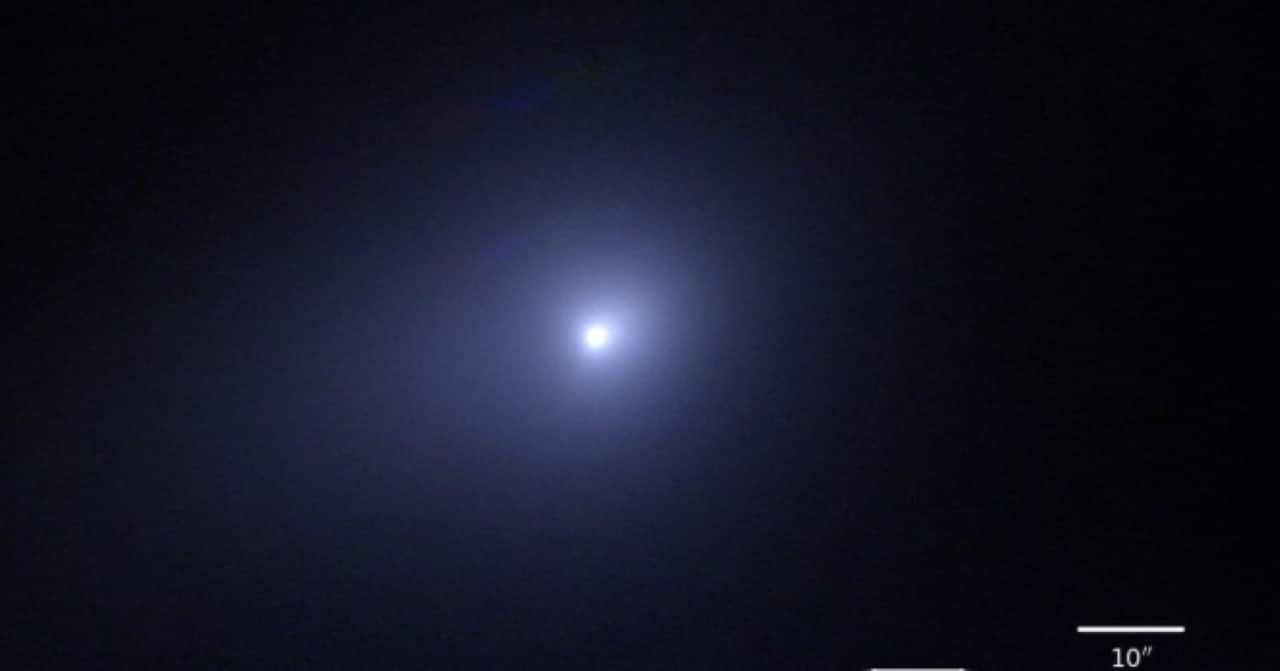
Telescópio Subaru observed the interstellar comet 3I/ATLAS on January 7, 2026. The observation occurred after the object made its closest approach to Sol. The data indicates a change in the composition of the comet’s coma.
Astrônomos analyzed colors in the gas cloud around the nucleus. Eles estimated the ratio of carbon dioxide to water. The result was smaller than that obtained in previous observations made by space telescopes.

Observação post-perihelion
The team led by Yoshiharu Shinnaka of Koyama Space Science Institute of Kyoto Sangyo University used Telescópio Subaru to collect information about the comet after perihelion. The object, also known as C/2025 N1, originated outside of Sistema Solar.
Pesquisadores applied methods developed in Sistema Solar comet studies. The analysis focused on the coma, which is formed by gases released from the nucleus. Essa region offers clues about the comet’s internal structure.
Comet 3I/ATLAS has attracted attention since its discovery. Observações previews by space telescopes recorded a higher CO2/H2O ratio. The new data from Subaru points to a reduced value.
Essa difference suggests that the composition of the surface and interior of the core is not uniform. Conforme the comet heated up near Sol, gases from different layers were released. The process reveals a chemical evolution throughout the passage through Sistema Solar.
CO2/H2O ratio Análise
Cientistas calculated the ratio of carbon dioxide to water in the coma. The method involved observations at different wavelengths. Imagens combined into V, R and I bands helped map the distribution of materials.
- The CO2/H2O ratio measured by Subaru is lower than that detected before perihelion
- Gases in a coma reflects the release of substances from the comet nucleus
- Mudanças in the composition indicates distinct layers within the object
- Técnicas analyzes were adapted from Sistema Solar’s comets
- Resultados were published in the magazine The Astronomical Journal
The observed variation is compatible with the idea that the nucleus presents heterogeneity. External and internal Partes respond differently to solar heating.
Contexto of the interstellar comet
3I/ATLAS is the third confirmed interstellar object to pass through Sistema Solar. Ele follows a hyperbolic trajectory and is not gravitationally bound to Sol. The comet passed Terra at a safe distance of 1.8 astronomical units.
Descoberto in July 2025 via the ATLAS system on Chile, the object generated global interest. Telescópios like Hubble and other space instruments also accompanied it in different phases. Previous Imagens have shown jets and an active tail.
Observações of Subaru in December 2025 had already recorded the comet’s tail. The January 2026 session allowed focus on the post-solar approach phase. Essa window is important for understanding how interstellar objects behave in environments like our Sistema Solar.
Implicações for future studies
Pesquisas like this allow you to compare comets formed in different star systems. 3I/ATLAS provides an opportunity to examine materials that did not originate here. Técnicas refinements on local comets now apply to interstellar visitors.
Yoshiharu Shinnaka highlighted the expectation of more discoveries with new scanning telescopes. Direct comparison between objects inside and outside Sistema Solar can clarify planetesimal and planet formation processes.
Estudos of this type contribute to knowledge about chemical diversity in varied stellar systems. The comet does not pose a risk of collision with Terra.
Publicação and technical data
The work detailed the use of oxygen forbidden lines to estimate composition. The observation took place on Havaí, with the FOCAS instrument in some previous sessions. Multispectral Imagens helped differentiate components in the coma.
The results appear in an article on The Astronomical Journal. A version is available on arXiv. The research included collaboration with Japanese institutions.
