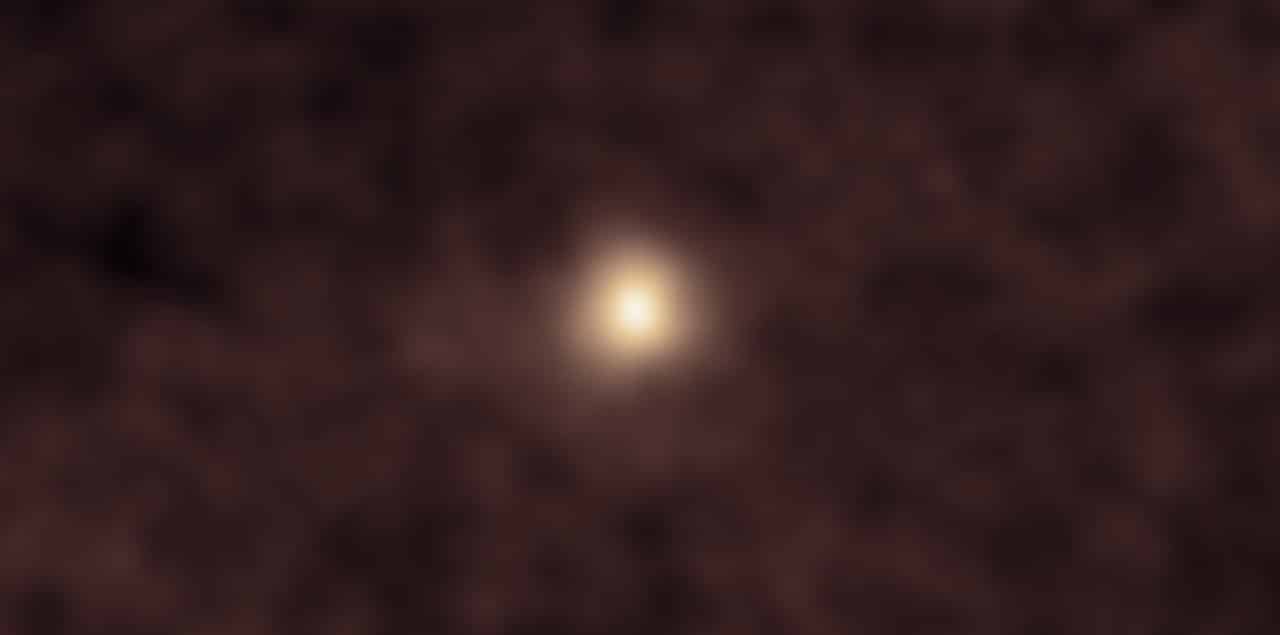
The Juice space probe caught a rare phenomenon during the passage of comet 3I/ATLAS through our planetary system. The Agência Espacial Europeia equipment detected the release of two tons of water vapor per second. The impressive rate occurred shortly after the object reached its point of closest approach to Sol. Astrônomos classify the event as a milestone in the observation of external celestial bodies.
The records took place in November 2025. The volume of material ejected by the rocky body would be enough to fill 70 Olympic swimming pools every 24 hours. The emission remained strong even when the visitor was already beginning its route away from the central star. Especialistas now analyze the thermal behavior of the rock to understand the dynamics of sublimation in a vacuum.

Captura data occurred while traveling towards Júpiter
The European spacecraft did not have the comet as the main target of its mission. The equipment is currently traveling towards the Jovian system, where it should only arrive in 2031. The trajectory coincided with the phase of greatest activity of the celestial body. Operadores on the ground took advantage of the window of opportunity between November 2nd and 25th.
The maneuver involved considerable operational risks. The thermal environment required extra attention with the ship’s sensitive sensors during the approach. The signal was weak. The effort resulted in captures of angles impossible to be obtained by telescopes installed on Terra.
The intense brightness of Sol obscured the view of ground-based observatories at several moments during the passage. The spacecraft’s privileged position allowed for precise orbit tracking. The crossing of information guaranteed the safety of the instruments during uninterrupted data collection.
Instrumentos reveals unprecedented details of gaseous structure
Detailed analysis showed that the water didn’t just evaporate from the rock’s solid core. A significant portion of the vapor arose from frozen dust grains present in the coma. Essa debris cloud surrounds the central part of the object. The face illuminated by Sol concentrated most of the sublimation activity detected by the sensors.
The technical team activated five different scientific tools to map the space phenomenon. Cada sensor focused on a specific aspect of the wandering body’s physical and chemical behavior. The joint work generated a complete picture of the interaction with solar radiation.
- The MAJIS spectrometer quantified the presence of water vapor and carbon dioxide.
- The SWI sensor mapped the concentration of emissions on the side facing the light.
- The JANUS camera photographed the formation of jets and filaments in the gas cloud.
- The UVS equipment measured the length of the tail over millions of kilometers.
- The NavCam tool ensured accurate tracking of the route through space.
The high-resolution images displayed rapid changes in the active surface. The sublimation of the ice created a dense gaseous halo around the main structure. Regiões with exposed material maintained activity for several consecutive days, contrary to the initial expectations of European researchers.
Assinatura chemistry points to origin in extreme environment
The composition of the water found in 3I/ATLAS differs from the pattern observed in bodies in our system. The proportion between light and semi-heavy molecules caught the attention of researchers. Essa chemical characteristic indicates a formation in an extremely cold and ancient environment. Preliminary Cálculos suggests the rock is more than 10 billion years old.
Cutting-edge Observatórios had already noticed similar anomalies in previous measurements. The numbers captured by the European mission confirm the theory of an origin under severe ultraviolet radiation. The material survived the long interstellar journey intact. Young, massive Estrelas often generate these extreme conditions in distant systems.
The visitor joins a select group of wandering celestial bodies. Ele shares the category with famous objects like ‘Oumuamua and Borisov. Cada new passage forces the scientific community to review planetary formation models. Chemical diversity challenges established theories about the creation of the universe.
Observação refines defense and space trajectory models
Precise measurements of the volume of ejected gas have immediate practical application. The release of matter subtly alters the orbit of moving celestial bodies. Scientists use this data to improve planetary defense systems. Understanding these mechanics helps predict the routes of dangerous asteroids with greater accuracy.
The European probe returned to its power-saving mode after the fortuitous encounter. The tests proved the efficiency of the sensors in the harsh environment of deep space. Teams on the ground are now preparing a complete scan of the stored information. The focus of the next few weeks involves activity recorded after perihelion.
The comet continues its journey towards the outer limits of the planetary system. The speed of the rock ensures that it will never return to the vicinity of Terra. The database built over these three weeks remains a definitive record. Science gains a rare window into another star’s past.