

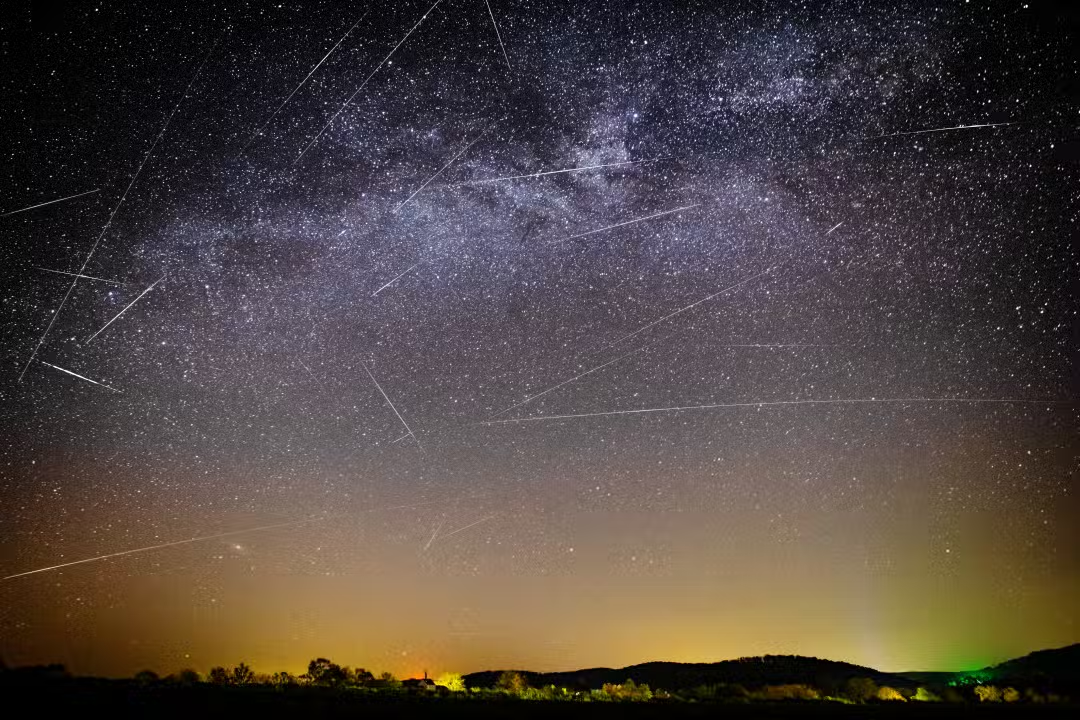
The Líridas meteor shower gains strength over the next few days. The phenomenon occurs when Terra crosses the debris trail left by comet C/1861 G1 Thatcher. The peak of activity is expected in the early hours of April 22nd.
Astrônomos indicate that the rate can reach 18 meteors per hour under ideal dark sky conditions. The crescent moon, with around 27% illumination, sets early, which favors observation. The event has been active since mid-April and continues until the end of the month.
Pico occurs in the early hours of April 22
The maximum activity of the Líridas meteor shower occurs around 7:40 pm Greenwich time on April 22. No Brasil this is equivalent to the dawn between April 21st and 22nd or between the 22nd and 23rd, depending on the region.
The best time to look at the sky is between 2 am and dawn at Brasília time. Nessa window the radiant, the point from which meteors appear to emerge, becomes higher. Observadores in the northern hemisphere see higher rates. In the south of the country, visibility is lower, but still possible.
The Lira constellation serves as a reference. The star Vega, bright and bluish-white in color, helps to locate the area where the tracks originate.
- Evite look directly at the radiant to capture longer trails
- Afaste is at least 40 degrees from that direction, the equivalent of about four fists extended across the arm
- Procure a place with a clear horizon to the east and northeast
- Espere 20 to 30 minutes for the eyes to adapt to the darkness

Condições observation favors the show
The moon shouldn’t interfere much in this edition. Ela sets around 2am in many Brazilian cities, making the sky darker. Sem excessive light pollution, contrast improves and fainter meteors become visible.
Regiões away from large urban centers offers the best chances. Parques, rural areas or beaches with little artificial lighting are ideal. Clear, cloudless weather is essential.
Astrônomos recommend lying down on a reclining chair or blanket to cover as much of the sky as possible. Binóculos or telescopes do not help as they limit peripheral vision. A flashlight with red light preserves night adaptation.
Cosmic Origem traces back to a long-orbiting comet
The Líridas meteors are fragments of the comet C/1861 G1 Thatcher. Esse celestial body has an orbital period of about 415 years and last passed close to Sol in 1861. Terra crosses this stream of dust and small rocks annually.
As the debris enters the atmosphere at around 49 kilometers per second, it heats up and burns, creating luminous trails. Alguns meteors are fast and bright, with a chance of occasional fireballs.
Líridas’s rain is one of the oldest recorded by humanity, with observations dating back more than 2,700 years. Ela marks the beginning of the spring meteor shower season in the Northern Hemisphere.
Dicas practices for those who will observe
Escolha a point with a wide view of the sky. Desligue artificial lights nearby and avoid using cell phones with high brightness. Astronomy Aplicativos with night mode or augmented reality helps you identify Vega and the Lira constellation.
Vista warm clothes, as April dawns can be cold. Avise someone about the chosen location if it is for a remote area. Paciência is important, as meteors appear irregularly.
Activity also remains good on nights close to the peak. Quem missing the 22nd still has chances in the following days, although with lower rates.
What to expect in the Brazilian sky
No Brasil the radiant is lower on the northern horizon. Mesmo so meteors can cross other parts of the sky. Regiões from Norte and Nordeste have an advantage because of geographical position.
The actual rate depends on factors such as light pollution and atmospheric conditions. In dark, clear skies, dedicated observers can record several events per hour.
The phenomenon does not pose any risk. The debris is small and disintegrates completely in the upper atmosphere.