

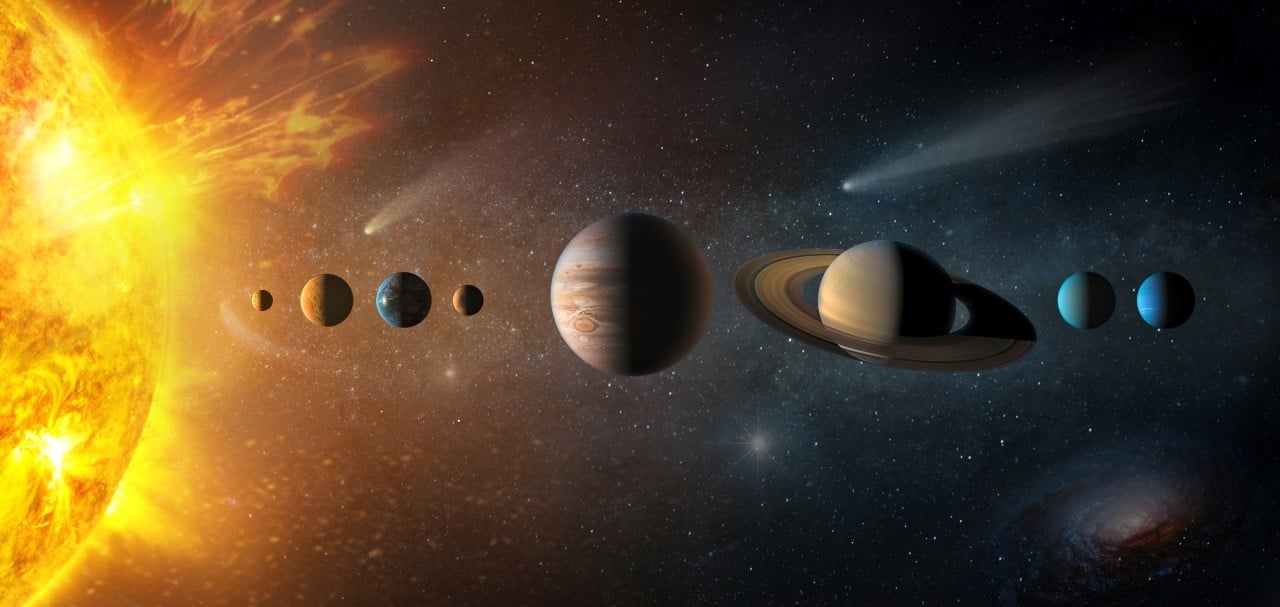
Dois of the eight planets in our Sistema Solar, Vênus and Urano, present a unique characteristic that intrigues scientists and challenges traditional models of planetary formation: their rotations are fundamentally different from those of most other celestial bodies. Enquanto the vast majority of planets rotate in a direction that follows the translational movement around Sol, Vênus rotates in a retrograde direction, and Urano has an axial tilt so extreme that it appears to roll sideways in its orbit. Essa anomaly suggests cataclysmic events in the distant past, drastically altering the course of its rotational evolution.
Understanding the genesis of Sistema Solar points to an initial scenario in which all planets should have a coherent alignment and direction of rotation. Há Approximately 4.6 billion years ago, a disk of gas and dust, known as a protoplanetary disk, gave rise to Sol and the planets that orbit it. Esse disk rotated in a specific direction, imparting an initial rotational boost to all forming bodies, which should result in a uniform rotation for most planets.
The mystery of anomalous rotation
Most of the planets in Sistema Solar, including Terra, rotate around their own axis in the same direction as Sol. Esse movement is called prograde, or direct, rotation. However, Vênus stands out for its retrograde rotation, rotating in the opposite direction to most planets. Seu’s day is longer than its year, taking about 243 Earth days to complete one revolution on its axis, while its year lasts approximately 225 days. Essa slowness and inverted direction are crucial points for research.
Urano, in turn, has an axis of rotation inclined at almost 98 degrees in relation to its orbital plane. Isso means that instead of spinning like a top vertically, it spins sideways, almost rolling along its trajectory around the Sol. Tal’s tilt is unique among gas and ice giants. Essa’s particularity causes its poles to experience decades of continuous sunlight followed by decades of darkness. Ambos cases raise profound questions about the forces that shaped Sistema Solar in its early phases.
The protoplanetary disk and origins
The most accepted theory for planetary formation postulates that Sistema Solar arose from a vast disk of gas and dust. The conservation of the angular momentum of this disk meant that all bodies formed within it inherited a rotational movement in the same direction. The planets grew by accretion, collecting material from this disk, which would naturally give them a spin in the initial direction.
The attributes of the protoplanetary disk are fundamental to understanding the formation of all celestial bodies. Ele was not just a shapeless cloud, but a dynamic and complex structure.
- Características crucial features of the protoplanetary disk include:
- Initial Homogeneidade:Embora with density variations, the material was distributed relatively evenly.
- Gradiente temperature:Mais hot near the proto-Sun, cooling at the edges.
- Composição of materials:Gás and dust, containing elements from hydrogen and helium to silicates and ice.
- Movimento rotational:A general counterclockwise rotation (as seen from the north pole of Sol).
- Formação planetesimal:Aglomeração of particles to form larger objects that would become planets.
Assim, any deviation from the expected rotation is a strong indication that external and energetic events occurred after the initial accretion phase. Tais events would need to have been powerful enough to reverse a movement or tilt an axis so drastically.
Hipóteses to Vênus inversion
Para Vênus, the most plausible explanation for its retrograde rotation involves a series of complex scenarios. One of the leading theories suggests a giant impact. A sizable body would have collided with Vênus in its early phases, providing enough energy to completely reverse its spin. Esse type of event is considered for the formation of terrestrial Lua, demonstrating that such collisions are not implausible.
Outra hypothesis considers the interaction between Vênus’s dense atmosphere and Sol’s intense heat. The thermal tidal forces exerted by Sol on the planet’s thick atmosphere could have generated significant torque over billions of years. Esse torque, acting gradually, would have first braked the original rotation and then reversed it. Modelos computational complexes seek to simulate this interaction, but there are still challenges in explaining the complete inversion and slow rotation currently observed.
Há also the possibility of a combination of factors. Múltiplos smaller impacts, along with atmospheric drag, could have contributed to the planet’s current state. The difficulty lies in finding direct evidence of these past events. The absence of a significant moon in Vênus may also have played a role, as moons generally act to stabilize the planetary rotation axis.
The collisions that shaped Urano: a case in point
The extreme tilt of Urano’s axis, which causes it to “roll” in its orbit, is also attributed to gigantic impacts. The prevailing theory proposes that one or more objects of considerable mass, perhaps the size of early Terra, collided with Urano during Sistema Solar’s chaotic phase. Esse impact(s) would have been oblique, transferring an enormous amount of angular momentum to the planet and fundamentally altering the orientation of its rotation axis.
Simulações computational tests corroborate this idea, showing that a single large impact could explain the 98-degree tilt. Contudo, more recent research suggests that multiple smaller impacts, or an impact combined with the gravitational influence of other planetary bodies in Sistema Solar’s infancy, could also have generated the observed effect. The evidence for this theory lies in models that attempt to replicate the current state of Urano, including its rings and moons, which also align with its tilted axis.
The formation of the Urano moon system after this catastrophic event is also a point of study. Acredita suggests that the debris generated by the impact may have regrouped to form these moons, all orbiting in the new inclined equatorial plane. Understanding these violent events is essential to completing the puzzle of the evolution of the outer planets.
Implicações for Understanding Sistema Solar
The anomalous rotations of Vênus and Urano are not just curiosities; they represent natural laboratories for testing and refining our theories about planetary formation and evolution. By understanding how these planets acquired their unusual rotations, scientists can improve computer models that describe the protoplanetary disk, the accretion of material, and the era of giant impacts. Cada case deviating from the norm offers clues about the extreme conditions and unpredictable events that have shaped our cosmos.
Continued research into Vênus and Urano also has implications for the study of exoplanets, planets outside our Sistema Solar. The discovery of exoplanets with unexpected orbits and rotations can be better interpreted in light of what we have learned from our cosmic neighbors. Future Missões probes to these planets, with more advanced probes, promise to collect data that could finally unravel the mysteries of their rotations and give us a more complete view of the dynamics of the universe.