
NASA has disconnected a scientific instrument from Voyager 1. The command was sent on April 17, 2026 by Jet Propulsion Laboratory engineers at Califórnia. The measure aims to preserve the probe’s remaining energy.
The Low-Energy Charged Particles instrument, known as LECP, has operated almost without interruption since the spacecraft’s launch in 1977. Ele measures low-energy charged particles, including ions, electrons and cosmic rays coming from Sistema Solar and the galaxy.
The decision came after an unexpected drop in power levels during a routine maneuver in February. Qualquer additional reduction could trigger the undervoltage protection system. Esse mechanism automatically turns off components to prevent damage to the probe.
Queda Energy Accelerates Savings Plan
Voyager 1’s radioisotope thermoelectric generator uses decaying plutonium to produce heat and electricity. As the decades pass, the available amount of plutonium decreases. Power production drops by about four watts per year.
Engenheiros observed the significant reduction during the February maneuver. Eles chose to turn off the LECP manually to prevent the protection system from acting alone. The command process took around 23 hours to reach the probe, given the current distance. The execution itself lasted just over three hours.
LECP provided data on the interstellar medium
The instrument helped map the structure of the interstellar medium. Ele detected pressure fronts and variations in particle density beyond the heliopause, the boundary of Sol’s influence.
Essas information is only possible because Voyager 1 has been in interstellar space since 2012. The probe travels at approximately 61 thousand km/h and is more than 25 billion kilometers from Terra.
- LECP measures low-energy ions and electrons
- Registrava galactic cosmic rays
- Ajudava understanding the transition between Sistema Solar and interstellar space
- Fornecia data over regions of different particle density
- Operava in conjunction with other sensors for complete analysis
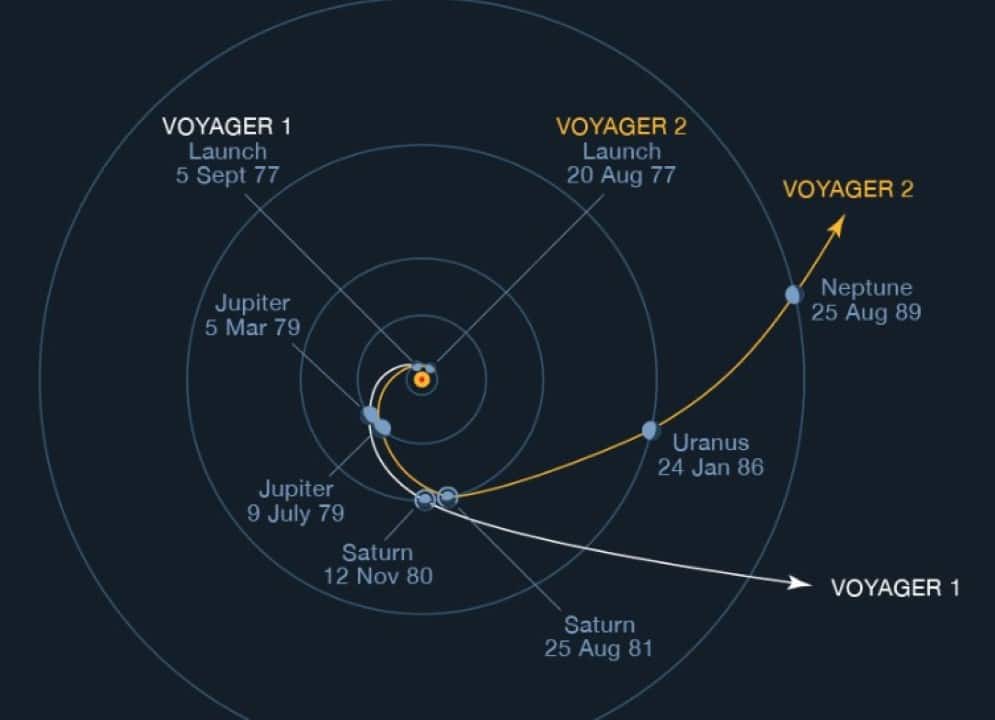
Sete of the ten instruments have already been deactivated
Of the ten identical series of original instruments in each Voyager, seven are already turned off in the Voyager 1. The LECP was next on the planned energy saving list. Na Voyager 2, the same instrument was decommissioned in March 2025.
The strategy follows an order defined by the engineers. The goal is to keep essential systems operational for as long as possible. With the shutdown, the rig gains around an additional year of margin.
The team uses this period to finalize broader energy-saving adjustments that could benefit both probes. A small LECP motor remains on for possible future reactivation, if there is extra energy.
Voyager 1 approaches historic milestone
The spacecraft celebrates 49 years in space in August 2026. In November, it is expected to become the first man-made object to reach within a light day of Terra. Nessa brand, a radio signal takes 24 hours to reach it.
The current distance already requires around 23 hours for the command to travel from the control center to the probe. Qualquer response takes almost two days to come back. Esses delays increase operational challenges.
Dois scientific instruments still work
Após LECP shutdown, two scientific instruments remain operational on Voyager 1. The probe continues to send engineering and basic science data to Terra.
Engineers monitor energy consumption carefully. Eles plan additional actions as needed to avoid total failures. The mission has already far exceeded its original five-year deadline.
Voyager 1 and its twin sister represent the human effort to explore beyond known limits. Elas provide unique insights into the interstellar environment that no other spacecraft has achieved.
