

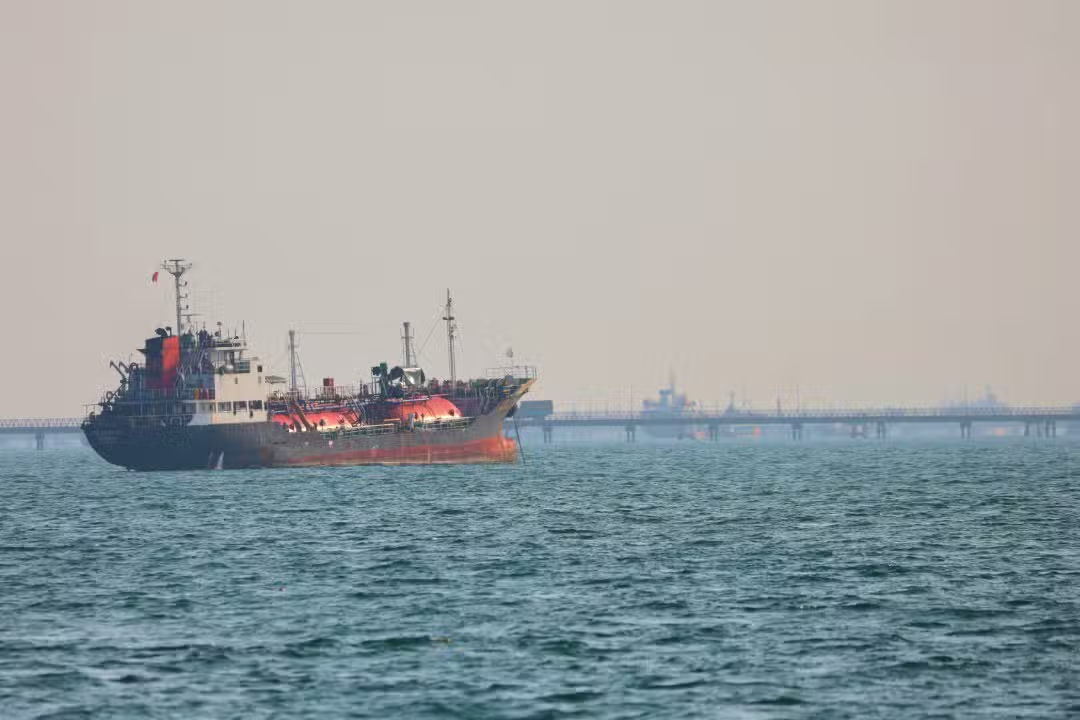
A vessel carrying 44 containers and more than 800 tons of cargo left the port on the China bound for the coast of Bahia to enable the start of construction of the Salvador-Itaparica bridge. The ship, which began its journey on March 30, brings the necessary material to assemble a logistical support platform essential for the execution of the project on the Baía of Todos-os-Santos. The freighter is expected to dock at Salvador during the second half of May, marking the first large-scale physical movement of the international structure.
The planned structure will be 12.4 kilometers long over the water, consolidating itself as the largest bridge over the sea in the entire América Latina. The project is managed by a consortium of Chinese state-owned companies and has an estimated cost of R$15 billion. The central objective of the connection is to optimize urban mobility and production flow for an estimated audience of 10 million people in Bahia. With the arrival of inputs, the technical schedule enters a phase of final preparations before the installation of the maritime construction sites.
Unreleased Chinese Tecnologia will be applied to Baía of Todos-os-Santos
The material transported in the 44 containers does not make up the bridge’s definitive beams or pillars, but rather the elements of a lateral support platform. Este system will be fixed directly to the seabed to serve as a base of operations for workers and a delivery point for heavy materials throughout construction. It is the first time that this type of engineering technology will be used on Latin American soil, allowing greater agility in works of great depth and extension.
- Fixação temporary metal platform for logistical support.
- Estocagem of basic materials at strategic points on the sea.
- Alojamento technician for precision engineering teams.
- Sistema for rapid delivery of inputs via support ferries.
The implementation of this method aims to ensure that the five-year construction schedule is strictly adhered to. Como the structure is vast, the existence of a fixed parallel base reduces the dependence on constant transport between dry land and the middle of the bay. Isso reduces the risks of delays due to adverse weather conditions or congestion at local ports during the foundation period of the main pillars.
Prazos and bureaucratic procedures for starting interventions
The expectation of the concessionaire, formed by the giants China Communications Construction Company (CCCC) and China Railway Construction Corporation (CRCC), is that the machines will begin operating effectively in June. Para For this to happen, the group awaits the release of the construction permits that have already been filed with the city halls of Salvador and Vera Cruz. The documentation was delivered last week and follows the technical environmental and urban analysis procedures of the municipalities involved in the interconnection.
The concession contract has a total validity of 35 years, with the first five dedicated exclusively to the engineering and heavy construction phase. The official inauguration of the road axis is projected for June 2031, after which the private company will take over the maintenance and operation of the toll for almost three decades. The project is seen as the biggest infrastructure challenge in the state’s recent history, requiring coordination between governments and foreign investors.
Impactos in regional mobility and overcoming historical milestones
Quando completed, the Salvador-Itaparica bridge will surpass the maritime section of the Rio-Niterói bridge, the current record holder in the region. The new road will allow the route between the capital and the south of the state to be drastically reduced, avoiding a return via the BR-101 highway or exclusive dependence on the ferry system. The expected influx will not only facilitate tourism, but is also expected to boost real estate and commercial development in Ilha of Itaparica and in nearby towns like Santo Antônio of Jesus.
Economistas locals point out that the ease of access could generate a new industrial and services hub in the expanded metropolitan region. The logistical integration promoted by the bridge is compared to large global maritime connectivity projects carried out by China on other continents. The use of Chinese state-owned companies guarantees the necessary financial support for a project of this size, which faced decades of planning and budget discussions before getting off the ground.