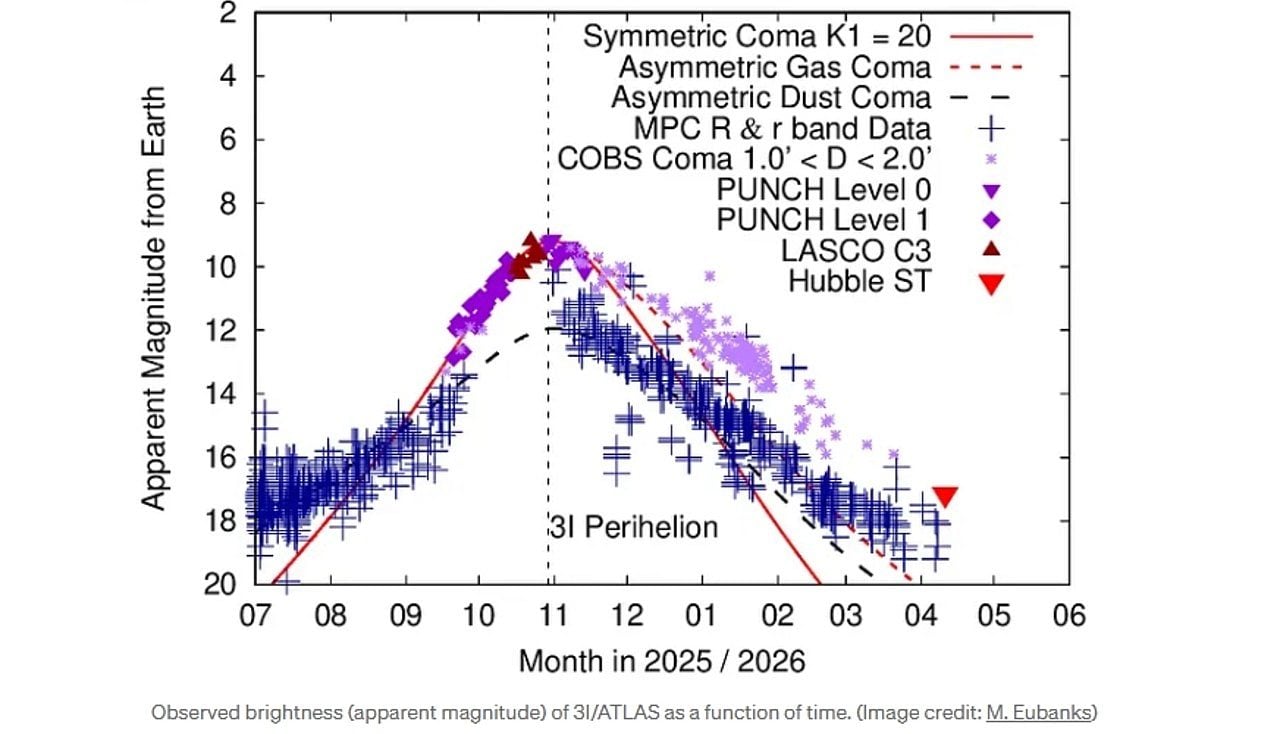
The interstellar celestial body 3I/ATLAS has surpassed the orbit of Júpiter and is advancing towards deep space one billion kilometers from Terra. Recent Imagens images captured by Telescópio Espacial Hubble on April 10, 2026 show the visitor as a fuzzy speck in the cosmic void. The current distance represents almost seven times the separation between our planet and Sol. The object maintains an impressive speed. The trajectory of return to interstellar space continues to be closely monitored by the world’s main research centers.
Apesar From continued distancing, the celestial body’s brightness remains abnormally high on its exit route. The phenomenon occurs due to the excessive release of gases and dust accumulated during the solar maximum approach. Pesquisadores are now awaiting the release of data collected by NASA’s Juno probe. The spacecraft recorded crucial information on March 16, 2026. The moment marked the visitor’s closest proximity to the gas giant in our system.
Composição atypical chemistry raises unprecedented hypotheses
The structural analysis of 3I/ATLAS revealed features that deviate from the known standards of modern astrophysics. The proportion of deuterium, a heavy isotope of hydrogen, reached levels a thousand times higher than the cosmic average in water. The element also appeared thirty times larger in methane samples. The numbers significantly exceed the values found in traditional comets and meteorites. The difference reaches three orders of magnitude when compared to the methane present on known planets.
The ratios of carbon isotopes in carbon dioxide and carbon monoxide also exceeded usual observation marks. The abundant presence of organic molecules in the gas phase intrigues experts. Methanol and methane appeared strongly after perihelion. Survival of these compounds during a journey lasting billions of years would require a thick protective layer of material. The late detection of methane suggests an unusual layered structural formation.
The scenario generated intense debates about a possible technological signature in the space visitor. Deuterium functions as a highly efficient fuel for nuclear fusion reactions. An explosion in the object’s core could have triggered a chain reaction. Professor Avi Loeb, of Universidade of Harvard, points out that the anomalies defy purely natural explanations. Methane and other organic molecules function as biomarkers recognized by science.
Geometria orbital and millimeter alignment
The trajectory of the celestial body presents a geometry that surprised astronomers in the first months of observation. The object followed a retrograde route perfectly aligned with the orbital plane of the solar planets. The statistical probability of this event occurring naturally is only 0.2%. The Via Láctea disk has a misalignment of approximately 60 degrees in relation to the ecliptic. The unusual coincidence suggests that the 3I/ATLAS route could have been previously planned.
The visitor’s arrival schedule seemed optimized for skimming through other worlds in the system. The body reached minimum distances of 29 million kilometers from Marte. The approach with Júpiter reached 53.6 million kilometers. The Jovian number occurred at the exact limit of the planet’s Hill radius, which is 53.5 million kilometers. Curiosamente, the body remained unobservable from Terra during its perihelion. The mathematical precision raises the hypothesis of a sounding mission.
The axis of rotation maintained a constant 8-degree alignment with the solar direction upon entering the system. The chance of a chance alignment of this magnitude is 0.5%. Stability would allow the maintenance of a day and night side throughout the trip. The configuration would ensure consistent surface temperatures. Thermal control is fundamental for the operation of any technological equipment in deep space.
Fenômenos visuals and symmetrical jets in space
The Telescópio Espacial Hubble photographs exposed complex dynamics of gas and dust around the core. An inverted tail, aimed at Sol, formed a collimated jet ten times longer than it was wide. The structure stretched hundreds of thousands of kilometers into a vacuum. Known comet Nenhum exhibited similar natural behavior toward the central star. The occurrence of the jet before and after perihelion has almost zero probability of being a random event.
Processing images captured between November 2025 and February 2026 revealed additional mechanical details. Specific Filtros removed the circular glow around the core. The procedure showed three minijets symmetrically separated by 120 degrees. Symmetry directly refers to the operation of directional thrusters. The mechanism would serve to stabilize the three-dimensional movement of the celestial body during navigation.
- Polarização extreme:The visitor demonstrated negative behavior unprecedented for known comets. The anomaly could be linked to its complex geometry or peculiar inverted tail.
- Brilho intense:The object brightened faster than any cataloged celestial body. The color became bluer than Sol itself during closest approach.
- Signal Origem:The direction of arrival coincides with the origin of the famous “Wow!” radio signal. The margin of error is just 9 degrees, with a probability of 0.6%.
Light intensity near perihelion can be interpreted in unconventional ways by the research team. The sudden brightness would work like charging a device using direct solar energy. The directional coincidence with the “Wow!” raises questions about the origin of the historical transmission captured in the 1970s. The radio signal could have originated from a companion of 3I/ATLAS.
Teorias on the origin of the interstellar visitor
The set of twelve physical and chemical anomalies consolidates 3I/ATLAS as one of the greatest enigmas in astronomy. The core’s characteristics surpass previous visitors in mass and speed. ‘Oumuamua and Borisov had much simpler dimensions and behaviors. The combination of robust size and extreme speed adds an extra layer of complexity to studying the fleeing celestial body.
The “Troia Horse” theory is gaining traction among the most daring researchers in the astronomy department. The hypothesis suggests that a natural comet may have been adapted by a distant technological civilization. The resources of the celestial body itself would have been used to navigate to the habitable zone of our system. The overabundance of nickel in relation to iron in the gas plume reinforces the idea. Aspect ratio is a hallmark of industrially produced metal alloys for advanced aerospace applications.
