

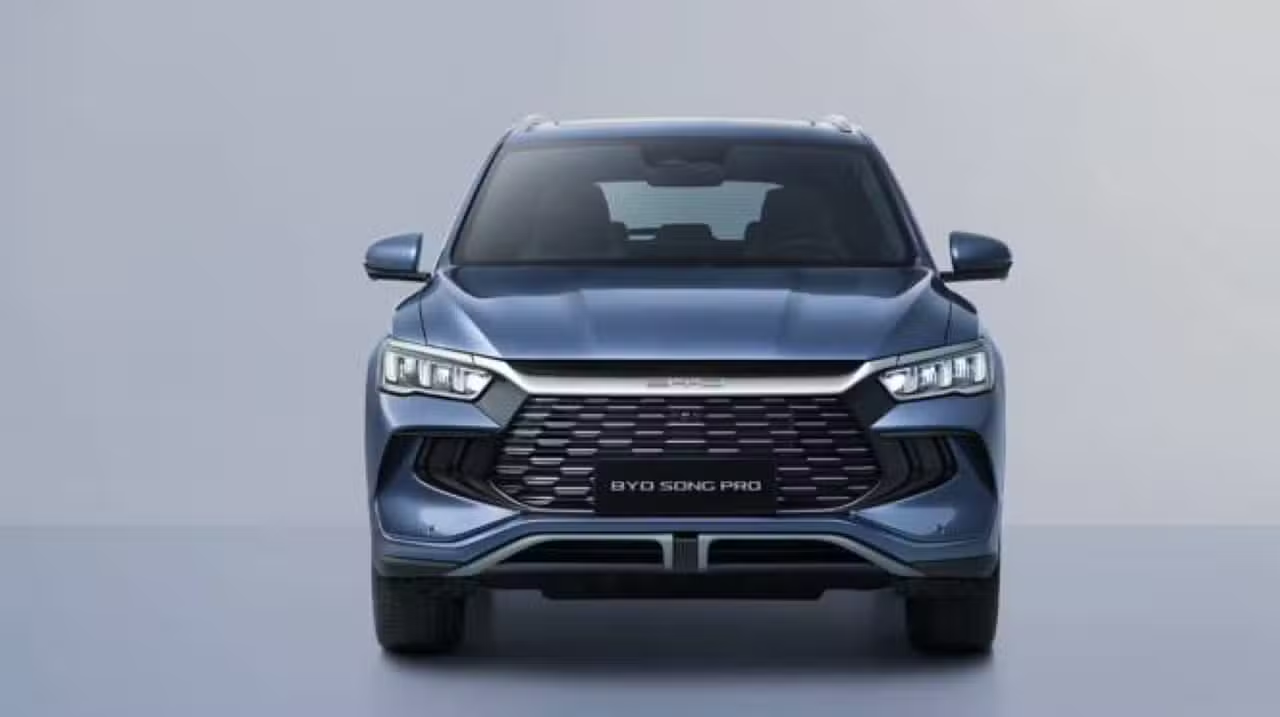
Asian manufacturer BYD presented a significant update for the Song Pro sports utility vehicle in the Chinese market. The plug-in hybrid vehicle underwent structural modifications to the energy storage assembly. The new configuration delivers superior driving figures in pure electric mode. Fuel consumption also registered significant optimization. The most expensive version in the catalog reaches 31.25 km/l during local homologation tests.
The automaker named the new product Flying Edition. The model arrives at dealerships in the Asian country with aggressive prices for the segment. Direct conversion indicates a starting price in the range of R$75,000. The company’s move seeks to recover the volume of car registrations in the region. No Brasil, the scenario follows a different timeline. The national operation is preparing an aesthetic restyling and the introduction of a flexible propellant for the course of 2026.

Capacidade energy and performance on Asian streets
The main technical change to the vehicle lies in the battery pack with Blade technology. The brand’s engineers have made two new capacity options available to consumers. The component can now be purchased with 26.6 kWh or 34.27 kWh. The higher density configuration allows the driver to travel urban routes without activating the combustion engine. The CLTC test cycle indicates a maximum range of 301 kilometers on electricity alone.
The powertrain combines two distinct sources of traction. The 1.5 gasoline-powered block generates 101 horsepower. Ele works in synchronization with an electric drive installed on the front axle. Este second engine delivers an additional 163 horsepower to the system. The joint calibration results in a combined power output of approximately 235 horsepower in the top-of-the-line variants. Fuel consumption is 3.2 liters for every 100 kilometers driven in the China’s traffic conditions.
- The 26.6 kWh entry-level battery guarantees 220 kilometers of electric driving.
- The top 34.27 kWh component increases the range to 301 emissions-free kilometers.
- The efficiency index reaches 31.25 km/l in the best calibrated version.
- The vehicle’s total autonomy exceeds the barrier of 1,900 kilometers on a full tank.
The technical evolution meets a direct demand from customers for greater independence from gas stations. Internal competition in the Chinese automotive market forced the manufacturer to improve product specifications. The focus is on reducing daily travel costs. The sports utility vehicle competes with equivalent models from brands such as Toyota and Geely. The strategy attempts to consolidate the car as the most balanced option between price and energy efficiency in the average family category.
Posicionamento commercial and driver assistance package
The price list charged at China highlights the automaker’s commercial aggressiveness. The entry-level version starts at 102,900 yuan. The most complete configuration, called the BYD Song Pro DM-i Flying Edition 301 km Excelent, costs 132,900 yuan. The value represents around R$97 thousand in direct currency conversion, without the incidence of Brazilian taxes. The low price policy keeps the vehicle affordable for the local middle class.
The embedded technology package received important improvements in active safety. The God’s Eye Nível C ADAS system is part of the list of standard equipment. The tool manages advanced autopilot during highway travel. Buyers can add the Nível B package as optional equipment. The resource costs an extra 9,900 yuan, something close to R$7,200. The update adds support for driving on urban roads and performs complex parking maneuvers without human intervention.
The cabin preserves the visual identity characteristic of the brand’s cars. The dashboard displays a 15.6-inch floating central screen for controlling the multimedia system. The gear selector is positioned just behind the two-spoke steering wheel. The body has generous dimensions to accommodate five passengers in comfort. The length totals 4,735 millimeters. The width measures 1,860 millimeters. The height reaches 1,690 millimeters, while the distance between the axles is 2,712 millimeters.
Contraste technician with the units sold in Brasil
The Brazilian consumer finds a different technical reality in the country’s dealerships. The Song Pro units shipped to the national market use considerably smaller batteries. The GL version has a 12.9 kWh component. The GS variant has an 18.3 kWh part. The purely electric range varies between 49 and 68 kilometers, depending on the configuration chosen. Official data from the labeling program indicates an equivalent consumption of 38.4 km/l.
The update presented on Ásia does not have an immediate date for landing in the national territory. The current sports utility vehicle is among the most popular hybrid models in its category on the domestic market. The suggested price for the GL and GS versions varies between R$190,000 and R$200,000. Local production takes place in the Camaçari industrial complex, located in the state of Bahia. The nationalization of assembly guarantees regular supply to the dealer network and facilitates the distribution of spare parts.
National Adaptação includes unprecedented flexible motorization
The automaker’s Brazilian operation plans profound changes for the second half of 2026. The first change involves an aesthetic update based on the Dragon Face visual language. The front part of the car will receive narrower headlights and a redesigned chrome bar. The rear bumper will also undergo modifications to align the design with the brand’s recent launches. The restyling seeks to keep the product attractive in the face of the arrival of new competitors in the country.
The second novelty represents a technological milestone for the manufacturer in the domestic market. The Song Pro will become the company’s first hybrid vehicle capable of burning ethanol. Local engineering developed the adaptation of the combustion engine specifically for the Brazilian reality. The flexible system will debut simultaneously with the visual changes to the bodywork. The use of vegetable fuel reduces the carbon footprint of the mechanical assembly and enhances the country’s energy matrix.
The introduction of flexible technology changes the supply dynamics for homeowners. The efficiency of the hybrid system reduces the exclusive dependence on gasoline for daily trips. The driver has the option of choosing the most advantageous fuel at the pumps. The possibility of traveling dozens of kilometers on just a battery charge attracts consumers focused on reducing expenses. The price positioning of the future national line remains confidential to the automaker.