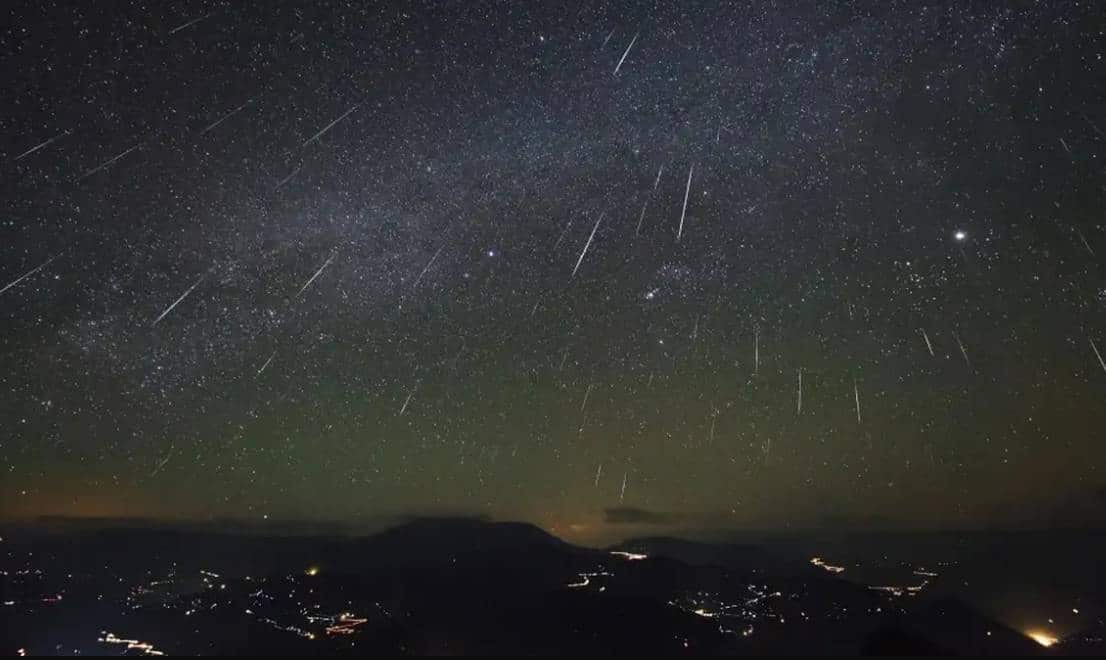
The Líridas meteor shower has gained strength in recent days. The annual phenomenon reaches peak activity and can be observed in parts of Brasil until the end of this week.
Registros photographs show luminous traces in the night sky. The activity occurs as Terra crosses the trail of particles left by a comet. Especialistas indicate that the event represents the first big opportunity of the year for those who follow the sky.
Chuva active since mid-April
The phenomenon began on April 16th and remained visible until the 25th. The moment of greatest intensity occurred on the nights of April 21st and 22nd. Under favorable conditions, observers in dark locations recorded between five and 11 meteors per hour.
Lua in its growing phase did not interfere as much in the darker dawns. No Hemisfério Norte, the rate reached 18 meteors per hour at times. No Brasil, the number is smaller because the radiant is in the northern region of the sky.
- Locais away from big cities offers the best conditions
- Horários after midnight increases chances of visibility
- Direção north helps locate the apparent origin of the traces
- Aplicativos astronomy charts indicate the position of the constellation Lira
- Evitar light pollution makes a difference in the number of meteors seen
Origem cosmic spectacle
Meteors appear when fragments of space rock enter the Earth’s atmosphere at high speed. Friction generates a bubble of plasma that glows for fractions of a second. Na Líridas, these fragments come from comet C/1861 G1 Thatcher.
Terra crosses this debris cloud every April. Marcelo Zurita, from Rede Brasileira from Observação from Meteoros, explains that all meteors from the same shower follow parallel trajectories. The perspective effect makes them appear to come from a single point, called the radiant, in the Lira constellation.
A few Lyrid meteors from last night! The shower peaks tonight, up to 20 meteors per hour are possible.#Lyrids #MeteorShower #NightSky pic.twitter.com/sd4KiWQwRU
— Jeremy Cruz (@J_master_caster) April 21, 2026
História registered millennia ago
Astrônomos Chinese documented Líridas more than 2,700 years ago. Trata is one of the oldest meteor showers with continuous records. Old Observações reports meteors falling as rain on certain nights.
The Lira constellation gives the event its name. Vega, one of its brightest stars, serves as a reference for locating the radiant. No Brasil, the further north the observer, the greater the chance of seeing meteors. Ainda thus, it is possible to record traces in any direction of the sky.
Como distinguish Líridas from other phenomena
Sporadic Meteoros appear on any given night. Those of Líridas maintain parallel direction and characteristic speed. Apps like Stellarium or Star Walk help confirm the radiant and differentiate events.
Rain does not require special equipment. Basta a dark place, patience and look up. Fotografias with long exposure captures the features more easily. Muitos recent registrations came from observers on Europa and Ásia.
What changes for the rest of the year
Líridas ends a calmer period after January’s Quadrântidas. Outras important rains will come in the coming months. Astrônomos monitor the sky to record possible outbreaks or variations in annual activity.
The phenomenon reinforces the citizen observation routine. Grupos like BRAMON collect data from amateurs across the country. Essas information contributes to the understanding of how Terra interacts with cosmic material.
Registros remains possible until April 25th, although with lower intensity after the peak. Quem missed the main nights but still has opportunities in places with clear skies. The event reminds us that the sky offers regular shows for those who dedicate time to observation.