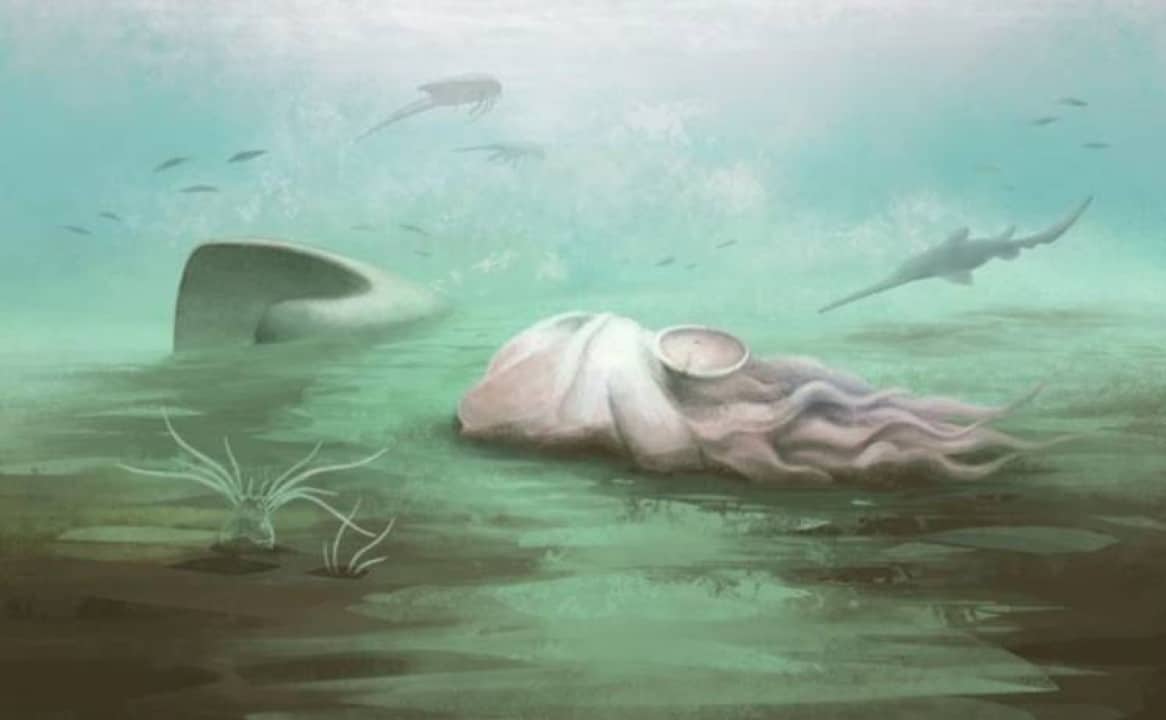
An international team of scientists has identified the fossilized remains of a colossal octopus that inhabited the oceans around 100 million years ago. The prehistoric animal reached impressive proportions. Estimativas point out that the creature reached a total length of up to 19 meters when stretching its limbs. The discovery immediately surprised the academic community. The find places an invertebrate at the top of the marine food chain of its time, altering the understanding of past biology.
The detailed study was published in the prestigious scientific journal Science. Pesquisadores of Universidade of Hokkaido conducted the main analyses. Eles examined dozens of fossilized jaws found in specific highly preserved rock formations. The material comes from excavations carried out at Japão and Canadá over the course of several expeditions. The research changes the perception about the dynamics of aquatic ecosystems during the Cretáceo period, showing a much greater predatory complexity than previously estimated.
Dimensões colossals and prehistoric predator anatomy
The scientific investigation classified the finds into two distinct species that lived in the same oceans. The first was named Nanaimoteuthis jeletzkyi and was considered medium in size by the standards of that geological era. The second species, named Nanaimoteuthis haggarti, represented the true deep-sea giant. Esta last had a main body that varied between 1.5 and 4.5 meters in length. The extremely elongated and muscular tentacles completed the animal’s colossal structure.
The giant octopus belonged to the group of octopods with lateral fins. Essa anatomical feature facilitated rapid and precise locomotion in open waters. The body structure is reminiscent of current Dumbo octopuses, although on a much larger size scale. The long, flexible arms served as lethal tools during daily hunting. The predator captured its victims with impressive agility before taking them to the crushing beak located in the center of its limbs.
Tecnologia advances in fossil reconstruction
The preservation of cephalopods in the fossil record occurs extremely rarely in nature. The soft body of these animals undergoes rapid decomposition shortly after death due to the action of bacteria and scavengers. Apenas rigid structures can resist the relentless action of time. Hardened jaws found in sedimentary rocks provided the main key to the research. Professor Yasuhiro Iba coordinated the detailed work of recovering and cleaning these fundamental pieces.
The team used state-of-the-art tools to overcome the shortage of complete biological material. Imagens in high-resolution three dimensions mapped every microscopic detail of the excavated pieces. Artificial intelligence processed visual data on supercomputers. The innovative method allowed the animal’s volume and body length to be calculated with unprecedented precision in paleontology. Anteriormente, similar fragments ended up mistakenly assigned to other taxonomic families due to lack of appropriate technology.
Evidências points to a diet based on hard prey
Close analysis of the jaws revealed the aggressive feeding behavior of the giant octopus. Calcified parts show deep marks of severe mechanical wear. The constant friction indicates that the animal was processing highly resistant foods in its habitat. Ele used the enormous force of its bite to break the carapaces and skeletons of its victims.
- Estrutura robust jaw adapted to crush dense bones.
- Marcas severe chewing on hardened beak surfaces.
- Digital Modelagem that proves the extreme force of the animal’s bite.
- Registros geological data dated between 100 and 72 million years ago.
- Capacidade from processing thick shells of ancient molluscs.
The predator’s menu involved an immense variety of sea creatures that inhabited the region. Large Peixes and armored molluscs were part of the essential daily diet. Scientists believe that even small aquatic reptiles ended up devoured in ambushes. The jaw worked like high-pressure scissors capable of piercing natural armor. The octopus dominated the waters with incomparable lethal efficiency.
Impacto in understanding the food chain of the Cretáceo period
Traditional paleontology held a narrow view of the alpha predators of the dinosaur era. Tubarões primitive and large marine reptiles appeared as the only absolute lords of the ancient oceans. The confirmation of the existence of Nanaimoteuthis haggarti breaks this scientific paradigm established for decades. The discovery proves that invertebrates also exercised imposing territorial dominance. Eles competed on equal terms with the feared mosasaurs for food and space.
The large size guaranteed a considerable competitive advantage in hunting areas. The giant octopus didn’t just serve as a food source for larger creatures. Ele actively hunted and controlled the population growth of several smaller species. The complexity of Cretáceo Superior’s food web gains new contours with this structural revelation. Prehistoric oceans harbored a much richer diversity of predators than previous theories suggested to academics.
Escavações Joints between Japão and Canadá Drive Science
The success of the research depended on strong international collaboration between leading institutions. Japanese and Canadian Especialistas joined forces to map the most promising rock formations. Museus of natural history made available specimens stored for decades in their dusty collections. Reviewing this ancient material with modern eyes has yielded surprising results for evolutionary biology. Rigorous geological dating confirmed the exact time window for the existence of these fantastic animals.
Fieldwork continues apace in the Hokkaido regions and on the island of Vancouver. Cada new excavation holds the promise of additional fragments that could further detail the extinct species’ biology. The giant octopus surpasses contemporary giant squids in volume and total length. The research sets a new milestone in the study of fossil invertebrates around the world. Continuous technological advancement promises to unravel other mysteries hidden in the depths of Earth’s geological time.
