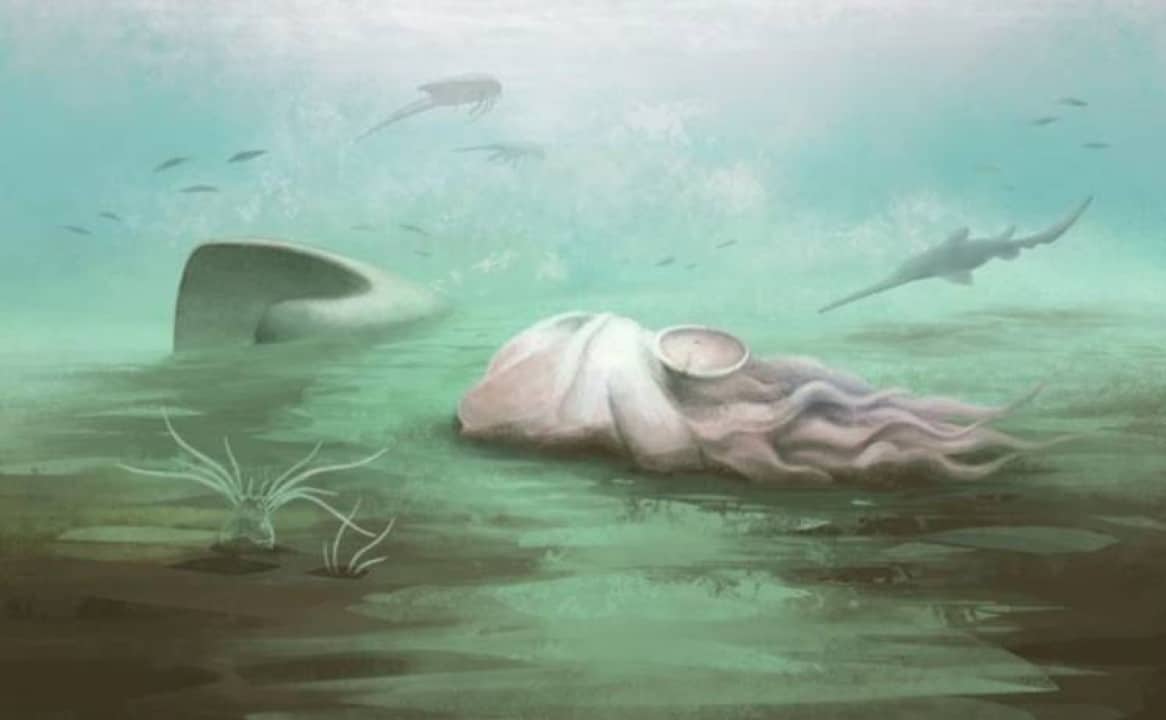
An international group of scientists has identified the fossilized remains of a colossal octopus that inhabited the oceans of Terra about 100 million years ago. The prehistoric animal had immense tentacles and reached a total length estimated at 19 meters. The discovery occurred after detailed analysis of fragments preserved in rocks from the Cretáceo Superior period. The study redefines current understanding of the dynamics of marine food chains at that time.
The research was led by experts from Universidade of Hokkaido, located at Japão. Paleontologists used modern technologies to examine ancient pieces and new finds. The giant octopus competed directly with large marine reptiles for food. The presence of an invertebrate of this size at the top of the food web surprised the academic community. The find demonstrates the complexity of aquatic ecosystems before the extinction of the dinosaurs.
Digital Reconstrução reveals the exact dimensions of the prehistoric predator
The researchers based the study on a set of 27 distinct fossils. Quinze of these pieces were already part of museum collections and awaited a thorough review. The other 12 fragments were recently discovered in specific rock formations. The team applied three-dimensional modeling techniques to recreate the animal’s structure. Ferramentas artificial intelligence helped to bring together the fragmented parts.
The fossilization process of cephalopods is extremely rare in nature. Esses animals have soft bodies that decompose quickly after death. Apenas the most rigid parts can resist the action of time and the elements. Scientists focused their efforts on analyzing the octopus’s beak, a hard structure made of chitin. The shape and size of this piece made it possible to calculate the proportions of the rest of the body.
Estimates indicate that the animal’s mantle alone measured between 1.5 and 4.5 meters in length. The tentacles formed the majority of the creature’s physical structure. The total length of 19 meters places the species among the largest invertebrates ever documented by science. The size exceeds the measurements of the modern colossal squid, which currently inhabits the depths of the ocean. The accuracy of the digital models eliminated doubts about the scale of the predator.
Competição for food involved sharks and large marine reptiles
The Cretáceo Superior period was marked by intense biological activity in the planet’s oceans. The waters were home to a wide variety of fish, crustaceans and large predators. The giant octopus needed to hunt bulky prey to sustain its own metabolism. The animal’s diet included bony fish and other smaller cephalopods. The strength of the tentacles allowed it to capture moving targets extremely quickly.
The presence of this colossal invertebrate changed the perception of the marine hierarchy at the time. Scientists believed that only vertebrates dominated the top of the food chain. Prehistoric mosasaurs and sharks were considered the absolute predators of the seas. The new discovery proves that the giant octopus competed for the same ecological niche. The animal had enough agility to face or escape these formidable rivals.
Duas distinct species were confirmed during the fossil cataloging process. The first received the scientific name Nanaimoteuthis jeletzkyi. The second, named Nanaimoteuthis hasegawai, represents the largest specimens found in the research. Variation between species suggests successful evolutionary adaptation in different marine environments. The biological success of these animals lasted millions of years before the mass extinction event.
Características physics guaranteed lethal advantage at depth
The anatomy of the giant octopus offered perfect tools for hunting in the open sea. The absence of a heavy outer shell ensured fluid and speedy movement. The jet propulsion system, common to cephalopods, allowed sudden starts during ambushes. The animal used the darkness of deeper waters to surprise its prey. The physical structure combined brute strength with extreme flexibility.
Fossil records point to a series of fundamental biological adaptations:
- The rigid and sharp beak worked like scissors capable of piercing carapaces and bones.
- The dense musculature of the tentacles provided a grip that was impossible for the prey to break.
- The colossal size intimidated smaller predators and guaranteed control of vast hunting territories.
- Highly developed vision made it easier to locate targets in low-light environments.
- The accelerated metabolism required a constant consumption of calories to keep the body functioning.
The combination of these factors transformed the species into an efficient hunting machine. The animal’s beak, similar to that of a modern parrot, crushed food before digestion. Chemical analysis of the fossilized remains confirmed the presence of minerals associated with a strict carnivorous diet. Evolution endowed the octopus with features that rivaled the jaws of the largest aquatic reptiles. The creature’s biology reflects a highly competitive and unforgiving environment.
Escavações on Japão and Canadá unite global project experts
The success of the research depended on close collaboration between institutions from different countries. The original fossils were recovered in two distinct and distant geographic locations. Some of the material was on the island of Hokkaido, in the northern region of Japanese territory. The rest of the pieces were located in Ilha of Vancouver, on the west coast of Canadá. The distribution of finds indicates that the giant octopus inhabited a vast expanse of prehistoric Oceano Pacífico.
Japanese and Canadian scientists shared data and technological resources during the months of investigation. The exchange of information made it possible to cross-reference the characteristics of the fossils found on each continent. The rocks of Hokkaido provided the best-preserved fragments of the creature’s beak. The Canadian material helped confirm the geological age of the samples. The dating indicated that the animals lived between 100 million and 72 million years ago.
The teams’ work highlights the importance of reviewing the collections of natural history museums. Muitas discoveries remain stored in collections for decades until suitable technology is available. The use of new scanning tools has revealed details that have gone unnoticed by curators in the past. Paleontologists are already organizing the mapping of other rock formations in Pacífico in search of additional remains of the species. The cataloging of new biological fragments expands the database on extinct marine fauna.
