

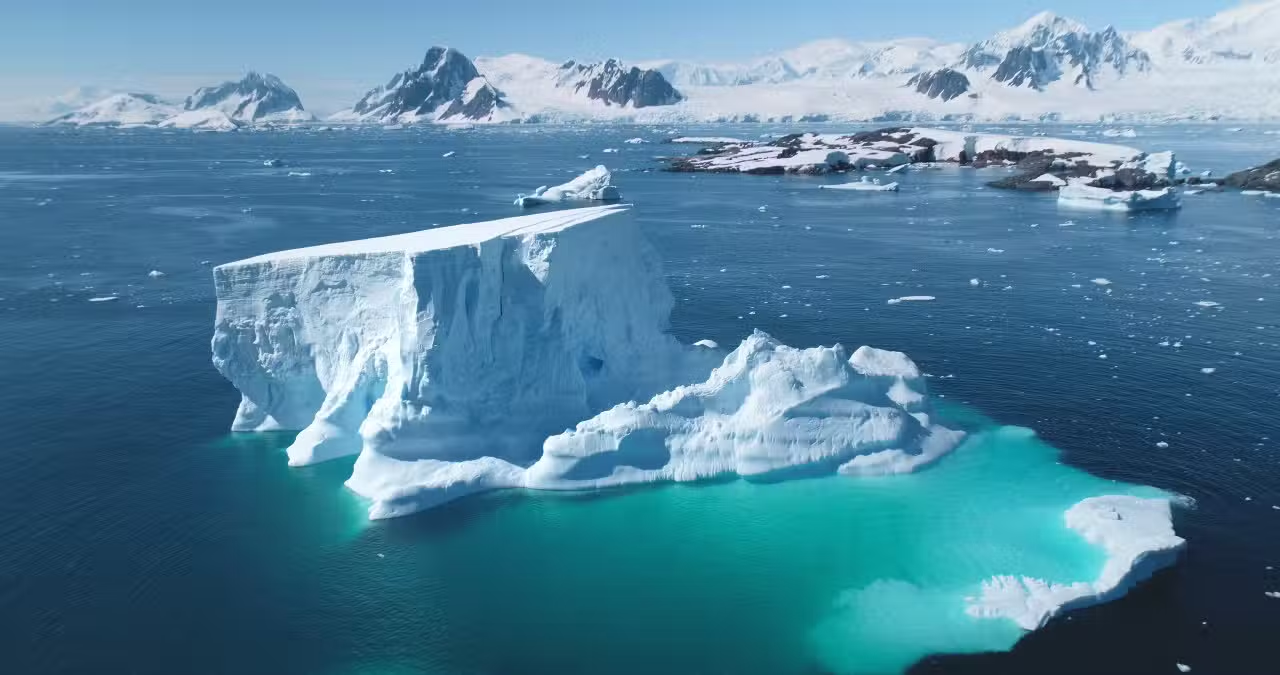
Pesquisadores identified that the planet Terra underwent significant cooling three million years ago, even with a modest drop in greenhouse gas levels. The discovery occurred after detailed analysis of ice samples taken from the Antarctic continent. The new data contradicts previous models based only on marine sediments. The study provides the earliest recorded direct measurement of the chemical composition of Earth’s atmosphere, setting a new precedent for climate science.
The detailed results are part of two scientific articles published in the journal Nature. The work involved experts from Centro, Exploração, Gelo Mais Antigo, an initiative linked to Universidade Estadual, Oregon. The samples were collected in the region known as Allan Hills, located on the edge of the eastern ice sheet of Antártida. The material allowed scientists to observe a geological period in which global temperatures were considerably higher than today.

Preserved air Bolhas reveals composition of ancient atmosphere
The dynamics of the ice sheet in Allan Hills causes physical distortions in the frozen structure. Esse constant movement brings blocks from different geological periods closer to the surface, breaking the traditional linear sequence of accumulation. Pequenas air bubbles become trapped within these structures during the freezing process. The material functions as an intact time capsule.
Julia Marks-Peterson, Universidade Estadual researcher of Oregon, led the first part of the scientific investigation. The second stage was coordinated by Sarah Shackleton, teacher at Instituição Oceanográfica Woods Hole. The team used advanced extraction techniques to access the trapped gases without contaminating the original samples.
Direct records of greenhouse gases reached a maximum limit of 800 thousand years until the publication of this survey. Ed Brook, director of the research center, explained that the new methodology drastically expands the ability to observe past climate. The financing of Fundação Nacional of Ciência of Estados Unidos made expeditions in Antarctic territory possible.
Resfriamento of the oceans reached up to two and a half degrees in the period
Measuring ocean temperature required the analysis of noble gases contained in ancient bubbles. Indicators indicate that global waters cooled by between 2 and 2.5 degrees Celsius during the climate transition. The thermal drop occurred abruptly at the beginning of the analyzed period. The phenomenon coincides exactly with the formation of the first large polar ice caps in Hemisfério Norte.
Surface waters maintained a gradual cooling rate until about a million years ago. Oceanographers believe that changes in heat exchange between deep currents and the surface influenced this continuous pattern. Previous research methods were only able to assess isolated maritime regions. The new approach delivers a unified global picture of ocean behavior.
The planet was experiencing the Plioceno period before this widespread drop in global temperatures. Evidências fossils confirm the existence of dense forests in areas that are now covered by snow, such as Alasca and Groenlândia. Sea level also operated at levels much higher than contemporary records. Linhas ancient coastlines identified on the North American east coast attest to the greater volume of liquid water in the oceans at that time.
Níveis of greenhouse gases contradict previous estimates
Carbon dioxide remained below the 300 parts per million mark for most of the range studied. The indicator reached approximately 250 ppm 2.7 million years ago, suffering a reduction of just 20 ppm over the next million years. Methane showed continued stability in the range of 500 parts per billion. Current numbers highlight a completely different atmospheric reality. Administração Nacional Oceânica and Atmosférica recorded averages of 425 ppm for CO2 and 1,935 ppb for methane last year.
Direct measurements taken from the ice have exposed a flaw in old estimates based on ocean sediments. Previous models suggested much higher concentrations of carbon in Plioceno’s atmosphere. The technical discrepancy reinforces the need to seek direct physical records to calibrate climate projection systems.
- Air bubbles provide the exact chemical composition of the atmosphere without external interference.
- The concentration of noble gases works as an accurate thermometer for ocean waters.
- The cooling of Terra occurred independently of the sharp drop in carbon dioxide.
- Cross-referencing glacial data with fossil records validates the findings about Plioceno.
Additional Fatores explain changes in Earth’s climate
The absence of a direct correlation between the decline in carbon and global cooling redirected the focus of the investigation. The reflectivity of the Earth’s surface played a determining role in temperature change. The expansion of areas covered by ice increased the amount of solar radiation reflected into space. Modificações in the distribution of continental vegetation also altered heat absorption.
The dynamics of ocean circulation acted in conjunction with changes in the surface. Scientists emphasize that greenhouse gases represent only one part of the planet’s complex climate mechanism. Mapping these ancient interactions helps understand how different natural components react under heat stress.
Novas expeditions search for samples six million years old
The successful drilling at Allan Hills boosted the planning of new exploratory missions. Glaciologists have identified potentially older ice formations trapped at the base of deep rock cores. The technical team has already begun the preliminary analysis of this newly discovered material. The improvement of extraction equipment allows access to layers that were previously considered unattainable.
The Programa Antártico of the Estados Unidos provides all the necessary logistical infrastructure for field work in extreme weather conditions. The collected material travels under strict refrigeration to the Instalação of Núcleos of Gelo, located in the city of Denver, in the state of Colorado. The physical collection remains under specialized curation to guarantee the integrity of the samples for decades. The central objective of the next scientific campaigns involves locating and extracting ice up to six million years old.