
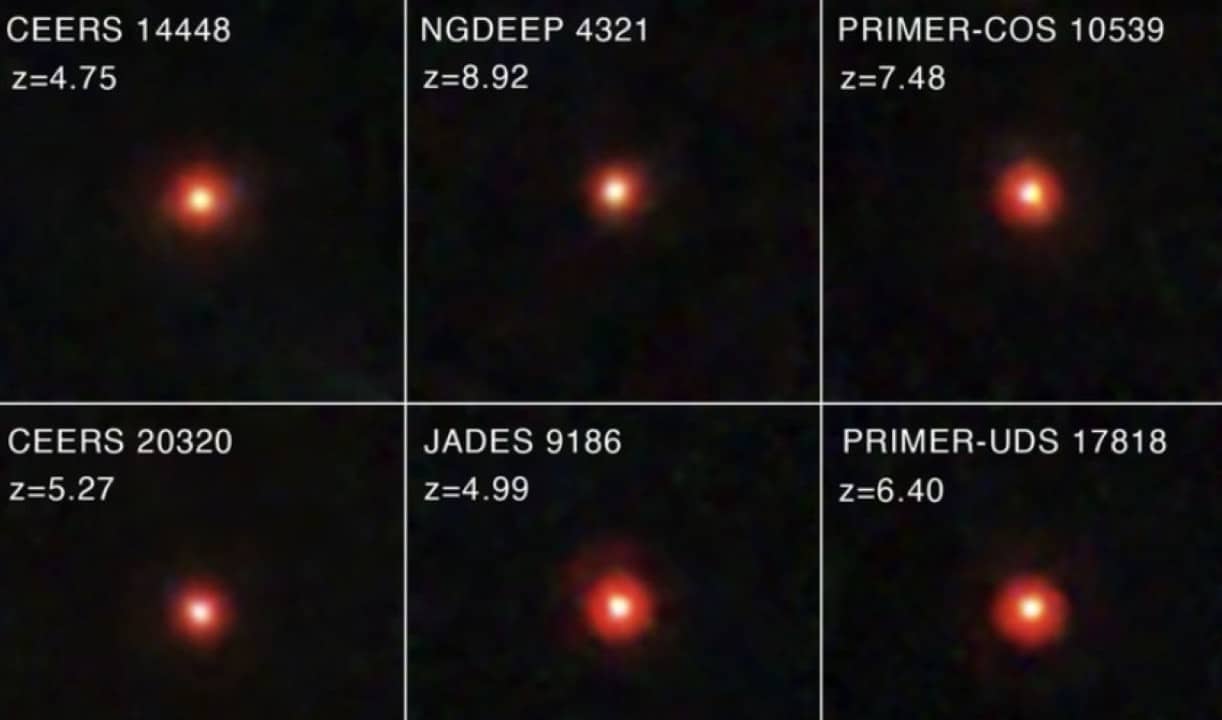
Telescópio Espacial James Webb captured small, compact, bright red dots in images of the distant universe. Esses objects, known as LRDs, appeared in large numbers in the observations. One of them appears in practically any field of view of the equipment.
The dots stand out for their intense red color, small size and high luminosity. The light reaching the telescope today left when the universe was about 600 million years after Big Bang. Isso places objects at an early stage in cosmic history. Eles became rare or disappeared around 1.5 billion years after Big Bang.
Red Pontos appears in several Webb images
Initial observations of James Webb, which began full operation in 2022, revealed LRDs in an unexpected way. Objects are compact. Eles emit strong red light. The high number caught the attention of researchers from the first analyses.
A recorded example shows a red dot on a specific image processed by teams including Colby College. Their repeated presence in different directions across the sky indicates that LRDs were common in the young universe. Rohan Naidu, an astrophysicist at MIT, noted that they appear in virtually all of the telescope’s images. Compreender these points help to piece together the complete picture of the early cosmos.
- LRDs are compact and bright
- The color red results from the redshift of distant light
- Eles appears in large numbers in observations of Webb
- Most date to around 600 million years after Big Bang
- Objects rarefy after 1.5 billion years of Big Bang
Hipóteses initials on the nature of objects
Astrônomos first considered that the dots could be compact galaxies with active supermassive black holes at the center. Outra possibility involved black holes in an evolutionary stage not yet observed. A third option pointed to galaxies with intense star formation and a lot of dust, where new stars are born at an accelerated rate.
Essas ideas sought to explain the high brightness and reduced size. Spectroscopic data collected by Webb provided clues about emission and absorption lines. Ainda therefore, no traditional explanation perfectly fit all the observed characteristics. The debate remains open between the teams that analyze the data.
The small size combined with the high brightness and abundance in the early universe raises doubts about known cosmic formation processes. Modelos Current evolution of galaxies and black holes face challenges in accommodating the LRDs without significant adjustments.
Teoria of stars with black holes gains space
Pesquisadores now evaluate the chance that LRDs represent a different object type. One hypothesis discusses the existence of quasi-stars or stars with a black hole inside. Esse concept was theoretically predicted about 20 years ago. A central black hole would be surrounded by a dense layer of gas.
The configuration would explain the observed red, the brightness and the compact appearance. The surrounding gas would act as a cocoon that modifies the light emitted. Recent Estudos, including analyzes of Webb spectra, test this idea on specific objects. One of them, informally nicknamed in some works, shows characteristics that align with the model of a black hole surrounded by dense gas.
The theory suggests that these objects would be precursors of supermassive black holes that today inhabit the centers of large galaxies. If confirmed, the explanation would alter parts of the narrative about how massive structures formed soon after Big Bang. Equipes continues to collect more data to differentiate between the possibilities.
Observações of LRDs at different distances
Cientistas identified LRDs at various times in the early universe. In July last year, three of these objects were located at smaller distances, corresponding to about 1 billion light years from Terra. Esses closest examples are relatively young and expand the set of cases for study.
The variation in distances allows us to compare properties at different times in cosmic evolution. Astrônomos seek to understand whether LRDs change over time or whether they represent transient phases. The presence in distant and closer regions reinforces the idea that the phenomenon occurred widely in the young universe.
Novas observation strategies are necessary because traditional methods used for black holes do not directly apply to LRDs. Current focus includes mass measurements and more detailed spectral analyses.
Mass Determinação is priority for classification
The next step involves accurately determining the mass of the objects. Esse data will help distinguish whether an LRD is an active black hole galaxy, a forming black hole, or another phenomenon. Current Técnicas black hole detection systems require adaptations or new approaches for these compact cases.
International Equipes combines Webb data with computational models. The objective is to reproduce the observed characteristics and test training scenarios. More detailed Resultados should appear in scientific publications throughout 2026, including specialized editions that discuss the topic.
Telescópio James Webb continues to map the deep sky. Cada new image or spectrum may provide additional evidence about the small red dots. The collective effort seeks to fill gaps in the history of the early universe.
