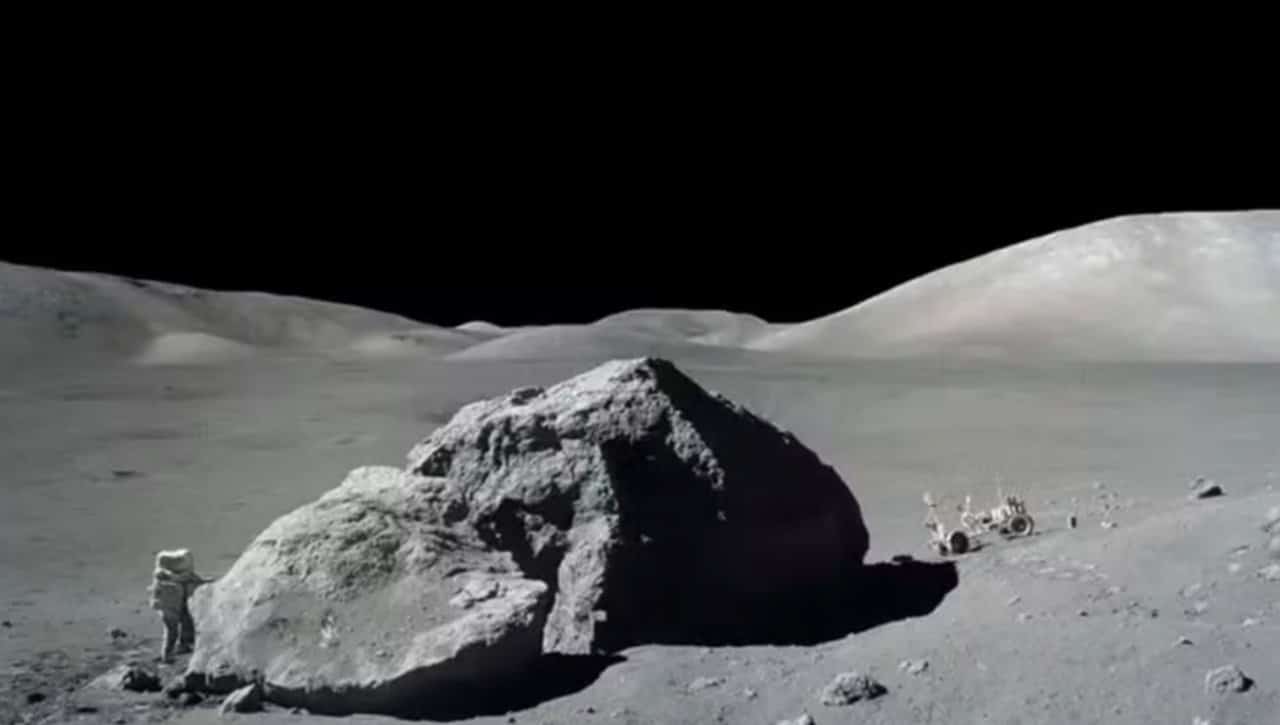
Tonight’s night sky offers the chance to relive four pioneering moments in space exploration and astronomy. One of them takes the viewer to the lunar surface where humans first set foot. The others involve a distant star, a planet outside the solar system and the satellites that changed the view of the cosmos centuries ago.
Quem has binoculars or a small telescope and can identify these targets with basic guidance. Lua, in a phase that favors the visualization of dark seas, helps to locate the exact point of Apollo 11. Júpiter appears bright in the constellation of Gêmeos. Vega appears in the northeast after sunset. The star 51 Pegasi is visible in the hours before dawn.
Local landing from Apollo 11 on Mar from Tranquilidade
The Apollo 11 mission touched the lunar surface on July 20, 1969. Neil Armstrong and Buzz Aldrin descended from the Eagle lunar module in the region known as Base Tranquilidade, within Mare Tranquillitatis. The place is too small to be solved by the naked eye of the Terra.
Ainda thus observers can point to the general area with modest equipment when Mar of Tranquilidade receives direct sunlight. Isso occurs in the weeks before the full moon. A 6-inch telescope or powerful binoculars reveals the vast, dark basalt plain.
Mare Tranquillitatis appears as a dark spot above the lunar equator, on the eastern portion of the visible face. Crateras Ritter and Sabine mark the southwestern edge of this region. An imaginary line drawn from the base of Ritter to the center of Sabine, extending about 2.5 times the width of the latter, indicates the approximate landing zone.
Outros five landing sites from the Apollo era can also be approximated with similar lunar maps. The technique requires patience and clear skies. Rotating the Lua and lighting angle changes the contrast from day to day.
- Localize first the Mare Tranquillitatis as the main reference.
- Identifique the Ritter and Sabine craters on the southwest rim.
- Trace the imaginary line between them.
- Estenda the indicated distance to reach the Apollo 11 area.
- Confirme with detailed maps or astronomy applications.
51 Pegasi b, the first confirmed exoplanet in a star similar to Sol
Astrônomos Michel Mayor and Didier Queloz announced in October 1995 the discovery of 51 Pegasi b. The planet orbits a G-type star, similar to Sol, about 50 light-years from Terra. Ele belongs to the class of hot Júpiteres, with a short orbit of just four days.
The detection came from the oscillation in the star’s light caused by the planet’s gravity. Esse radial velocity method paved the way for thousands of cataloged exoplanets later. The object was given the official name Dimidium.

Para To observe the host star, look for the constellation of Pégaso low on the eastern horizon before dawn in early spring. Grande Quadrado of Pégaso serves as a guide. Scheat and Markab are the shining stars in the corners. 51 Pegasi appears as a weaker point among them.
The light arriving today left the star 50 years ago. The planet itself is not directly visible with amateur equipment. Observing the star, however, connects the observer to the historic milestone of exoplanetology.
Vega records the first photograph of a star other than Sol
In July 1850, William Cranch Bond and J. A. Whipple captured Vega’s image using Harvard’s Grande Telescópio Refrator. Foi is the first time a star other than Sol has been imaged. The daguerreotype technique fixed light on a silver plate.
Vega is about 25 light years away and shines as one of the brightest stars in the northern sky. Ela is part of the constellation Lira and appears on the northeast horizon after sunset. The star rises high during the night and is almost at its zenith before dawn.
Décadas later, Telescópio Espacial Hubble recorded the surface of Betelgeuse, in the constellation Órion, as the first direct image of a star other than Sol. Vega remains easy to find and serves as a reference for beginners.
The star appears blue-white and is part of Triângulo and Verão along with others. Seu constant brightness helps calibration of astronomical instruments throughout history.
Luas Galileans of Júpiter, the first telescopic discoveries
Galileu Galilei pointed his telescope at Júpiter in 1609 and saw four points of light moving around the planet. Hoje is known to be Io, Europa, Ganimedes and Calisto. Elas were named after the Galilean moons in honor of their discoverer.
Qualquer 10-centimeter aperture telescope or strong binoculars reveals these satellites as dots lined up near Júpiter’s disk. The gas giant appears bright in the constellation Gêmeos, above the western horizon at sunset.
The moons change position night after night due to their fast orbits. At times, they all line up on one side of the planet. The phenomenon repeats what Galileu observed centuries ago.
- Júpiter shines as a constant point near the stars of Gêmeos.
- Moons appear as bright spots around the planetary disk.
- Binóculos or small telescope are enough for viewing.
- The configuration changes each night depending on the orbits.
- The discovery of Galileu expanded understanding of the solar system.
Aplicativos and equipment help with precise location
Apps astronomy with augmented reality indicates the exact position of targets in the sky. Eles projects constellations and objects onto the image from the cell phone camera. Mapas printed or digital stars complement the observation.
Céu dark away from urban lights improves contrast. The new moon or early phases favor the seeing of fainter stars. Júpiter and Lua offer easy targets even in moderate light pollution conditions.
Observing these milestones connects today’s audiences to the pioneers who pushed the boundaries of human knowledge. Cada point of light carries a story of curiosity and technological advancement.